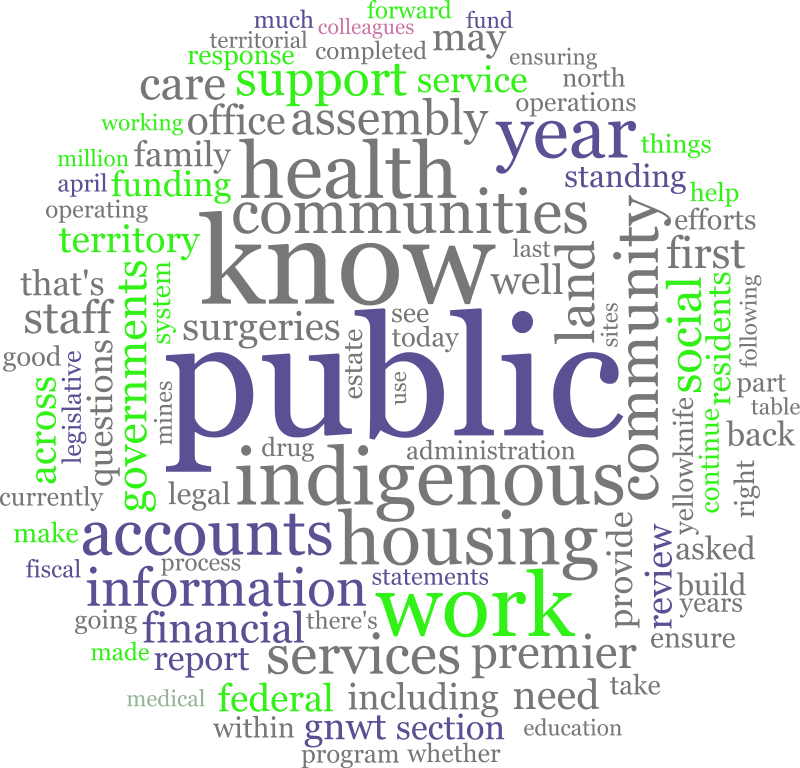
This is page numbers 2331 - 2378 of the Hansard for the 20th Assembly, 1st Session. The original version can be accessed on the Legislative Assembly's website or by contacting the Legislative Assembly Library. The word of the day was public.

Topics

Follow-up to Oral Question 546-20(1): Driver's Licence Extensions for Territorial Nominee Program Participants
Follow-up To Oral Questions

Page 2344

Clerk Of The House Mr. Glen Rutland

Further to the response provided to the Member for Great Slave on February 26, 2025, the following additional information is provided:

I committed to coordinating with my colleagues to work to minimize delays in driver's licenses extensions required by participants in the Territorial Nominee program whose work visas are expiring.

All NWT driver's license holders may receive a one-time extension of 90 days from the date of expiration of a driver's licence. This provision includes participants in the Territorial Nominee Program with expired work visas. In addition, there are many ways the Department of Infrastructure assists clients with immigration concerns who hold expired driver's licences.

If a client presents a letter from Immigration, Refugees and Citizenship Canada, or IRCC, confirming their permanent residence application is complete and they are now a permanent resident, their licence may be extended by one year from the issue date on the letter.

If a client provides an IRCC letter confirming receipt of their application, their licence may be extended until the date indicated on the letter, which may be beyond the 90 days. This letter must indicate the work permit number, the date to which they are authorized to work, and must be attached to their work permit.

If a client has a Confirmation of Permanent Residence document or a physical Permanent Residence card, they are eligible for a 1-, 3-, or 5-year renewal of their driver's licence.

If a client presents an updated work permit, study permit, or visitor record, their license may be renewed until the expiry date on these documents, provided the request is made more than 90 days before the document's expiry.

Follow-up to Oral Question 549-20(1): Elder Abuse in the Northwest Territories
Follow-up To Oral Questions

Page 2344

Clerk Of The House Mr. Glen Rutland

Further to the response provided to the Member for Monfwi on February 26, 2025, the following additional information is provided:

The Seniors and Continuing Care Services Division within the Department of Health and Social Services maintains a dedicated Elder Abuse and Neglect website which offers supports and services available to residents if they are experiencing or witnessing abuse of older adults.

Webpages with general information, links and resources that can be downloaded:

Protecting Elders from Abuse and Neglect: www.hss.gov.nt.ca/en/services/protecting-elders-abuse-neglect

Getting help for Elder Abuse: www.hss.gov.nt.ca/en/services/protecting-elders-abuse-and-neglect/getting-help-elder-abuse

This webpage identifies specific help resources, such at the Family Violence Helpline, 811, or RCMP with phone numbers and/or links to websites such as the NWT Community Counselling Program.

Further, residents can also phone the NWT Seniors' Society Information Line for relevant information at 1-800-661-0878.

Follow-up to Oral Question 562-20(1): Inuvik Airport Security Screening Area
Follow-up To Oral Questions

Page 2344

Clerk Of The House Mr. Glen Rutland

Further to the response provided to the Member for Inuvik Boot Lake on February 28, 2025, the following additional information is provided:

I committed to providing an update to the Member for Inuvik Boot Lake on whether security and screening capability was considered in the design of the Inuvik Airport Terminal Building project. I also committed to reviewing the project to ensure this feature was included in the design of the building.

The Canadian Air Transport Security Authority, or CATSA, a Crown corporation, is responsible for security screening of passengers and baggage at designated airports in Canada. The Government of the Northwest Territories GNWT is not aware of any plans by CATSA to expand service locations in the Northwest Territories at this time. Any decision to expand the service outside the current 89 locations would need to be negotiated between CATSA, the GNWT and the airline seeking to provide a new service.

It was important during the design phase of the Inuvik Airport Terminal Building project to allow for a flexible design to assist in facilitating any expansion to the facility. I can confirm that if CATSA were to offer security screening for passengers and baggage at this airport in the future, the current hold room at the terminal building would be converted to security screening and a new hold room would be built beside this space via a facility expansion.

Follow-up to Oral Question 567-20(1): Yellowknife Emergency Shelter for Homeless
Follow-up To Oral Questions

Page 2344

Clerk Of The House Mr. Glen Rutland

Further to the response provided to the Member for Yellowknife North on February 28, 2025, regarding information about the available shelters in Yellowknife for those experiencing homelessness, I offer the following information:

I will table a document that provides a listing of emergency shelters in Yellowknife that offer support and services to individuals experiencing temporary or chronic homelessness. This resource will also be shared with community partners, including Non-Government Organizations, or NGOs, local businesses, the City of Yellowknife, and the Royal Canadian Mounted Police.

The Department of Executive and Indigenous Affairs continues to collaborate with the business community, the City of Yellowknife, and NGOs through the Yellowknife Community Partnership Forum. At the Forum's meeting on May 6, members collectively identified several concrete actions, including the need to share information about shelter operations.

Since the closure of the On-the-Land Camp in January, Executive and Indigenous Affairs has been closely monitoring shelter utilization. Between January 17 and April 27, 2025, shelters reached full capacity on only seven nights. The average occupancy rate during that time was 87%. While this data suggests shelter space has generally been available, we recognize the need to enhance our data collection and analysis to better understand fluctuations in demand. This will help us plan more effectively, allocate resources wisely, and provide more targeted support to those in need.

Our Integrated Service Delivery team in Yellowknife has been working closely with emergency shelter providers to better understand the needs of shelter users. The team has also been engaging with individuals sleeping rough or in tents throughout the city. Contrary to common assumptions, many of these individuals are aware of available resources and have options for places to stay. Their reasons for choosing to sleep outside vary and may include personal relationships, safety concerns, sobriety requirements, shelter rules, and a desire for autonomy.

Executive and Indigenous Affairs continues to work with partners to address these barriers and remains committed to engaging with individuals to explore potential solutions.

I want to thank the Member for suggesting the development of this resource. I hope it proves to be informative and helpful.

Follow-up to Oral Question 569-20(1): Extended Healthcare Benefits for Seniors' Prescription Glasses
Follow-up To Oral Questions

Page 2344

Clerk Of The House Mr. Glen Rutland

Further to the response provided to the Member for Yellowknife Centre on
February 28, 2025, the following additional information is provided:

Under the Extended Health Benefits Policy, vision care benefits are available for eligible seniors, 60 years of age and older, in accordance with the terms and rates established in the NIHB Vision Care Fee Grid NWT (December 13, 2024):

Maximum eligible amount for standard coverage is up to $300.00.

Maximum eligible amount for high index coverage is up to $440.00.

There is some additional coverage for specialized needs that requires prior approval and is also outlined in the NIHB Vision Care Fee Grid NWT.

If the cost of the eyeglasses is greater than the maximum eligible amount, the client is reimbursed only to the maximum eligible amount.

Both in the application for EHB and the Alberta Blue Cross Claims form, it indicates that eligible EHB seniors must first use any other health-related insurance plan they have access to before making a claim under EHB. The EHB Seniors Benefit Application and the Alberta Blue Cross Health Services Claim set the criteria for EHB as the payor of last resort.

In a situation where the eligible senior has coverage through another health benefit plan such asa private insurance plan, the senior must use the other health benefit plan first before making a claim for benefits under the Extended Health Benefit Policy. For example, if a senior has coverage from another plan for $250 every two years, the senior will submit a claim for $250 to their private plan and then submit a claim for $50, or $190 for high index coverage, to Alberta Blue Cross for the remainder of the full maximum eligible amount.

Follow-up to Oral Question 571-20(1): Arctic Energy Alliance Program Funding
Follow-up To Oral Questions

Page 2344

Clerk Of The House Mr. Glen Rutland

Further to the response provided to the Member for Great Slave on March 3, 2025, the following additional information is provided:

The Minister committed to following up on the outcomes of an initiative supporting energy efficiency in Norman Wells, highlighting energy-saving measures implemented by Arctic Energy Alliance, or AEA, and sharing insights that could benefit other communities. The response below is provided to fulfill this commitment.

Beyond its core programs in 2024-25, AEA supported Norman Wells through initiatives such as the Winterization Walk-Throughs and the Firewood Access project.

The Winterization Walk-Throughs involved AEA staff visiting low-income households in Norman Wells and Yellowknife to assess homes for energy efficiency improvements and assist households with the installation of energy saving measures such as insulating window plastic and weatherstripping for doors.

The Firewood Access project delivered two iterations of a three-day course for participants in the Sahtu region, with certified chainsaw safety instructors providing training and certification in safe wood-harvesting techniques. The course also included a component on how to start a small local wood-harvesting business.

In recent years, AEA has partnered with Indigenous governments to deliver similar programs in two or three communities annually; these are intended to continue and improve in the future.

Follow-up to Oral Question 575-20(1): Dempster Highway Conditions
Follow-up To Oral Questions

Page 2344

Clerk Of The House Mr. Glen Rutland

Further to the response provided to the Member for Mackenzie Delta on March 3, 2025, the following additional information is provided:

The previous Minister of Infrastructure committed to providing the Member for Mackenzie Delta information regarding signage placement near Rengleng River. I was named Minister of Infrastructure on March 31, 2025 and I am following up on the commitment made by my colleague.

The department has taken steps to address concerns regarding signage placement near Rengleng River to improve safety for all road users. While slow signs have always been in place on both sides of the river, additional 50 km/h maximum speed signs were installed on March 4, 2025. These new signs are positioned farther back to provide drivers, particularly trucks, with more advance warning to slow down before reaching the area.

Regarding inspections of the Dempster Highway, the Department continues to conduct daily highway inspections from the Yukon/NWT border to Tuktoyaktuk and Aklavik during ice road season. These inspections are carried out by GNWT highway technicians and local contractors. Any significant changes in road conditions are communicated to the public through mass emails to local contractors and updates on DriveNWT.ca. This platform is updated at least weekly under normal conditions. Significant changes in road conditions are reflected as needed, including hourly or daily updates as required.

The department acknowledges there have been vacancies in staffing, including a Highway Project Officer in Inuvik and a Highway Technician in Fort McPherson. While the Department continues to make progress in ensuring these positions are filled, during periods of staffing shortages, contractor assistance is utilized to ensure continued road inspections and updates.

Follow-up to Oral Question 576-20(1): Delivery of New Housing Units to Fort Resolution
Follow-up To Oral Questions

Page 2344

Clerk Of The House Mr. Glen Rutland

Further to the response provided to the Member for Tu Nedhé-Wiilideh on Monday, March 03, 2025, the following additional information is provided:

Housing NWT's residential assets, larger than a duplex, are covered by the Government of the Northwest Territories Property Insurance Policy. While not insured, Housing NWT was able to accommodate the replacement of the public housing duplex that was lost due to the fire within its existing capital budget.

In addition to replacing this public housing duplex, Housing NWT has also delivered eight additional new public housing units for Fort Resolution as part of the 100 new public housing unit initiative committed to during the 19th Legislative Assembly.

As for the market housing duplex lost in the fire, with no demonstrated need at the time from the market housing waitlist, this duplex was not replaced. In addition, Housing NWT is currently evaluating its approach to the provision of market housing, aiming to promote additional market housing investment by Indigenous Governments and the private sector.

Follow-up to Oral Question 578-20(1): Drug Related Activity in Public Housing Units
Follow-up To Oral Questions

Page 2344

Clerk Of The House Mr. Glen Rutland

With regards to illegal activities in your communities, it was a pleasure having an opportunity to meet with you on March 10, 2025, to discuss these matters in more detail.

Follow-up to Oral Question 612-20(1): Environmental Assessment of Line 490 Replacement Project in Norman Wells
Follow-up To Oral Questions

Page 2344

Clerk Of The House Mr. Glen Rutland

Further to the response provided to the Member for the Sahtu on March 6, 2025, the following additional information is provided:

Officials from the Department of Environment and Climate Change met with the Executive Director of the Mackenzie Valley Environmental Impact Review Board, or Review Board, on April 18, 2025, regarding the scope of the Line 490 Replacement Project Environmental Assessment process versus the on-going Environmental Assessment for the Norman Wells Operations. I will table a Note to File regarding this meeting prepared by the Review Board which has been filed on the Review Board's public registry.

As of May 7, 2025, the Line 490 environmental assessment has been adjourned, at the request of the developer, Imperial Oil. The GNWT will continue to participate actively in environmental assessment proceedings related to Imperial Oil's Norman Wells Operations.

Follow-up to Oral Question 658-20(1): Yellowknife Drinking Water Pipeline Replacement
Follow-up To Oral Questions

Page 2344

Clerk Of The House Mr. Glen Rutland

Further to the response provided to the Member for Yellowknife Centre on
March 13, 2025, the following additional information is provided:

The Minister committed to getting more information on correspondence between the Department of Municipal and Community Affairs and the City of Yellowknife regarding a new water pipeline.

To provide a bit of background, the project to replace the water line is funded through the Federal Disaster Mitigation and Adaptation Fund, or DMAF, up to a maximum of $25,862,218. The City was approved for this funding in 2020 based on cost estimates from 2017. Updated cost estimates are now significantly higher. Additionally, progress on the Giant Mine Remediation Project has made other options more viable. Due to these factors the City has completed a study to review four options to replace the water intake line. One option that the City is considering is switching to Yellowknife Bay as the primary water source which is more economically feasible than the original option. DMAF funding has been extended for the project and will be utilized for whichever options the City selects.

MACA staff have regular discussions with City staff and have discussed Federal Funding programs that may be applicable; however, the City has not requested direct support regarding the waterline project. MACA continues to work with the City to support them in maximizing all funding sources for their capital infrastructure as per City priorities. MACA will continue to advocate with the federal government for additional funding to support development and replacement of critical municipal infrastructure.

Follow-up to Oral Question 659-20(1): Northwest Territories Power Corporation Distribution in Hay River
Follow-up To Oral Questions

Page 2344

Clerk Of The House Mr. Glen Rutland

Further to the response provided to the Member for Yellowknife Centre on March 13, 2025, the following additional information is provided:

The Member inquired if there was specific debt issued or if cash reserves were used to acquire the Hay River franchise assets.

The Hay River Franchise purchase was included in Northwest Territories Power Corporation's, or NTPC's 2024-25 Capital Plan and included in the NT Hydro/NTPC 2024-25 Corporate Plan. NTPC finances all capital expenditures through a combination of debt and internally generated cash flow.

Follow-up to Oral Question 659-20(1): Northwest Territories Power Corporation Distribution in Hay River
Follow-up To Oral Questions

Page 2349

The Speaker

The Speaker Shane Thompson

Thank you, Mr. Clerk. Oral questions. Written questions. Returns to written questions. Mr. Clerk.

Return to Written Question 14-20(1): Operating Rooms at Stanton Territorial Hospital
Returns To Written Questions

Page 2349

Clerk Of The House Mr. Glen Rutland

Thank you, Mr. Speaker. I have a return to written question asked by the Member for Range Lake on March 6th, 2025, regarding the productivity of operating rooms at Stanton Territorial Hospital.

Later today, at the appropriate time, I will table a document titled Operating Room Activities for Stanton Territorial Hospital.

The Member asked for the total number of scheduled surgeries and day procedures completed in 2024, broken down per month. There were a total of 2,053 surgeries completed at Stanton Territorial Hospital in 2024. The monthly breakdown of Operating Room activity is presented in Table 1 of the tabled document, which is titled Scheduled Surgeries and Day Procedures Completed in 2024.

The Member asked for the total hours worked by all surgical teams for the year 2024. A full time Operating Room Registered Nurse will work 1,950 hours per year. Each service is provided with an allocation of Operating Room days per week. For example, the types of surgeries are scheduled as follows:

  • Orthopedics surgeries are scheduled on Monday and Wednesday;
  • General surgeries are scheduled on Monday and Wednesday;
  • Gynecology surgeries are scheduled on Tuesday and Friday;
  • Ophthalmology surgeries are scheduled on Thursday;
  • Ears, Nose and Throat surgeries are scheduled on Wednesday and Friday; and
  • Urology surgeries are scheduled once per month on Tuesday and Wednesdays.

The Member asked for the number of surgeries and day procedures cancelled over the same period. In 2024, there were a total of 561 surgery cancellations. There are a variety of reasons for these cancellations. 210 were patient generated cancellations, 85 were cancelled by the Surgeon, and there were 81 no shows. In the tabled document, a summary of these reasons is given as well as a break down by month, in Table 2 titled Summary of Rationale for Surgery Cancellations, for 2024.

The Member asked for a full cost accounting of all scheduled surgeries and day procedures completed in 2024. The 2024-25 fiscal year revised operating budget for the operating room is $5,910,000. The 2024-25 revised operating budget for Day Procedures is $3,014,000. Expenses for the year are not due to be finalized until the end of June 2025.

The 2023-24 total expenditures for both Operating Room and Day Procedures was $7,877,643.

The Member asked for the average completed surgeries and day procedures vs. cancelled surgeries and day procedures over a 5-year period.

The breakdown of completed surgeries at Stanton Territorial Hospital for the previous five years is as follows:

  • 607 surgeries completed from January 1 to April 31, 2025;
  • 2,053 surgeries completed in 2024;
  • 1,589 surgeries completed in 2023;
  • 1,447 surgeries completed in 2022;
  • 852 surgeries completed between July 1 and December 31, 2021; and there is no data available from January 1 to June 30, 2021.

*Due to the COVID-19 pandemic response and measures, there were fewer surgeries performed in 2021. There is no electronic data available prior to July 1, 2021.

Further, the total number of surgery cancellations at Stanton Territorial Hospital for the previous five years is as follows:

  • 138 surgeries were cancelled from January 1 to April 31, 2025;
  • 561 surgeries were cancelled in 2024;
  • 507 surgeries were cancelled in 2023;
  • 392 surgeries were cancelled in 2022; and
  • 480 surgeries were cancelled in 2021; and there is no data available from January 1 to June 30, 2021.

Due to the COVID-19 pandemic response and measures, there were more surgery cancellations in 2021. There is no electronic data available prior to July 1, 2021.

As indicated in Table 2: Summary of Rationale for Surgery Cancellations, for 2024, of the tabled document, there are a variety of reasons for cancellations that are often beyond Stanton Territorial Hospital's control. Additionally, when cancellations occur, there is very little lost Operating Room time as same day surgical procedures are often scheduled. Thank you, Mr. Speaker.

Return to Written Question 15-20(1): Title Transfer Issues in the Tlicho Region
Returns To Written Questions

Page 2349

Clerk Of The House Mr. Glen Rutland

Mr. Speaker, I have a return to oral question asked by the Member from Monfwi on March 3rd, 2025, regarding title transfer issues in the Tlicho region.

The Member asked how many properties in the Northwest Territories are currently registered in the name of deceased individuals.

Unfortunately, the Government of the Northwest Territories does not have the number of properties in the Northwest Territories whose registered owners are deceased individuals.

The land registry system used in the Northwest Territories and elsewhere in Canada is a Torrens system which registers interests and characteristics in land, and not who owns land. The Land Titles Office has no data on the named registered owners of land nor does the Land Titles Office enforce the use of legal names that appear on the records of Vital Statistics.

A separation between the NWT Vital Statistics Office under the Department of Health and Social Services, and Legal Registries under the Department of Justice prevents the Land Titles Office from accessing or cross-referencing information like death records that are not collected or intended for a particular purpose.

The Member also asked what specific legal steps are required to transfer ownership from a deceased titleholder to the rightful heirs under the current land title system.

The legal steps required to transfer ownership from a deceased titleholder to their rightful heirs in the Northwest Territories depend on several factors, including the type of interest in the land, how the ownership was structured, and the specifics of the deceased's estate. However, the two most common scenarios are transfer through estate administration, and transfer through survivorship.

Transfer through estate administration, for tenancy in common or sole ownership, begins with the administration of the deceased's estate; a personal representative, specifically an executor or administrator, is appointed by the court. The Court formally grants the personal representative the authority to manage the estate's assets, including real estate property. Once appointed, the personal representative is responsible for ensuring that all debts of the estate are paid prior to distribution of assets. This would include, among other things, taxes owing on the land, arrears in lease payments if applicable and any mortgages on the property, including amounts owed to Housing Northwest Territories. The debts need to be settled prior to the transfer of land. In some cases, land must be sold to pay off debts and if there are funds left, they can then be distributed. The personal representative must file a Transmission Application with the NWT Land Titles Office. The Application provides proof of the personal representative's authority. After the transmission is registered, the personal representative must identify the rightful heirs and then transfer the land to them. This is formalized by filing a Transfer of Land with the Land Titles Office.

Transfer through survivorship occurs if the deceased held the property in joint tenancy with another person. The surviving joint tenant automatically inherits the deceased's share. The surviving joint tenant must file an Application of Surviving Joint Tenant with the Land Titles Office. The Application must be accompanied by proof of the deceased's death, such as a death certificate. Many applicants follow this process without legal assistance as it does not require administration of the estate. Upon successful application, the Land Titles Office will register the surviving joint tenant as the sole owner of the property. The sole owner is responsible for any outstanding mortgage and/or debts.

It is strongly recommended that individuals who may have an interest in a deceased person's estate to seek legal advice from a lawyer specializing in estate administration and real estate law in the Northwest Territories. They can provide guidance tailored to the specific circumstances of each case. The Land Titles Office can provide further information but is prohibited from giving legal advice to members of the public.

The Member asked how the Department of Justice facilitates the identification of rightful heirs, and what actions must be taken to resolve any title issues including any specific declarations that must be made to the Land Titles Office.

The Department of Justice's role in identifying rightful heirs is primarily through the Public Trustee's Office and is limited in scope. The public trustee generally accepts administration of estates only when the only beneficiaries are children, the beneficiary is a spouse and over the age of 65, the beneficiary is mentally incapable, or there are significant assets and no next of kin can be found.
If the estate or individuals have assets or funds that exceed any prescribed amounts for the public trustee, these issues are considered private property matters. The determination of heirs, resolution of title disputes for most estates, and real estate transactions are also considered private legal issues. The Department of Justice is not implicated as it does not provide private legal services to members of the public.

Dealing with a deceased person's estate is a very common legal issue. It is strongly recommended that individuals plan how they wish their estate to be dealt with while still alive. Estate administration can cause pain, costs, and other burdens being left for loved ones, which can be avoided or mitigated with good estate planning.

Individuals facing land title issues or the need to identify heirs should seek legal counsel. A lawyer specializing in estate administration and real estate law can conduct thorough investigations to identify heirs, navigate the legal process of transferring property ownership, represent individuals in court proceedings if necessary, and prepare and file the required legal documents including applications and declarations.

Lastly, the Member asked about properties in the Tlicho Region that have not been surveyed or registered with the Land Titles Office. Specifically, they asked about what legal process exists for establishing ownership and what steps must a resident take to begin the land survey and title registration process under current Northwest Territories laws.

  • There are 1,411 parcels of land within the constituency of Monfwi. Of these 1,411 parcels:
  • There are 17 parcels held in fee simple with the registered owner being the Commissioner of the Northwest Territories (meaning the Government of Northwest Territories).
  • There are 32 parcels held in fee simple with the registered owner being individuals.
  • There are 877 parcels held in fee simple with the registered owner being Indigenous governments.
  • 435 parcels have an active leasehold title associated with the fee simple interest.
  • 485 parcels are untitled and would require a title to be raised by the proper authority.

Parcels can have different structures and overlapping title and may be included in more than one type. For an individual to acquire ownership of land that has not been previously surveyed or registered, this will typically start with a Crown Grant, notification, or a notice to issue title which is accompanied by a legal survey of the parcel of land.
Within the Tlicho region, this process is likely conducted by the Tlicho Government under the Tlicho Land Claims and Self-Government Agreement. The Tlicho Government may have its own internal process. Thank you, Mr. Speaker.

Return to Written Question 16-20(1): Environmental Liabilities
Returns To Written Questions

Page 2349

Clerk Of The House Mr. Glen Rutland

Mr. Speaker, I have a return to written question number 16-20(1) asked by the Member for Frame Lake on March 13th, 2025, regarding environmental liabilities, inventory, and securities held by the Government of the Northwest Territories

The GNWT follows Canadian Public Sector Accounting Standards issued by the Public Sector Accounting Standards Board. One of the standards issued covers how to account for contaminated sites.

On an annual basis, the GNWT's inventory of contaminated sites is updated each year in accordance with the accounting standards. The liability amount for the fiscal year end is determined based on that listing and cost estimate at March 31. The liability goes up when new sites are added or cost estimates increase, the liability goes down when sites are either removed from the list and/or sites are remediated.

The GNWT publishes through an online searchable database the contaminated sites as reported in the public accounts as at March 31 of each year end.

The public accounts publish the environmental liability information and the amounts at an aggregated level and does not disclose site specific amounts as this could interfere with future procurement processes to remediate these sites. Of the inventory of projects, historically some may have had leases, land use permits or water licenses. Of the list of contaminated sites at March 31, 2024, only one site had permits with a reclamation security required. The total security held for that site was $2.9 million.

Later today I will table a supporting document with more details to supplement this response.
Thank you, Mr. Speaker.

Return to Written Question 16-20(1): Environmental Liabilities
Returns To Written Questions

Page 2351

The Speaker

The Speaker Shane Thompson

Thank you, Mr. Clerk. Returns to written questions. Replies to the Commissioner's address. Petitions. Reports of Committees on the Review of Bills. Reports of Standing and Special Committees. Member from Frame Lake.

Bill 17: Municipal and Community Affairs Statutes Amendment Act
Reports Of Committees On The Review Of Bills

Page 2351

Julian Morse

Julian Morse Frame Lake

Mr. Speaker, your committee would like to report on its consideration of Bill 17, Municipal and Community Affairs Statutes Amendment Act.

Bill 17 received second reading in the Legislative Assembly on February 10th, 2025 and was referred to the Standing Committee on Government Operations for review. The standing committee completed its clause-by-clause review of the bill with the Minister of Municipal and Community Affairs on April 22nd, 2025.

Mr. Speaker, the committee reports that Bill 17, Municipal and Community Affairs Statutes Amendment Act is ready for consideration in Committee of the Whole. Thank you, Mr. Speaker.

Bill 17: Municipal and Community Affairs Statutes Amendment Act
Reports Of Committees On The Review Of Bills

Page 2351

The Speaker

The Speaker Shane Thompson

Thank you, Member from Frame Lake. Member from Frame Lake.

Bill 18: An Act to Amend the Partnership and Business Names Act
Reports Of Committees On The Review Of Bills

Page 2351

Julian Morse

Julian Morse Frame Lake

Thank you, Mr. Speaker. Mr. Speaker, your committee would like to report on its consideration of Bill 18, An Act to Amend the Partnership and Business Names Act.

Bill 18 received second reading in the Legislative Assembly on February 10th, 2025 and was referred to the Standing Committee on Government Operations for review. The standing committee completed its clause-by-clause review of the bill with the Minister of Justice on April 22nd, 2025.

Mr. Speaker, the committee reports that Bill 18, An Act to Amend the Partnership and Business Names Act, is ready for consideration in Committee of the Whole. Thank you.

Bill 18: An Act to Amend the Partnership and Business Names Act
Reports Of Committees On The Review Of Bills

Page 2351

The Speaker

The Speaker Shane Thompson

Thank you, Member from Frame Lake. Reports of Standing and Special Committees. Member from Range Lake.

Committee Report 22-20(1): Report on the Review of the 2023-2024 Public Accounts, carried
Reports Of Standing And Special Committees

Page 2351

Kieron Testart

Kieron Testart Range Lake

Your Standing Committee on Public Accounts is pleased to provide its Report on the Review of the 2023-2024 Public Accounts and commends it to the House. Thank you, Mr. Speaker.

Mr. Speaker, from January to April 2025, the Standing Committee on Public Accounts (committee) publicly reviewed the 2023-2024 Public Accounts. The public accounts are financial statements that show the financial results of the Government of the Northwest Territories for a fiscal year. The fiscal year of the GNWT is April 1st of one year to March 31st of the next calendar year.

Committee recognizes that new public accounting standards will be implemented on April 1st, 2026, affecting the 2025-2026 fiscal year. Committee has therefore not recommended changes to the GNWT accounting practices at this time as committee appreciates that the adoption of the new standards will be comprehensive and take time to implement which will impact some government reporting entities or GRE.

Committee wants to acknowledge the efforts made by staff in the Office of the Comptroller General and the Office of the Auditor General in preparing the 2023-2024 Public Accounts. This report notes new recommendations that committee believes have merit and deserve consideration from the government.

The public accounts are financial statements that show the financial results of the GNWT for a given year. The Standing Committee on Public Accounts was appointed by Order of the Legislative Assembly in February 2024 to review and provide follow-up reporting on the public accounts. These reviews assess the credibility of the government's financial position and provide accountability for the government's financial results. Committee examines whether public money was spent prudently and as the Legislative Assembly originally intended.

The 2023-2024 Public Accounts were released by the Minister of Finance in November 2024 and tabled in the Legislative Assembly in February 2025. These are the second set of public accounts that committee has reviewed during the 20th Assembly. On January 28, 2025, committee held a public meeting for its review of the public accounts for the fiscal year ending March 31, 2024, which included staff from the GNWT's Office of the Comptroller General (OCG) and the Auditor General and Financial Audit Team from the Office of the Auditor General of Canada (OAG).

Following its January hearing, committee invited staff from the Department of Environment and Climate Change (ECC), the Department of Municipal and Community Affairs (MACA), and the OCG to a public meeting held on April 3rd, 2025, to answer further questions about environmental liabilities and local capacity. This April meeting helped committee finalize its review of the 2023-2024 Public Accounts. Committee has identified recommendations in these key areas as well as with respect to the transparency of heritage Fund and public-private-partnerships, or P3 reporting.

Committee appreciates the collaboration of the Auditor General and OAG, representatives from GNWT departments who attended public meetings and responded to committee requests for information, and particularly the Comptroller General for helping to ensure a timely and comprehensive review of the public accounts from January to April 2025.

BACKGROUND

The public accounts are required to be prepared annually by the government in accordance with the Northwest Territories Act and regulations of the Financial Administration Act and regulations. Section 35 of the FAA specifies that the public accounts must be prepared by the Comptroller General and approved by the Minister of Finance. The FAA requires the public accounts to be tabled in the Legislative Assembly. The Legislative Assembly then refers the public accounts to the Standing Committee on Public Accounts to review and report back in accordance with the Northwest Territories Act.

The financial statements are audited by the OAG each year. The Auditor General gives an audit opinion on whether the public accounts are in accordance with the PSA standards and relevant Acts.

The Financial Statement Discussion and Analysis, or (FSDA), included with the Consolidated Financial Statements (discussed below) is a standard reporting practice that includes a summary of the results from the fiscal year. These notes are not audited but are reviewed by the OAG. The financial health of the government is measured by three indicators: sustainability, flexibility, and vulnerability. The FSDA also provides (i) an overview of the territorial debt and the NWT economy in comparison to other provinces and territories, (ii) financial trends, and (iii) reporting on the GNWT's fiscal responsibility policy.

The public accounts currently have four sections:

Section l. Consolidated Financial Statements and Financial Statement Discussion and Analysis

The Consolidated Financial Statements must include all government-controlled organizations (all GNWT departments, revolving funds, public agencies, and other entities that make up the Government Reporting Entity, or GRE. The result is an overview of all financial activities under the control of the government. These statements show (i) the cost of providing programs and services, (ii) cost of financing debt, (iii) annual surplus or deficit, (iv) consolidated budget, (v) revenues received in the year, and (vi) assets and liabilities of the government

Section II. Non-Consolidated Financial Statements

The Non-Consolidated Financial Statements only include information relating to GNWT departments. These statements relate to the information that has been approved by the Legislative Assembly in the main estimates process. Section II gives detailed supplemental schedules that provide additional information when assessing the activities of the GNWT department over the fiscal year.

Section III and IV. Boards and Other Consolidated Entities

Sections III and IV include information for all education bodies, health boards, public agencies, and other related entities which are considered part of the GRE. Audited financial statements of each entity are to be completed within 90 days of the entities' year end.

RECOMMENDATIONS

Environmental Liability Reporting

During both the January and April public meetings, committee asked many questions about Environmental Liabilities and liabilities for sewage lagoons and solid waste sites. Committee sought further information about how the GNWT determined, reviewed, updated, and prioritized the list of environmentally contaminated sites — which stood at 231 at the end of fiscal year 2024. These questions and the rate at which sites are remediated inform the relationship between the Actuals reported in the public accounts and the appropriations in the main estimates and Supplementary Estimates, given that the Department of Finance allocates $2 million each year to remediation efforts. Committee has requested a table from the Department of ECC listing the specific information that is known about individual sites, whether they have already been remediated or approved for remediation and appropriated. Committee also discussed whether it would be beneficial to include more information about Environmental Liabilities in the public accounts as appropriations and actuals frequently differ. The following recommendation aligns with committee's view that the public accounts can be a helpful tool for MLAs when they are reviewing the main estimates.

Recommendation 1 The Standing Committee on Public Accounts therefore recommends that the Government of the Northwest Territories Office of the Comptroller General add information in the public accounts indicating how long an environmental liability has been on the books with a corresponding summary of the known information about sites in the Notes and Discussion section.

Improving Local Capacity

In the 2023-2024 Public Accounts, committee noted that MACA lapsed 26.2 percent of its budget, or $101.1 million during the last fiscal year. Committee learned that these lapses are largely related to carry-overs from the federal Investing in Canada Infrastructure Program, other projects that were delayed due to the 2023 wildfires and evacuations, in addition to general issues with staffing and local capacity across communities. As MACA lapsed a similar portion of its budget in the 2022-23 fiscal year, committee wanted to follow up with departmental officials about the causes behind large budget lapses in consecutive years. Committee agrees with the Department that local capacity should be improved, projects that have allocated funding should begin, and lapses should decrease over time.

Recommendation 2 The Standing Committee on Public Accounts therefore recommends that the Government of the Northwest Territories create a work plan to improve staff retention within the Department of Municipal and Community Affairs to help the flow through of funding, which will be reflected by an overall decrease in Departmental lapses recorded in the public accounts.

Heritage Fund and P3 Reporting

Legislation requires the GNWT to publish the public accounts within nine months, which the GNWT met this year by publishing in November 2024. According to section 35.1 of the Financial Administration Act, the requirement to report in the public accounts does not apply to the Northwest Territories Heritage Fund (the Fund). However, the board established by the Northwest Territories Heritage Fund Act (the Act), under section 5.1 (1) and (2) is still required to table an annual report on the Fund in the Legislative Assembly no less than 150 days after the end of the fiscal year. The Act requires statutory review every ten years, which the Standing Committee on Government Operations will complete for the 2026 fiscal year.

The Department of Finance publishes the annual financial statements of the Fund as part of the public accounts (Section III) each year. Committee has asked whether the inclusion of financial statements for the Fund in Section III meets the requirements of section 5.1(2) of the Act concerning the production and tabling in the Assembly of annual reports on the Fund, particularly with respect to the question of whether they meet the requirements of "annual report" as defined in the GNWT's Planning and Accountability framework.

Annual reports generally include analysis of both financial and non-financial activities conducted throughout the year. Committee acknowledges that reporting on the Fund is timely; however, transparency and accountability could be improved. Specifically, the inclusion of more detailed information—particularly management discussion and analysis would provide the public with a clearer overview of the Fund's operations over the past year and how this performance may shape future decisions.

Recommendation 3 The Standing Committee on Public Accounts therefore recommends that the Government of the Northwest Territories, the Northwest Territories Heritage Fund Board, and the Office of the Comptroller General enhance the transparency and accountability of the reporting on The Northwest Territories Heritage Fund in the public accounts by including more information about the Fund's activities, investments, management discussion, analysis, as well as overview of operations from the previous fiscal year.

During the 19th Assembly, the Standing Committee on Government Operations recommended that the GNWT "Classify the Stanton Legacy Project as a public-private partnership (P3)" in its Report on the Review of the 2018-19 and 2019-20 public accounts, which committee reiterated in its Report on the Review of the 2022-2023 public accounts. The GNWT maintains that the government is unable to accept this recommendation as the Department of Finance has determined the most appropriate accounting treatment based on the Public Service Accounting Standards.

A P3 is a collaborative arrangement between a government and a private-sector partner to deliver public infrastructure or services. In a P3, the private partner typically takes on significant responsibilities — such as designing, building, financing, operating, or maintaining a facility—over a long-term contract. While the GNWT will not report the Stanton Legacy project as a P3, committee feels that there should still be increased transparency so that the public has a sense of what happened and why the government re-assumed responsibility for risks associated with the Stanton Legacy Project which was originally intended to be offset through a P3 arrangement.

Recommendation 4 The Standing Committee on Public Accounts therefore recommends that the Government of the Northwest Territories either classify Stanton Legacy Project as a public-private partnership (P3), which was originally procured as a P3 project, or establish in the FSDA the point in time when this ceased to be the case.

CONCLUSION

This concludes the Standing Committee on Public Accounts' Report on the Review of the 2023-2024 Public Accounts. Committee looks forward to the government's response on how they will implement these recommendations.

Recommendation 5

The Standing Committee on Public Accounts recommends that the Government of the Northwest Territories provide a response to this report within 120 days.

Thank you, Mr. Speaker.
Committee Report 22-20(1): Report on the Review of the 2023-2024 Public Accounts, carried
Reports Of Standing And Special Committees

Page 2353

The Speaker

The Speaker Shane Thompson

Thank you, Member from Range Lake. Member from Range Lake.

Committee Report 22-20(1): Report on the Review of the 2023-2024 Public Accounts, carried
Reports Of Standing And Special Committees

Page 2353

Kieron Testart

Kieron Testart Range Lake

Thank you, Mr. Speaker. I move, seconded by the Honourable Member for Nunakput, that Committee Report 22-20(1), Standing Committee on Public Accounts Report on the Review of the 2023-2024 Public Accounts, be received and adopted by the Assembly. Thank you, Mr. Speaker.

Committee Report 22-20(1): Report on the Review of the 2023-2024 Public Accounts, carried
Reports Of Standing And Special Committees

Page 2353

The Speaker

The Speaker Shane Thompson

Thank you, Member from Range Lake. The motion is in order. To the motion.