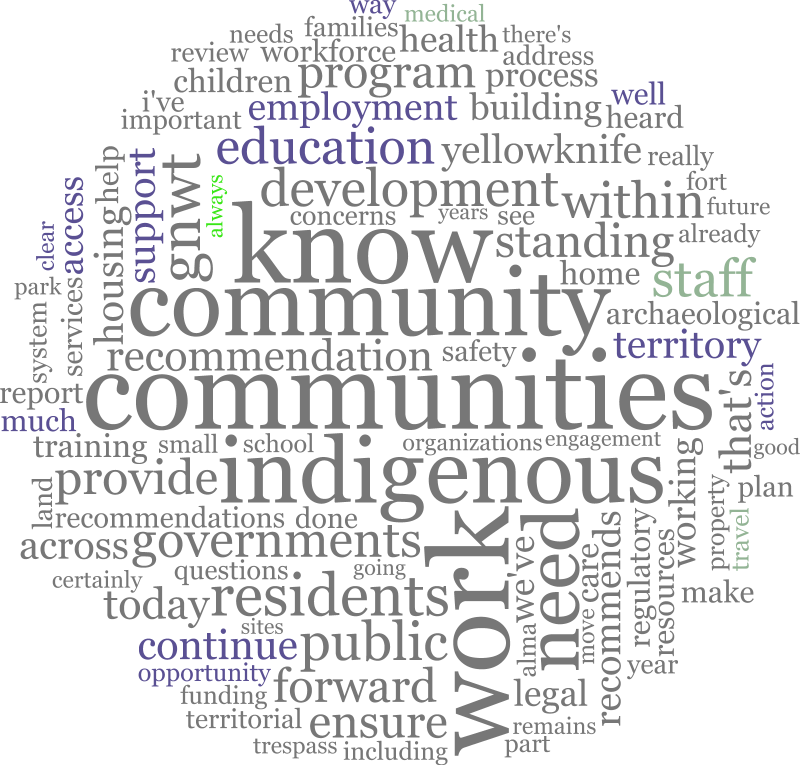
This is page numbers 2379 - 2418 of the Hansard for the 20th Assembly, 1st Session. The original version can be accessed on the Legislative Assembly's website or by contacting the Legislative Assembly Library. The word of the day was work.

Topics

Members Present

Hon. Caitlin Cleveland, Mr. Edjericon, Mr. Hawkins, Hon. Lucy Kuptana, Hon. Vince McKay, Hon. Jay Macdonald, Mr. McNeely, Ms. Morgan, Mr. Morse, Ms. Reid, Mr. Rodgers, Hon. Lesa Semmler, Mr. Testart, Hon. R.J. Simpson, Hon. Shane Thompson, Hon. Caroline Wawzonek, Mrs. Weyallon Armstrong, Mrs. Yakeleya

The House met at 1:31 p.m.

---Prayer or reflection

Prayer Or Reflection

Page 2379

The Speaker

The Speaker Shane Thompson

Thank you very much, George Suluk, for opening guiding words.

Ministers' statements. Minister for ECE.

Minister's Statement 124-20(1): Update on Community Learning Centres
Ministers' Statements

Page 2379

Caitlin Cleveland

Caitlin Cleveland Kam Lake

Mr. Speaker, in January 2025 Aurora College announced its plans to close community learning centres as part of its efforts to resolve low enrolment and adjust the way academic upgrading is delivered. Following that news, I heard loud and clear from Indigenous governments, communities, non-profit organizations and my colleagues in this House, that hands-on community-based learning is essential. I want to express my gratitude to all those who brought forward their concerns and their visions for the future of these centres, and for community-based education more broadly.

Mr. Speaker, Aurora College is implementing a modernized approach to the delivery of adult learning and basic education through campuses and online, including hiring instructors and technical support staff to facilitate and support distance learning across all communities. The approach will focus on flexibility, engagement and support while using technology to create effective learning environments. While the Aurora College board of governors is responsible for the operational decisions of the college, the Department of Education, Culture and Employment is responsible for providing residents with access to quality programs and supports that enhance education and employment opportunities. The Department will continue to deliver high school equivalency tests, now called the Canadian Adult Education Credential, which can help open new doors to employment, advance careers and support access to other learning or training opportunities, including apprenticeships.

In addition, the department is building on past employment readiness successes. Over a two-year period, which concluded in 2024, the department provided funding to the NWT Literacy Council to help fund employment readiness programs. This training included four weeks of classroom-style programming followed by two weeks supported employment model. Learners were supported with a training allowance, childcare funding, and wraparound supports like transportation, counselling and clothing needed for jobs. This training was delivered in Behchoko, Gameti, Wekweeti, Whati, Fort Simpson, Aklavik, and Fort McPherson, and 75 percent of participants either gained employment or went on to further education. This program was a clear success, and the department is working closely with the NWT Literacy Council to discuss future community deliveries. I look forward to keeping Members updated on that work.

Mr. Speaker, later this year we will begin to receive data resulting from the Post-Secondary Education Accountability Framework. The framework gives post-secondary institutions direction on what must be reported each year and supports the monitoring and evaluation of our post-secondary education system. This will increase our understanding of the types of programs our residents are accessing, including those learners accessing adult literacy and basic education through Aurora College campuses or online.

Mr. Speaker, every community is unique, and their needs, objectives and plans are distinct. Similarly, each facility that has been used as a community learning centre is unique. Some are standalone buildings while others access space through sharing agreements with other facilities. Each of these factors add complexity and nuance to the equation, but it also gives us an incredible opportunity to collaborate with Indigenous governments and community partners on their future use.

Last session, I made a commitment to engage Indigenous governments and communities on the future of community learning centres, and I am pleased to share that engagement is well underway. We have reached out to partners, including Indigenous and local community governments, and offered one-on-one discussions centered specifically around the facilities in their communities and focused on their needs. I have also heard from partners who have a direct interest in seeing these facilities continue to deliver programs and services that support adult learners. In addition, a commitment was made to develop a critical path and timeline toward ensuring residents have access to quality programs that enhance education and employment opportunities going forward. Building from the steps I have highlighted, I look forward to sharing further details with my colleagues prior to the end of this sitting.

Mr. Speaker, alongside the steps Aurora College has taken to extend the reach of adult literacy and basic education, I see this as an opportunity to ensure the vision and voice of communities are captured as we reshape the way adult learning is delivered in the NWT. I applaud all the Northerners who are pursuing adult education, literacy and skill building, and I want to provide assurance that the GNWT is working hard to remove barriers and improve access to education for all residents. Mahsi.

Minister's Statement 124-20(1): Update on Community Learning Centres
Ministers' Statements

Page 2379

The Speaker

The Speaker Shane Thompson

Thank you, Minister of Education, Culture and Employment. Ministers' statements. Minister responsible for Housing NWT.

Minister's Statement 125-20(1): Homelessness
Ministers' Statements

Page 2379

Lucy Kuptana

Lucy Kuptana Nunakput

Thank you, Mr. Speaker. Mr. Speaker, homelessness is a complex issue that affects all of our communities. The rising cost of living, addictions, and climate emergencies have disproportionately affected our most vulnerable residents. The GNWT is committed to finding solutions that provides more homes for Northerners.

The GNWT continues to focus on a whole-of-government approach to address homelessness, following the development of A Way Home: A Comprehensive Strategy to Address Homelessness in the Northwest Territories.

A Way Home highlights the need for collaboration among government agencies, community organizations, and Indigenous governments and organizations. These solutions need to be culturally appropriate and respect the unique needs and strengths of our Indigenous communities. It is a challenge I am committed to addressing by enhancing supports, improving access to services, and making meaningful progress.

Non-governmental organizations play a critical role in the service delivery continuum to address and prevent homelessness, and we are committed to fostering these relationships to ensure that NGOs remain resilient and provide sustainable services.

Earlier this spring, I was able to tour the Hay River Homeless Shelter and witnessed the positive work that is being done to support residents experiencing homelessness. I was happy to see how GNWT's investment with the Hay River Metis Local 51 is strengthening these vital services. We are making a real difference by investing in community-led solutions and work towards a more inclusive Northwest Territories.

Part of our focus is increasing transitional and supportive housing options which are crucial for helping people stabilize their lives. Moving directly from shelters to independent housing is often challenging, so housing with wraparound support is essential. The Transitional Housing for After Addictions Recovery Program in Yellowknife is one example of the GNWT and an NGO partnering to provide housing for those who have completed addictions treatment. A similar site is being developed in Inuvik.

Transitional housing is a step toward a healthier and more compassionate community, and I look forward to developing additional transitional housing projects across the North.

Homelessness remains one of the most pressing issues facing our territory, and it is something I deeply care about. I am committed to continually work towards everyone having a safe, stable place to call home. Quyananni, Mr. Speaker.

Minister's Statement 125-20(1): Homelessness
Ministers' Statements

Page 2379

The Speaker

The Speaker Shane Thompson

Thank you, Minister responsible for Housing NT. Ministers' statements. Minister of Health and Social Services.

Minister's Statement 126-20(1): Medical Travel Modernization
Ministers' Statements

Page 2380

Lesa Semmler

Lesa Semmler Inuvik Twin Lakes

Mr. Speaker, making health care accessible to every Northwest Territories resident is a core mandate priority of this government. People across the Northwest Territories access our medical travel program, whether they are travelling to access health services in a regional centre, in the capital, or in the south. This means that a reliable medical travel program is vital to the Northwest Territories residents and to achieving this mandate priority.

In every community I have visited, residents tell me how difficult it is to navigate medical travel. This process can be confusing and frustrating, and it is the subject of a great many questions that come to my office from MLAs and constituents.

Medical travel staff work tirelessly to meet the needs of every traveler, but the program is inherently complex and each day they struggle by juggling patient referrals, coordinate with health care providers, and arrange flights and accommodations for dozens of travelers, all at the same time, often on short notice.

During my first year as Minister, it became very clear that this program needs a thorough overhaul so it can better serve Northwest Territories residents and be simpler for staff to manage.

Mr. Speaker, I am very pleased to share some of the work that is underway to modernize this program. When complete, the modernized medical travel program will give residents better support and make the steps for arranging medical travel clearer and easier to follow.

In recent months we have drafted the detailed work plan to improve how medical travel services are delivered in the Northwest Territories. The plan maps current program operations, sets clearer and more consistent processes, and will give residents simpler and more useful information. A dedicated project team is leading this work, and we have already presented the plan to the Standing Committee on Social Development for feedback.

Mr. Speaker, let me be clear: This work will not cut or scale back medical travel services. Residents who must leave their community for care will continue to receive the support that they rely on. Our aim is to make the program more consistent, simpler to navigate, and truly centered on the client's needs.

This work is also supported by the broader efforts being led by the public administrator of the NTHSSA. Through engagement with staff and leadership and presentations to standing committees, we are identifying gaps in client experience and improving how care is coordinated. The goal is to make medical travel smoother for those who need it, and to reduce the need for travel over time by strengthening access to quality care within communities.

Over the next six months, we will focus on examining each step of the program and introducing improvements so residents can understand and access medical travel with greater ease.

The newly modernized medical travel program is expected to come into effect on September 1, 2026. Until that time, we will continue to work with Indigenous governments, staff, and Members of this Legislative Assembly to ensure that we are on the right path. This is part of our broader commitment to improve access to care and build a stronger and more sustainable health and social services system in the Northwest Territories. Thank you, Mr. Speaker.

Minister's Statement 126-20(1): Medical Travel Modernization
Ministers' Statements

Page 2380

The Speaker

The Speaker Shane Thompson

Thank you, Minister of Health and Social Services. Ministers' statements. Deputy Premier.

Minister's Statement 127-20(1): Premier Absent from the House
Ministers' Statements

Page 2380

Caroline Wawzonek

Caroline Wawzonek Yellowknife South

Mr. Speaker, I wish to advise the House that the Honourable Member for Hay River North, the Premier, will be absent from the House today to host the western Premiers' conference here in Yellowknife.

Minister's Statement 127-20(1): Premier Absent from the House
Ministers' Statements

Page 2380

The Speaker

The Speaker Shane Thompson

Thank you, Deputy Premier. Ministers' statements. Members' statements. Member from Tu Nedhe-Wiilideh.

Member's Statement 630-20(1): Residential School Impacts for Fort Resolution Residents
Members' Statements

Page 2380

Richard Edjericon

Richard Edjericon Tu Nedhe-Wiilideh

Mr. Speaker, earlier this year, I shared with my colleagues the story of 5-year-old Alma who passed away in residential school in Fort Resolution. Alma was buried in Fort Resolution, but her sister promised her mother that she would bring Alma home back to Fort Smith to be laid to rest along with her. The children who died at St. Joseph's School were buried in Fort Resolution, not in their home communities. The death of these children needs to be properly investigated by the coroner's office as there are serious reasons to doubt her cause of death was TB as stated by the Indian agent on her death certificate.

Unfortunately, the Department of Education, Culture and Employment is adamant in stepping outside their jurisdiction and demanding that the repatriation of these children requires an application for an archaeological permit. The circumstances of this investigation falls outside the scope and requirement of the Archaeological Site Act. These are marked graves in an active cemetery. There's burials of 11 children have been discovered without crosses rotting in the grass. ECE does not investigate crimes, and the remains of the children are not artifacts.

The Minister's mandate letter directs her to advance the implementation of the United Nations Declaration on the Rights of Indigenous Peoples, the Truth and Reconciliation Calls to Action, insisting that the remains of the Indigenous children are subject to Archaeological Sites Act review is the same colonial mindset that led to the creation of the residential school to begin with. This stands in direct contradiction to both the spirit and intent of Minister Cleveland's mandate letter from the Premier.

Canada is at the age of reconciliation, and Northerners expect more from this government to talk without action, yet in front of us, the rights of Indigenous peoples are being reduced to a mere privilege dependent on this Minister's discretion alone. This afternoon, I will give this government another opportunity to commit to this investigation proceeding without delay so that Alma's sister has the chance to find the closure she deserves within her lifetime as she is now 87 years old.

I would reiterate the Deninu Kue First Nation wants the coroner's office to assist in the investigation in the death of these children. By honouring this request, we're honouring the children that have passed. Thank you, Mr. Speaker.

Member's Statement 630-20(1): Residential School Impacts for Fort Resolution Residents
Members' Statements

Page 2380

The Speaker

The Speaker Shane Thompson

Thank you, Member from Tu Nedhe-Wiilideh. Members' statements. Member from Yellowknife North.

Member's Statement 631-20(1): Status of Northwest Territories Healthcare
Members' Statements

Page 2380

Shauna Morgan

Shauna Morgan Yellowknife North

Mr. Speaker, if we work together for a common good, we stand. And if we're divided, we fall. I believe this is true now more than ever in the context of our NWT healthcare system. I've been concerned at some of the public messaging coming from the health authority and the Minister that could pit our residents and communities against one another.

The messaging seems to imply that we have to choose between community health centres or cabins and regional hospitals, which deserve more of our attention and resources; that we have to choose whether we work on health promotion and prevention, or whether we put more resources into emergency care; that we need to choose who we should listen to more, Indigenous residents in small communities or the frontline doctors and nurses serving the territory.

I understand that resources are always constrained, but health care can never become a competition for which of our residents deserve better care. All of our residents deserve good care and good access, no one should be suffering, either because there's no emergency responder to come help you if you've fallen down in your home, there's no one at the end of the phone line at the health centre, or the primary care phone system in Yellowknife doesn't work at all. All these situations are unacceptable.

Mr. Speaker, as soon as we start having debates about health cabins versus hospitals, health promotion versus emergency care, we are in trouble. It's like having a debate about which is more important, your left hand or your right hand, your heart or your liver. If any of the pieces in our system are missing or broken, the system falls apart, and the whole territory suffers.

Health authority management may struggle to deal with the course of concerns and suggestions coming from frontline nurses and doctors, but the answer is not to brush them aside and say, well, we've been listening to you all complaining for too long, it's time we listened to Indigenous community members instead. Real solutions need all of these voices, frontline providers and community members, talking to each other, not having all their input filtered separately through a dozen layers of management and packaged into a sterile plan that few actually read. We need to stop setting up residents and communities in competition against each other, stop taking staff for granted and instead value everyone's contribution. We need to build a healthcare system that lifts everyone up. Thank you, Mr. Speaker.

Member's Statement 631-20(1): Status of Northwest Territories Healthcare
Members' Statements

Page 2380

The Speaker

The Speaker Shane Thompson

Thank you, Member from Yellowknife North. Members' statements. Member from Great Slave.

Member's Statement 632-20(1): Statement of Youth Parliamentarian Jack Penny Regarding Tin Can HIll
Members' Statements

Page 2380

Kate Reid

Kate Reid Great Slave

Thank you, Mr. Speaker. Mr. Speaker, today I would like to read my youth parliamentarian statement by Mr. Jack Penny. I have modified it slightly for accuracy but as of current -- currently as of today, but it's a pleasure to read these each year.

I would like to speak about the importance of preserving Tin Can Hill in Yellowknife by designating it as a territorial park, an area for scientific study.

Mr. Speaker, Tin Can Hill is currently under the jurisdiction of the city of Yellowknife. City council has designated it as a parks and recreations area in its zoning bylaw. In 2022, the Government of the Northwest Territories, in partnership with Aurora College, proposed development of a new polytechnic university campus on a portion of Tin Can Hill. This proposal led to the signing of an MOU between the GNWT and the city of Yellowknife indicating the city's willingness to consider transferring land for the campus development; however, Yellowknife city of Yellowknife ended this agreement in March when the mayor and city manager said that there is currently no plan to develop any part of the area.

Mr. Speaker, the authority to establish a territorial park falls under the jurisdiction of the Minister of ITI under the Territorial Parks Act. I call on this government to enter a new agreement with the city to complete a transfer of land and establish Tin Can Hill Territorial Park.

Mr. Speaker, it's crucial that we protect the network of trails and geological features of Tin Can Hill for future generations. Designating this area as a territorial park would ensure long-term environmental stewardship while respecting Indigenous history and providing opportunities for education and sustainable tourism.

Mr. Speaker, residents have spoken clearly. They want Tin Can Hill preserved. By creating a territorial park, we not only protect the land but we invest in our community. I urge the department of ITI to work collaboratively with the city of Yellowknife and Indigenous governments to make this vision a reality. Thank you, Mr. Speaker.

Member's Statement 632-20(1): Statement of Youth Parliamentarian Jack Penny Regarding Tin Can HIll
Members' Statements

Page 2381

The Speaker

The Speaker Shane Thompson

Thank you, Member from Great Slave.

Colleagues, before we continue with our Members' statement, I'd like to recognize visitors from the College Nordique and their guests from college, and I apologize if I said it wrong. I do not speak French, so I apologize. So welcome to our Assembly.

Members' statements. Member from the Sahtu.

Member's Statement 633-20(1): 2024 Wildfires and Evacuation and Preparedness for 2025 Wildfire Season in Sahtu Region
Members' Statements

May 22nd, 2025

Page 2381

Daniel McNeely

Daniel McNeely Sahtu

Thank you, Mr. Speaker. Mr. Speaker, reflecting on last year's devastating wildfires in the Sahtu and the evacuation of the community of Fort Good Hope to neighboring communities, and the fish camp downstream from the community, bring back horrific, tragic trauma, memories. The tragic helicopter crash left a family impacted the certainty on returning home by families, children, elders continued to play the experience.

Mr. Speaker, the leaders I must commemorate for their determination in protecting their home communities, cabins, families, children, and the everyday well-being on shortage of supplies. Similarly, this experience has impacted the Northwest Territories as a whole directly and in many other ways indirectly.

Mr. Speaker, the NWT is resilient. We learn, and we move forward in developing our future. All said, Mr. Speaker, this raises the issues of preparedness and readiness. On those points later, Mr. Speaker, I will have questions to the appropriate Minister. Mahsi.

Member's Statement 633-20(1): 2024 Wildfires and Evacuation and Preparedness for 2025 Wildfire Season in Sahtu Region
Members' Statements

Page 2381

The Speaker

The Speaker Shane Thompson

Thank you, Member from the Sahtu. Members' statements. Member from Deh Cho.

Member's Statement 634-20(1): Community Safety in Fort Providence
Members' Statements

Page 2381

Sheryl Yakeleya

Sheryl Yakeleya Deh Cho

Mahsi, Mr. Speaker. Just over two months ago, a shooting occurred in the community of Fort Providence. This violence tragically resulted in one person being killed and two others injured. Shortly after their investigation began, the RCMP linked the shooting to the drug trade. Two days ago, media reported that the RCMP made an arrest in Kelowna, BC, and an individual be brought back to the Northwest Territories to face charges. I want to acknowledge the efforts of the RCMP in this investigation. The RCMP's hard work and unwavering dedication to our communities is very much appreciated.

Mr. Speaker, if making residents in communities safe is a priority of this Assembly, then we must do more. We need new legislation. People are worried about their safety and well-being. Youth are being coaxed into the drug scene. Homes that used to have open doors are now locked and shuttered due to drug violence. Conditions placed on offenders or repeat offenders are not working or are not being followed. Violence connected to the drug trade is becoming more and more common not only in the Deh Cho but across the territory.

Safe communities and neighbourhoods legislation will, without a doubt, provide authorities with additional tools to combat the onslaught of drugs and violence affecting our communities. Our communities need help, and they need it now. I will have questions for the Minister of Justice at the appropriate time. Mahsi, Mr. Speaker.

Member's Statement 634-20(1): Community Safety in Fort Providence
Members' Statements

Page 2381

The Speaker

The Speaker Shane Thompson

Thank you, Member from the Deh Cho. Members' statements. Member from Inuvik Boot Lake.

Member's Statement 635-20(1): Conditions at Nova Apartments in Inuvik
Members' Statements

Page 2381

Denny Rodgers

Denny Rodgers Inuvik Boot Lake

Thank you, Mr. Speaker. Mr. Speaker, I had hoped not to have to make this Member's statement once again in this House; I think I've made it a couple of times. Mr. Speaker, it's dealing with the issue of Nova Apartments in the community of Inuvik in my riding.

Mr. Speaker, I still get weekly emails, messages, and calls regarding the standard of living in the building. Messages are often accompanied by photos, sometimes videos, showing the often horrendous living conditions and the common areas of this building. Often there are videos of altercations within the building, violence, doors being destroyed, and other illegal activities taking place in the common areas. Exterior doors are often damaged to the point that the building is no longer secure.

Mr. Speaker, there have been several drug busts in this building over the past several months, likely over the past couple of years, and I applaud the local RCMP for their diligence in getting that work done but, Mr. Speaker, it seems to never end. Once one bad actor is removed, another seems to take their place.

There are families with young children in this building; there are elders in this building, often living in fear. I understand, Mr. Speaker, that this space is leased from a private landlord; however, our housing corporation does occupy the majority of units in the building. If the existing lease agreement does not provide options for proper security and management of the building, then we must act quickly to make the appropriate changes. If not, then, for heaven's sake let's finds a safe place for our residents to live where they're not having to live, life, daily, in fear.

Mr. Speaker, this has been ongoing for months, as I've said, even years. I implore the Minister, for the safety of the residents, for the quality of life of the residents, let's get this issue dealt with once and for all. Thank you, Mr. Speaker.

Member's Statement 635-20(1): Conditions at Nova Apartments in Inuvik
Members' Statements

Page 2381

The Speaker

The Speaker Shane Thompson

Thank you, Member from Inuvik Boot Lake. Members' statements. Member from Range Lake.

Member's Statement 636-20(1): Unfair Application of Education, Culture and Employment Policies in Dehcho Region
Members' Statements

Page 2381

Kieron Testart

Kieron Testart Range Lake

Mr. Speaker, earlier this month, I had the opportunity to visit Fort Simpson on the request of their district education authority. Obviously, this is somewhat expectational but nonetheless, when Northerners anywhere need this Assembly's help, I'm happy to play my part, and I know you would do the same for my Range Lake constituents.

Mr. Speaker, it became clear to me from these discussions that a common theme was emerging: the lack of support from the education system. It is heartbreaking to see duly elected community representatives and hard-working parents not getting the help they deserve to address very serious concerns that include:

  • Mishandling of a critical incident;
  • Leadership failures and inaction;
  • Misinformation and inconsistent communication;
  • Alleged retaliation and abuse of authority;
  • Lack of transparent communication with staff and families;
  • Failure to facilitate restorative practices or community healing; and,
  • Blocking student participation in school activities due to interpersonal conflicts.

The effects of these actions have reportedly led to high staff turnover and multiple stress leaves, a loss of trust among educators, families, and the broader community, and a sense of unsafety within the school environment. The broad administrative response has been brought into question as well. When the DEA tried to fix these problems that they were elected to fix, they were met with perceived favouritism and a lack of fairness from supervisory officials and inadequate responses to serious complaints and no real community engagement.

Mr. Speaker, some of these issues have already been reported in the media, and I suspect more will follow. I should stress that the concerns raised here are alleged and not proven, but the voices of the community are loud and united in purpose to solve a problem that has slowly grown worse over time. Now the Minister has a choice: Listen to the voices of the small communities or continue to support a colonial system that is failing to protect students, staff, and families. I hope she will make the right choice. Thank you, Mr. Speaker.

Member's Statement 636-20(1): Unfair Application of Education, Culture and Employment Policies in Dehcho Region
Members' Statements

Page 2382

The Speaker

The Speaker Shane Thompson

Thank you, Member from Range Lake. Members' statements. Member from Monfwi.

Member's Statement 637-20(1): Legal Aid Commission Outreach Program
Members' Statements

Page 2382

Jane Weyallon Armstrong

Jane Weyallon Armstrong Monfwi

Thank you, Mr. Speaker. Legal outreach.

Mr. Speaker, small communities need a wide range of legal services, not just criminal matters. We have elders who need to commission oath or need advice on property, wills, and other issues. Mr. Speaker, the Legal Aid Commission offers a free outreach program to residents to provide limited legal advice. How can people in small communities access this service?

According to the Department of Justice website, outreach lawyers can provide individuals with an hour of free confidential advice, and the program is intended to help with housing and tenants dispute, income support claims and appeals, employment, wills and estate, child protection, elder abuse, civil claims, and other matters.

Mr. Speaker, this is a good program, and I am glad we have it. But, do we have lawyers visiting our communities for outreach?

I had heard that resources for clinics have been reduced. Residents of small communities currently pay their own travel expenses to access legal aid in Yellowknife. This does not factor in co-pay. My constituents rely on legal aid and have few other options for legal services. Mr. Speaker, their financial eligibility table has not been updated since February 2019. It should reflect our high cost of living.

This table states it is assumed the cost of a lawyer increases across zones. But, Mr. Speaker, there is really only one zone where legal services are available. All three legal aid clinics are in Yellowknife. Of the nearly 40 panel lawyers of the commission, only 11 are residents - 10 in Yellowknife and 1 in Hay River. Mr. Speaker, I will have questions for the Minister of Justice. Thank you.

Member's Statement 637-20(1): Legal Aid Commission Outreach Program
Members' Statements

Page 2382

The Speaker

The Speaker Shane Thompson

Thank you, Member from Monfwi. Members' statements. Member from Yellowknife Centre.

Member's Statement 638-20(1): Trespassing Legislation
Members' Statements

Page 2382

Robert Hawkins

Robert Hawkins Yellowknife Centre

No trespassing, Mr. Speaker. I'm referring to a no trespassing Act. Mr. Speaker, it's almost impossible to remove someone who is unwanted on a particular property, business, or even in a private situation.

Mr. Speaker, individuals can hold property owners hostage on their own property because they are exercising their rights to be there. Where is the fairness in this, Mr. Speaker? Where is the rule of law? Where is the basic reason of understanding, Mr. Speaker? Mr. Speaker, where is the fairness when you empower an encampment to be on your property? Where is the process to ban them, to make them move along? The citizens believe the law is broken with no law.

Mr. Speaker, when you have a grocery store that can't stop people from entering who are known for stealing from it or causing disruption with staff and patrons, what are you left to do other than complain to your politicians who he looks and won't do anything.

Mr. Speaker, I've come to learn that moving at the speed of government has become a trend here, if not a fact, and moving at the speed means is slow, if not backwards, as possible. I know they want to do the right thing, but in my experience that's after trying the wrong thing ten times.

Mr. Speaker, when citizens try to go home -- Northern Heights is a good example -- you have a cluster of people, 20 people, blocking the entrance of their home. They intimidate them. They block them. They demand things. They scare people. It leads to lower quality of life. And I guarantee you, I can't imagine that improves property value. There's no law on the books, but it's a slippery slope. When you start tolerating this, it emboldens them. You give them food, it entrenches them. You fence them in to protect them, you empower them. You provide toilets, you've given them a reason to be there. And of course, all through this process you end up acquiescing them by giving them, by your reluctance, to address the problem. This gives them rights over your rights, over owner rights. No court will remove them once you've emboldened them, protected them, tolerated them, and now provided for them, Mr. Speaker.

Mr. Speaker, I only took trespass laws packages from four jurisdictions, and there are more. I've got Alberta, BC, Manitoba, and Nova Scotia. They are less than six pages each. I'll be speaking to the government today during question period. Because if they don't want to do this, maybe a Private Member's bill is time to address this issue. Thank you.

Member's Statement 638-20(1): Trespassing Legislation
Members' Statements

Page 2382

The Speaker

The Speaker Shane Thompson

Thank you, Member from Yellowknife Centre. Members' statements. Member from Frame Lake.

Member's Statement 639-20(1): Workforce Development and Coordination
Members' Statements

Page 2382

Julian Morse

Julian Morse Frame Lake

Thank you, Mr. Speaker. Mr. Speaker, when it comes to workforce development, we have had some success in the NWT with individual companies developing a project-specific workforce through training and development programs. This has worked well for long-term projects like mines which have lifespans of a decade or more; however, our economy is increasingly shifting towards more project-based employment for which this kind of workforce development model does not work as well. Projects are more time limited, sometimes involve seasonal work, and are spread across the territory. Any individual project, be it mine remediation, housing construction, or large scale construction projects like the Stanton hospital, often aren't long-term or large enough to develop their own workforce, nor can they take on the responsibility of lining up future work for people as their project winds down. I think unless there is better coordination and planning around workforce development and deployment, we may see local employment numbers drop even further than what we are already seeing. I would like the government to be proactive about addressing this challenge, and I think the GNWT is best positioned to take on the role of workforce planning and coordination.

Mr. Speaker, the issue of workforce availability in this the NWT is an increasingly urgent and pressing issue. The president of the Northwest Territories and Nunavut Construction Association raised concern in the media recently that shortage of labour is one of their top concerns. When I was meeting with individuals involved in managing workforce for large remediation projects in the NWT, similar concern was expressed, and it was noted that the lack of centralized workforce coordination in the NWT makes it difficult to identify and link workers with and across projects to ensure continuity of employment through apprenticeships and steady employment after trade certificates are obtained. While GNWT does do some of this work and has prioritized workforce development, I think there is room for the government to step further and more effectively into not only training and development but also workforce coordination.

I am imagining a government agency or division which would act as a matchmaker of sorts which could coordinate with individuals, Indigenous governments, and others to help connect projects with skilled labour. This would help projects maximize northern employment and employment continuity for skilled workers. It could also strengthen our ability to help plan for workforce development and training with post-secondary institutions. Thank you, Mr. Speaker. I'll have questions for the Minister of ITI at the appropriate time.

Member's Statement 639-20(1): Workforce Development and Coordination
Members' Statements

Page 2382

The Speaker

The Speaker Shane Thompson

Thank you, Member from Frame Lake. Members' statements.

Member's Statement 640-20(1): Statement of Payton Bennet, Youth Parliamentarian for Nahendeh
Members' Statements

Page 2382

Shane Thompson

Shane Thompson Nahendeh

Colleagues, on May 1st I had the opportunity to preside over the 2025 Youth Parliament. I have to say it was a great to witness these young people be MLAs. Today, I have the pleasure of sharing the Member from the Nahendeh, Payton Bennet, statement.

I am speaking to you today about the inadequacies I have seen regarding facilities, access to training, and insufficient space in our smaller communities compared to the bigger centers like Yellowknife, Hay River, Inuvik, and Fort Smith.

Today I'm speaking for youth athletes. I've done a variety of sports that are available throughout the different seasons in Fort Simpson, including speed skating, soccer, snowboarding, and basketball. I've witnessed and experienced different issues associated with sports in northern communities firsthand. After participating and competing in sport while growing up in small communities, I've grown up understanding that the larger towns will always have advantages that leads to be more successful. I have coached children from the ages of 3 to 10 in speed skating. I love watching them grow in the sport, and have fun with it, although I want more for them. They have already accomplished so much; I want them to continue making achievements. They deserve to continue to feel proud and have the pride in their sport. All kids across the Northwest Territories deserve that but especially in the smaller communities.

I feel that the territorial sports organizations, school districts and school boards must engage in meaningful discussions on how to approach the idea of giving equal access, along with attention to sports, in the smaller communities. This includes addressing barriers such as limited access to proper facilities, inadequate funding, insufficient training for community coaches, and beneficial camps for young athletes. I have observed, and experienced athletes have shorter seasons in training due to weather conditions affecting their facilities.

I have seen many youths in the North use sports as a constructive outlet. It provides them with an activity, a place to go to cope, and get away with their personal challenges. I've seen my peers grow together as individuals.

I want to advocate for all the youth across the North that would like to be involved in sport. I will continue to bring attention to these ongoing issues. I encourage others to understand the unique circumstances small communities deal with.

Mr. Speaker, I respectfully urge the Government of the Northwest Territories to look at the way the smaller community sport is funded and supported. I feel that the smaller community athletes have a good chance at making teams more often if they are given the attention they deserve. This is done by recognizing the community athletes as strong and equal to the larger-centered athletes.

Along with consistent learning and growing opportunities and frequent access to the facilities that do exist through training trips. Ultimately these youth deserve the resources to achieve. Thank you, Ms. Payton Bennet.

Member's Statement 640-20(1): Statement of Payton Bennet, Youth Parliamentarian for Nahendeh
Members' Statements

Page 2383

The Speaker

The Speaker Shane Thompson

Members' statements. Motions. Returns to oral questions. Recognition of visitors in the gallery. Member from Great Slave.

Recognition Of Visitors In The Gallery

Page 2383

Kate Reid

Kate Reid Great Slave

Thank you, Mr. Speaker. Mr. Speaker, I would like to recognize Sarah-Jayne Dempster, the president of the Northern Territories Federation of Labour who is here today with her son Corbin Dempster. Welcome to your House; really glad you could be here.

Recognition Of Visitors In The Gallery

Page 2383

The Speaker

The Speaker Shane Thompson

Recognition of visitors in the gallery.

If we missed anyone in the gallery today, welcome to your chamber. I hope you are enjoying the proceedings. It's always nice to see people in the gallery and allow us to represent you in the Northwest Territories.

Recognition of visitors in the gallery. Acknowledgements. Member from Yellowknife North.

Acknowledgement 14-20(1): Audrey Debogorski and Stella Fairman - Scholastic Accomplishments
Acknowledgements

Page 2383

Shauna Morgan

Shauna Morgan Yellowknife North

Thank you, Mr. Speaker. Today, I would like to take this time to acknowledge two graduating students from Ecole St. Patrick High School, which is in my riding. I want to Congratulate Audrey Debogorski and Stella Fairman on their achievements. Along with the accomplishment of graduating from Ecole St. Patrick High School, Ms. Debogoski and Ms. Fairman are both receiving the Loran Award from the Loran Scholars Foundation. These students were selected, from amongst 6,000 applicants nation-wide, to become two of the 36 Loran Scholars for 2025. The award includes a four-year post-secondary scholarship, leadership-enrichment program and a mentorship program.

Congratulations and all the best to Ms. Debogorski and Ms. Fairman, and I want to say how proud our entire community is of you. Thank you, Mr. Speaker.

Acknowledgement 14-20(1): Audrey Debogorski and Stella Fairman - Scholastic Accomplishments
Acknowledgements

Page 2383

The Speaker

The Speaker Shane Thompson

Thank you, Member from Yellowknife North. Acknowledgements. Oral questions. Member from Yellowknife Centre.

Question 675-20(1): Trespass Act Update
Oral Questions

Page 2383

Robert Hawkins

Robert Hawkins Yellowknife Centre

Thank you, Mr. Speaker. Mr. Speaker, I understand why people do encampments. There are a variety of reasons, whether they're exercising their freedoms, they're demonstrating political statements, affordability and, of course, addictions and other types. It's not meant to be an all-inclusive list, but there's reasons why.

Mr. Speaker, knowing that the government isn't moving forward on the Trespass Act any time in the foreseeable future, it may be on a list for one day in the fulsome of time, but the truth be told is we need to act now.

So the question to the Minister of Justice is would he be supportive of accelerating the Trespass Act within this next sitting -- upcoming sitting. Thank you.

Question 675-20(1): Trespass Act Update
Oral Questions

Page 2383

The Speaker

The Speaker Shane Thompson

Thank you, Member from Yellowknife Centre. Minister of Justice.

Question 675-20(1): Trespass Act Update
Oral Questions

Page 2383

Jay MacDonald

Jay MacDonald Thebacha

Thank you, Mr. Speaker, and thank you to the Member for the question. Totally agree. I think that, you know, the three pieces of legislation that we've been targeting from the Department of Justice, the SCAN legislation, the Trespass Act, and the Civil Forfeiture Act, are certainly high on a priority list since I've become Minister of Justice and continue to have conversations with the department about moving these forward. And we've already accelerated the timeline from where it was originally proposed and, you know, we'll continue to work toward trying to bring that quickly to the House as possible. Thank you, Mr. Speaker.

Question 675-20(1): Trespass Act Update
Oral Questions

Page 2383

Robert Hawkins

Robert Hawkins Yellowknife Centre

Thank you, Mr. Speaker. In the spirit of collaboration, that was the nicest no I've heard all week.

Mr. Speaker, the Premier yesterday -- I'm not going to quote him in specifics because I don't have it in front of me, but he said it's the time to do things. So less talk, a lot more engagement and walk.

Mr. Speaker, would the government be supportive if a Private Member, such as myself, brought forward a Private Member's bill noting that most of these examples, whether they're Alberta and Nova Scotia, Manitoba, BC, are less than six pages? Would the government be open to a proposal from a private Member? Thank you.

Question 675-20(1): Trespass Act Update
Oral Questions

Page 2383

Jay MacDonald

Jay MacDonald Thebacha

Thank you, Mr. Speaker. Mr. Speaker, a considerable amount of work is already underway toward the Trespass Act. An LP is being currently developed. A lot of research has already started to address the fact that, you know, all the provinces within Canada have a Trespass Act. Unfortunately, the three territories, as of today, do not. It's certainly a priority of mine, as I said, to push this forward as quickly as possible and I am happy to, you know, continue in that direction. Certainly, you know, respect the private Members -- or the Member's right to move forward with a private Member's bill if he so chooses. Thank you, Mr. Speaker.

Question 675-20(1): Trespass Act Update
Oral Questions

Page 2383

The Speaker

The Speaker Shane Thompson

Thank you, Minister of Justice. Member from Yellowknife Centre.

Question 675-20(1): Trespass Act Update
Oral Questions

Page 2383

Robert Hawkins

Robert Hawkins Yellowknife Centre

Mr. Speaker, I'm always happy to do the government's work for them so anything they want to share with me, I'd be pleased. And that's not the question, but certainly I hope that's embedded in there somewhere.

Mr. Speaker, I want to point out and finish with families are feeling emotionally hostage, their personal safety, financial costs, and it's impacting their general daily lives. Mr. Speaker, would the Minister be willing to share what they have prepared today on this initiative? Because I'll push to move forward on a draft bill this coming fall so we can actually see some action in this Assembly with some new meaningful legislation that affects the day-to-day lives of citizens. Thank you.

Question 675-20(1): Trespass Act Update
Oral Questions

Page 2383

Jay MacDonald

Jay MacDonald Thebacha

Thank you, Mr. Speaker. Mr. Speaker, as I previously said, a lot of work is already started on this initiative and just prior to coming into the sitting today, I did have my staff reach out to the Department of Justice and ask them to provide me with an update on how quickly we could advance these three pieces of legislations quicker than the planned accelerated timeline that I spoke to yesterday. So happy to share that information with the House as soon as it's available. Thank you, Mr. Speaker.

Question 675-20(1): Trespass Act Update
Oral Questions

Page 2383

The Speaker

The Speaker Shane Thompson

Thank you, Minister of Justice. Oral questions. Member from Range Lake.

Question 676-20(1): Implementation of Deh Cho Education Authority Employment Recommendations
Oral Questions

Page 2383

Kieron Testart

Kieron Testart Range Lake

Thank you, Mr. Speaker. Mr. Speaker, as I said in my Member's statement, there's very serious concerns in Fort Simpson and in the Deh Cho education region. Mr. Speaker, the district educational authority, the district educational council, have all made recommendation along the following lines: Immediate administrative action to remove or reassign the individuals in question pending investigation, an independent review of the incidents of leaderships practices, trauma-informed support for affected staff and students, and inclusive leadership that reflects community values, fosters trust, and prioritizes safety and accountability.

My question today is, will the Minister of Education, Culture and Employment honour the recommendations of these duly elected boards and implement them immediately? Thank you.

Question 676-20(1): Implementation of Deh Cho Education Authority Employment Recommendations
Oral Questions

Page 2383

The Speaker

The Speaker Shane Thompson

Thank you, Member from Range Lake. Minister of Education, Culture and Employment.

Question 676-20(1): Implementation of Deh Cho Education Authority Employment Recommendations
Oral Questions

Page 2384

Caitlin Cleveland

Caitlin Cleveland Kam Lake

Thank you, Mr. Speaker. Mr. Speaker, there is due process that needs to take place with anything that has to do with public servants in this territory. While we do have an Education Act, the Education Act also has clauses that points to the Public Service Act, and we do have a Northwest Territories Teachers' Association who has a collective agreement. We need to make sure that we are operating with due process in the territory while respecting the residents of the territory as well. Thank you.

Question 676-20(1): Implementation of Deh Cho Education Authority Employment Recommendations
Oral Questions

Page 2384

Kieron Testart

Kieron Testart Range Lake

Thank you, Mr. Speaker. Mr. Speaker, I hear what the Minister is saying but what about the due process of parents? Of students? Of the elected board, so the people who ran to solve problems and are being told they're not allowed; what does the Minister have to say to them? Thank you.

Question 676-20(1): Implementation of Deh Cho Education Authority Employment Recommendations
Oral Questions

Page 2384

Caitlin Cleveland

Caitlin Cleveland Kam Lake

Thank you very much, Mr. Speaker. Mr. Speaker, there is a responsibility on all of us to ensure that we have healthy relationships across this territory. We are a small territory, and we are all very intimately connected and we all, I would like to believe, at the end of the day have the common goal of the success and prosperity of Northerners and our northern children at heart. I am using the tools that I have at my disposable, Mr. Speaker. I am listening to many of those DEA members who are also parents, listening to DEC members, and have never been in a position to not have those conversations. These conversations are incredibly important and finding a path forward is my focus. Thank you.

Question 676-20(1): Implementation of Deh Cho Education Authority Employment Recommendations
Oral Questions

Page 2384

The Speaker

The Speaker Shane Thompson

Thank you, Minister of Education, Culture and Employment. Member from Range Lake.

Question 676-20(1): Implementation of Deh Cho Education Authority Employment Recommendations
Oral Questions

Page 2384

Kieron Testart

Kieron Testart Range Lake

Thank you, Mr. Speaker. Well, talk is not what these individuals are asking for, that these elected officials are asking for; it's action. So let's put the staffing issues aside. Will the Minister commit to the other things that they've raised, an independent review of these incidents, trauma-informed support for the affected parties, and to instill inclusive leadership within the region? If she doesn't want to talk about one issue, can she talk about the other three because talk is cheap, and this is -- the community has run out of patience for this. They need to see real action. The divisions are deep. It's time to heal them. We need action from this Minister now. Thank you, Mr. Speaker.

Question 676-20(1): Implementation of Deh Cho Education Authority Employment Recommendations
Oral Questions

Page 2384

Caitlin Cleveland

Caitlin Cleveland Kam Lake

Thank you very much, Mr. Speaker. Mr. Speaker, I hear the Member as far as, you know, talk is cheap, and action is crucial, and we are taking action. There's due process underway right now, and we are honouring those processes. Thank you.

Question 676-20(1): Implementation of Deh Cho Education Authority Employment Recommendations
Oral Questions

Page 2384

The Speaker

The Speaker Shane Thompson

Thank you, Minister of Education, Culture and Employment. Oral questions. Member from Deh Cho.

Question 677-20(1): Safer Communities and Neighbourhoods Act
Oral Questions

Page 2384

Sheryl Yakeleya

Sheryl Yakeleya Deh Cho

Thank you, Mr. Speaker. The government is currently working on safer communities and neighbourhoods legislation. Can the Minister say what stage of development this legislation is in and when residents can expect the bill to be introduced? Thank you, Mr. Speaker.

Question 677-20(1): Safer Communities and Neighbourhoods Act
Oral Questions

Page 2384

The Speaker

The Speaker Shane Thompson

Thank you, Member for Deh Cho. Minister of Justice.

Question 677-20(1): Safer Communities and Neighbourhoods Act
Oral Questions

Page 2384

Jay MacDonald

Jay MacDonald Thebacha

Thank you, Mr. Speaker. Mr. Speaker, so the current status of the SCAN legislation is -- you know, the plan is to have it, along with the Trespass Act and a Civil Forfeiture Act, go out to have the LP ready in the summer of 2025 and go out to public engagement in the fall of 2025, have the What We Heard report completed and with the current plan to advance the bill in the summer of 2026.

Now, having said that, as I indicated with the question from the other Member regarding the Trespass Act, I did reach out to the department and ask for the opportunities to see what the potential escalated or advanced timeline could be on this piece of legislation. Thank you, Mr. Speaker.

Question 677-20(1): Safer Communities and Neighbourhoods Act
Oral Questions

Page 2384

Sheryl Yakeleya

Sheryl Yakeleya Deh Cho

Thank you, Mr. Speaker. I've heard that one aspect of SCAN would allow for evicting people suspected of drug dealing from homes. A recent Yukon Supreme Court decision struck down this section of the SCAN Act as unconstitutional. How has this affected the government's work on SCAN legislation? Thank you, Mr. Speaker.

Question 677-20(1): Safer Communities and Neighbourhoods Act
Oral Questions

Page 2384

Jay MacDonald

Jay MacDonald Thebacha

Thank you, Mr. Speaker. Mr. Speaker, this really does -- this question really speaks to the complexity of SCAN. You know, SCAN did come to this House previously, and I think, you know, as we looked at going through and redoing the SCAN legislation, a big part of that was ensuring that, you know, there was a detailed policy and legal analysis done to ensure that, you know, what was brought forward is appropriate for the NWT, it was sound legally, and in line with our jurisdictional best practices, you know. And certainly looking at the Yukon Supreme Court decision on how that would potentially impact SCAN legislation in the Northwest Territories is a big part of the work that goes on within the department to, again, ensure that what we put forward is, you know, sound from a legal perspective. Thank you, Mr. Speaker.

Question 677-20(1): Safer Communities and Neighbourhoods Act
Oral Questions

Page 2384

The Speaker

The Speaker Shane Thompson

Thank you, Minister of Justice. Final supplementary. Member from Deh Cho.

Question 677-20(1): Safer Communities and Neighbourhoods Act
Oral Questions

Page 2384

Sheryl Yakeleya

Sheryl Yakeleya Deh Cho

Thank you, Mr. Speaker. Can the Minister commit to ensuring consultation on this legislation is done as soon as possible and introduced as quickly as possible for the safety of the NWT? Thank you.

Question 677-20(1): Safer Communities and Neighbourhoods Act
Oral Questions

Page 2384

Jay MacDonald

Jay MacDonald Thebacha

Thank you, Mr. Speaker. Mr. Speaker, I certainly have, you know, a very similar sentiment to all of the Members in this House in that we really do realize the impact that drugs and crime are having on communities across the NWT. And since becoming the Minister, it's certainly been my priority to work diligently with all involved communities, Indigenous governments, Indigenous organizations, and members of the public, to ensure that we are moving this as quickly as possible. So right now, the community consultation is scheduled for the fall but similar to my earlier answer, I am waiting for a response back from the department to see if there's an opportunity to escalate that, provided we have adequate resources. Thank you, Mr. Speaker.

Question 677-20(1): Safer Communities and Neighbourhoods Act
Oral Questions

Page 2384

The Speaker

The Speaker Shane Thompson

Thank you, Minister of Justice. Oral questions. Member from Great Slave.

Question 678-20(1): Territorial Park for Tin Can Hill
Oral Questions

Page 2384

Kate Reid

Kate Reid Great Slave

Thank you, Mr. Speaker. Mr. Speaker, my questions today are for the Minister of ITI. So I am fairly certain she has already met with him, but will the Minister of ITI reach out to our new Yellowknife mayor about this specific topic as to whether to discuss a new agreement that could be reached to create a territorial park on Tin Can Hill. Thank you, Mr. Speaker.

Question 678-20(1): Territorial Park for Tin Can Hill
Oral Questions

Page 2384

The Speaker

The Speaker Shane Thompson

Thank you, Member from Great Slave. Minister of ITI.

Question 678-20(1): Territorial Park for Tin Can Hill
Oral Questions

Page 2384

Caitlin Cleveland

Caitlin Cleveland Kam Lake

Thank you very much, Mr. Speaker. Mr. Speaker, I have met with Yellowknife's new mayor, and at this time I can say that ITI has no plans to pursue the establishment of a territorial park on Tin Can Hill. Our North Slave region does have numerous territorial parks and that piece of legislation -- or sorry, that piece of property is currently owned by the municipality. Thank you.

Question 678-20(1): Territorial Park for Tin Can Hill
Oral Questions

Page 2384

Kate Reid

Kate Reid Great Slave

Thank you, Mr. Speaker. And yeah, I respect that answer. But if the city does desire to make a change in future, through engagement and discussion with public and Indigenous partners, would the Minister consider formalizing an agreement once more to transfer land to form a territorial park for generations to come? And perhaps she could speak about what roadblocks might be in her way. Thank you, Mr. Speaker.

Question 678-20(1): Territorial Park for Tin Can Hill
Oral Questions

Page 2384

Caitlin Cleveland

Caitlin Cleveland Kam Lake

Thank you very much, Mr. Speaker. Mr. Speaker, always happy to talk about this and always happy to sit down and talk about the goals of any organization or resident. So should the city of Yellowknife wish to pursue a territorial park on Tin Can Hill, first and foremost they would need to have that as part of their city plan. They would need to then transfer the land over to the GNWT. The GNWT would then need to add that park to their regulations. But before that would happen, we would first need to decide if that was an area where we wanted to spend our budget within the GNWT to put another territorial park within the North Slave region and, specifically, within the municipality of Yellowknife. It would come with it, Mr. Speaker, financial obligations as well as certain markers we would have to meet for it to meet the requirements as a territorial park. Thank you.

Question 678-20(1): Territorial Park for Tin Can Hill
Oral Questions

Page 2384

The Speaker

The Speaker Shane Thompson

Thank you, Minister of ITI. Final supplementary. Member from Great Slave.

Question 678-20(1): Territorial Park for Tin Can Hill
Oral Questions

Page 2384

Kate Reid

Kate Reid Great Slave

Thank you, Mr. Speaker. And, Mr. Speaker, having had this discussion for a long time with the Minister over -- since the time I was elected a year and a half ago, I can say that there are provisions within legislation and regulation that allow for community engagement, Mr. Speaker. So if that would be a cost saving measure for the GNWT to have a community group manage that space, provide clean up of that space, would that be something the Minister would be interested in? Thank you, Mr. Speaker.

Question 678-20(1): Territorial Park for Tin Can Hill
Oral Questions

Page 2384

Caitlin Cleveland

Caitlin Cleveland Kam Lake

Thank you very much, Mr. Speaker. Mr. Speaker, work like this could be done without the GNWT. The community could work with the city of Yellowknife, and the city of Yellowknife would have the ability to deem that space a recreational park and that wouldn't need GNWT involvement in order to pursue that work. So that's always an option as well. Thank you, Mr. Speaker.

Question 678-20(1): Territorial Park for Tin Can Hill
Oral Questions

Page 2384

The Speaker

The Speaker Shane Thompson

Thank you, Minister of ITI. Oral questions. Member from Tu Nedhe-Wiilideh.

Question 679-20(1): Unmarked Graves and Impacts of Archaeological Sites Act
Oral Questions

Page 2385

Richard Edjericon

Richard Edjericon Tu Nedhe-Wiilideh

Thank you, Mr. Speaker. Mr. Speaker, all I want to do is bring baby Alma home as soon as possible. The Archaeological Sites Act defines an archaeological site as any location where an artifact typically is over 50 years old with no continuous chain of possession. If found, if the Minister maintains that the marked graves of children in an active cemetery are not archaeological artifacts, then why is she invoking this legislation to classify their remains as such? Thank you, Mr. Speaker.

Question 679-20(1): Unmarked Graves and Impacts of Archaeological Sites Act
Oral Questions

Page 2385

The Speaker

The Speaker Shane Thompson

Thank you, Member from Tu Nedhe-Wiilideh. Minister of Education, Culture and Employment.

Question 679-20(1): Unmarked Graves and Impacts of Archaeological Sites Act
Oral Questions

Page 2385

Caitlin Cleveland

Caitlin Cleveland Kam Lake

Thank you very much, Mr. Speaker. Mr. Speaker, our current legislation was drafted some time ago. It needs to be updated to reflect human remains, especially unmarked graves and especially in regards to our residential school legacy across Canada.

I can advise the Member, and confirm for this House, that that piece of legislation is due to be updated, and that is work that we are undertaking over the course of this Assembly. It's something that will happen under our Intergovernmental Council protocols because that's a piece of legislation that will be co-drafted, and that work has been jump-started by myself already. Thank you.

Question 679-20(1): Unmarked Graves and Impacts of Archaeological Sites Act
Oral Questions

Page 2385

Richard Edjericon

Richard Edjericon Tu Nedhe-Wiilideh

Thank you, Mr. Speaker. If the Minister is creating precedence where remains are over 50 years old can be designated as archaeological artifacts regardless of being marked and located in an active cemetery, does that clarification now extend to all remains in Lakeview Cemetery here in Yellowknife that meets this criteria as well, or is this elective interpretation being applied only to the remains of Indigenous children? Thank you, Mr. Speaker.

Question 679-20(1): Unmarked Graves and Impacts of Archaeological Sites Act
Oral Questions

Page 2385

Caitlin Cleveland

Caitlin Cleveland Kam Lake

Thank you very much, Mr. Speaker. Mr. Speaker, within the piece of legislation, it is defined as anything that is over 50 years old.

It is my understanding as well, Mr. Speaker, that if a community can confirm for certain that human remains are of a certain person and have a firm belief that it is clear that this -- the remains are of that person, that the Archaeological Sites Act does not apply in that case.

I think it is also important here, Mr. Speaker, in regards to this conversation, the Member has referenced the oath that we all took as Members where we swore to honour and respect all treaties in the territory. And many of our modern treaties in this territory speak to the remains of their members, and also confirm and compel the government to make sure that we are doing engagement and notification of all Indigenous governments, not just in the Northwest Territories but Nunavut as well, given that children from across the Northwest Territories and Nunavut attended residential schools in multiple different areas and not just their traditional territory. So it's really important that we're able to honour those treaties as well. Thank you, Mr. Speaker.

Question 679-20(1): Unmarked Graves and Impacts of Archaeological Sites Act
Oral Questions

Page 2385

The Speaker

The Speaker Shane Thompson

Thank you, Minister of Education, Culture and Employment. Final supplementary. Member from Tu Nedhe-Wiilideh.

Question 679-20(1): Unmarked Graves and Impacts of Archaeological Sites Act
Oral Questions

Page 2385

Richard Edjericon

Richard Edjericon Tu Nedhe-Wiilideh

Yeah, thank you, Mr. Speaker. Mr. Speaker, I have an issue here that, you know, we have a mandate letter from the Premier to the Minister. All we got to do is implement that. And why do we have to wait years to bring baby Alma home? My question is the Minister mandate includes implementation of the United Nations Declaration on the Rights of Indigenous Peoples, the TRC Calls to Action, and the MMIWG Calls to Justice. How does interfering with residential school investigations into the death of these children align with those commitments? If the Minister cannot even allow such an investigation to proceed into the death of these children, is there any genuine intent to uphold Indigenous rights during her term? Thank you, Mr. Speaker.

Question 679-20(1): Unmarked Graves and Impacts of Archaeological Sites Act
Oral Questions

Page 2385

Caitlin Cleveland

Caitlin Cleveland Kam Lake

Thank you very much, Mr. Speaker. Mr. Speaker, this is something that is incredibly important to me and something that I definitely intend to uphold. Mr. Speaker, within this legislation -- sorry. Can we come back to this question, Mr. Speaker, please. Thank you.

Question 679-20(1): Unmarked Graves and Impacts of Archaeological Sites Act
Oral Questions

Page 2385

The Speaker

The Speaker Shane Thompson

Thank you, Minister of ECE. Oral questions. Member from Inuvik Boot Lake.

Question 680-20(1): Nova Apartments
Oral Questions

Page 2385

Denny Rodgers

Denny Rodgers Inuvik Boot Lake

Thank you, Mr. Speaker. Mr. Speaker, following up on my Member's statement regarding the conditions in the Nova Apartment building, I'd like to ask the Minister of housing what housing has been doing and what they plan to do to ensure that the security of the building, first and foremost, has been managed and the conditions are improved. Thank you.

Question 680-20(1): Nova Apartments
Oral Questions

Page 2385

The Speaker

The Speaker Shane Thompson

Thank you, Member from Inuvik Boot Lake. Minister responsible for Housing NWT.

Question 680-20(1): Nova Apartments
Oral Questions

Page 2385

Lucy Kuptana

Lucy Kuptana Nunakput

Thank you, Mr. Speaker. Mr. Speaker, Nova Apartments in Inuvik has been an ongoing issue over the last ten years. Both you and I know it, MLA Rodgers. Like, this is really important because these families that are living in these conditions are seeing ongoing violence and trauma every day. And the work that Housing NWT is doing is we're working with the landlord, the private landlord, to improve the conditions within Nova. It's difficult times, difficult conditions. We're see a lot of illegal activity. We're seeing drug busts on an ongoing basis. We're seeing crack being smoked in the hallways, and we're seeing tenants having to live through that. So Housing NWT is on this. They're aware of this. They're having these discussions with the landlord. And these are serious things that we push every day, and I push as Minister. So thank you, Mr. Speaker.

Question 680-20(1): Nova Apartments
Oral Questions

Page 2385

Denny Rodgers

Denny Rodgers Inuvik Boot Lake

Thank you, Mr. Speaker. And I appreciate that. And I know the Minister is well aware of what's happening up there. I know she has very close ties to Inuvik and is very respected in Inuvik.

Would the Minister consider in the short-term, you know, if possible, relocating some of -- at least the families and the elders out of that building until such time as that their work's been completed to get this building to where it needs to be? Thank you, Mr. Speaker.

Question 680-20(1): Nova Apartments
Oral Questions

Page 2385

Lucy Kuptana

Lucy Kuptana Nunakput

Thank you, Mr. Speaker. I have asked the same question to Housing NWT, how can we relocate these families to get them out of Nova, to get them away from that situation. The problem is that we don't have any other units available in Inuvik at this time. We continue to push it. We try to move them out and move them to other locations that are safer within the community. We're looking at different security measures within Nova to beef that up. We are talking to the landlord. But at this time, we do have a lack of available public housing in Inuvik. That's the crux of the problem, Mr. Speaker. Thank you very much.

Question 680-20(1): Nova Apartments
Oral Questions

Page 2385

The Speaker

The Speaker Shane Thompson

Thank you, Minister responsible for Housing NWT. Final supplementary. Member from Inuvik Boot Lake.

Question 680-20(1): Nova Apartments
Oral Questions

Page 2385

Denny Rodgers

Denny Rodgers Inuvik Boot Lake

Thank you, Mr. Speaker. Hopefully with our spanking new budget and our $50 million, we can get some of these boarded up units in Inuvik ready for some of these families to go in and enjoy life the way they should.

My final question, Mr. Speaker, is that would the department or has the department considered looking at -- and I'm not sure where the landlord is on this -- but, you know, purchasing this building, taking 100 percent ownership of this building, taking 100 percent responsibility to get this building up to where it needs to be? Thank you, Mr. Speaker.

Question 680-20(1): Nova Apartments
Oral Questions

Page 2385

The Speaker

The Speaker Shane Thompson

Thank you, Member from Inuvik Boot Lake. Minister responsible for Housing NWT.

Question 680-20(1): Nova Apartments
Oral Questions

Page 2385

Lucy Kuptana

Lucy Kuptana Nunakput

Thank you, Mr. Speaker. And, again, we are so fortunate that this Assembly approved $150 million over the next three years for housing and public housing replacements across the North. Inuvik is one of the communities that will see public housing replacements, considering many of their housing units are 50 plus years old and families are still staying in those units and struggling in those units. But I talked to Housing NWT about the opportunity to look at purchasing -- perhaps purchasing Nova. They're having ongoing discussions with the landlord to see what's possible and, hopefully, we'll get some good news soon. Thank you, Mr. Speaker.

Question 680-20(1): Nova Apartments
Oral Questions

Page 2385

The Speaker

The Speaker Shane Thompson

Thank you, Minister responsible for Housing NWT. Oral questions. Member from Sahtu.

Question 681-20(1): Preparations for 2025 Wildfire Season
Oral Questions

Page 2385

Daniel McNeely

Daniel McNeely Sahtu

Thank you, Mr. Speaker. My questions today is follow-up from my statement to the Minister of ECC. My first question, what did the ECC do to prepare for the 2025 wildfire season? Mahsi.

Question 681-20(1): Preparations for 2025 Wildfire Season
Oral Questions

Page 2385

The Speaker

The Speaker Shane Thompson

Thank you, Member from the Sahtu. Minister of Environment and Natural Resources.

Question 681-20(1): Preparations for 2025 Wildfire Season
Oral Questions

Page 2385

Jay MacDonald

Jay MacDonald Thebacha

Thank you, Mr. Speaker. And thank you to the Member for the question.

You know, I'd like to start off by saying that, you know, it's early days in the season for 2025 and to date, one thing that our ECC staff did is they've already responded to ten fires in the Northwest Territories. And, unfortunately, of those ten fires, nine were human caused. I'm happy to report that all ten have been declared out.

ECC has also done a lot of work in -- that we scanned for holdover fires to ensure that we're able to properly and proactively address those. We have brought our firefighters on earlier and done larger training engagements across the Northwest Territories with more centralized groups interacting from multiple regions. We've done cross-training between structural and ECC firefighters. And this has started and will continue through the summer to ensure that our -- we have a coordinated effort when we're -- if we run into instances of wildland/urban interface fires. We've worked with the NWT Association of Communities and held wildfire preparedness workshop in Yellowknife in April 23rd to 25th. We had participants from all across the NWT, Mr. Speaker, senior staff, community governments, fire chiefs, Indigenous governments, Indigenous organizations, structural firefighters, and from all accounts it was a very successful endeavour. Thank you, Mr. Speaker.

Question 681-20(1): Preparations for 2025 Wildfire Season
Oral Questions

Page 2386

Daniel McNeely

Daniel McNeely Sahtu

Thank you, Mr. Speaker. And thanks to the Minister for that reply. In conjunction, I'm hoping that the Minister is also in communication with the Minister of Municipal and Community Affairs.

My second question is how is the Department of ECC implementing the recommendations from the external 2023 wildfire response review? Mahsi.

Question 681-20(1): Preparations for 2025 Wildfire Season
Oral Questions

Page 2386

Jay MacDonald

Jay MacDonald Thebacha

Thank you, Mr. Speaker. Mr. Speaker, the MNP report that came out last year, you know, had a number of recommendations for the department, and we've agreed in principle with all of the recommendations that were put forward and we've already started planning or implementing many of them. You know, our crews and aircraft were brought on earlier to complete training. That was one of the recommendations. We've gone through and started to -- to the Member's point, you know, a collaborative effort with MACA and the rest of the GNWT to built capacity within the incident command system. We've recently implemented a qualification and certification standard across the territory. We have installed backup communications in most locations. We brought on a safety officer to help deal with health as well as mental health concerns after our staff and our members. And we've been successful in obtaining significant federal funding that will assist in implementing a wide range of wildfire prevention and mitigation and response actions. And we will continue to work with all other departments and agencies, local communities, Indigenous governments, Indigenous organizations, and the people of the NWT to ensure that our communities are fire resilient in the future. Thank you, Mr. Speaker.

Question 681-20(1): Preparations for 2025 Wildfire Season
Oral Questions

Page 2386

The Speaker

The Speaker Shane Thompson

Thank you, Minister of Environment and Natural Resources. Final supplementary. Member from the Sahtu.

Question 681-20(1): Preparations for 2025 Wildfire Season
Oral Questions

Page 2386

Daniel McNeely

Daniel McNeely Sahtu

Thank you, Mr. Speaker. And thanks to the Minister for that response there. If I can make a suggestion: The safety officer could be -- he or she's duties expanded for community audits.

My last question there, Mr. Speaker, is how does the Department of Environment and Natural Resources protect communities from wildfires? I understand there's a FireSmart program, for example. Those types of protection proactive measures. Mahsi.

Question 681-20(1): Preparations for 2025 Wildfire Season
Oral Questions

Page 2386

Jay MacDonald

Jay MacDonald Thebacha

Thank you, Mr. Speaker. Mr. Speaker, I think the department has done a fabulous job of committing to, you know, improving our wildfire preparedness across the NWT.

We've increased human and financial investment. We have the community wildfire resilience contribution program that was launched this year and is offering just under $2 million of additional investment in FireSmart implementation for communities and organizations across the territory. We're actively working with communities to provide preparedness and mitigation training.

Additionally, we've been working closely with the NWT Association of Communities to fulfill vegetation management projects within communities, community wildfire protection plans. And we assisted in having them leverage $20 million in 2022 that will support these activities through 2030.

ECC has provided recommendations and advice to communities, individuals, and other organizations on hazard assessment and risk mitigation, which can certainly assist with the emergency planning. And we've worked in 29 forested communities in the NWT to update their community wildfire protections plans, provide advice in areas to help them reduce the risk from wildfires. Thank you, Mr. Speaker.

Question 681-20(1): Preparations for 2025 Wildfire Season
Oral Questions

Page 2386

The Speaker

The Speaker Shane Thompson

Thank you, Minister of Environment and Natural Resources. Oral questions. Member from Yellowknife North.

Question 682-20(1): Support for Healthcare Workers in Northwest Territories
Oral Questions

Page 2386

Shauna Morgan

Shauna Morgan Yellowknife North

Thank you, Mr. Speaker. My questions are for the Minister of Health and Social Services. So the Minister has been holding town hall sessions with staff for the past few months and in the joint press release with the Minister of Finance on May 5th, the Minister stated that she's heard that more support is needed for frontline workers. She acknowledged that one of the consistent priorities she's heard is the need for greater leadership responsiveness and workplace culture improvements, along with the need to enhance workplace safety.

So, can the Minister give any examples of what is being done to ensure greater leadership responsiveness and improved workplace culture that would actually be seen and felt by frontline workers? Thank you, Mr. Speaker.

Question 682-20(1): Support for Healthcare Workers in Northwest Territories
Oral Questions

Page 2386

The Speaker

The Speaker Shane Thompson

Thank you, Member from Yellowknife North. Minister of Health and Social Services.

Question 682-20(1): Support for Healthcare Workers in Northwest Territories
Oral Questions

Page 2386

Lesa Semmler

Lesa Semmler Inuvik Twin Lakes

Thank you, Mr. Speaker. Mr. Speaker, those town halls are internal meetings with staff. Those are considered staff meetings. We did highlight in the -- so that way that they could freely speak to leadership. We have highlighted in the letter, and we have shared with committee, you know, the highlights of these and we will continue to work with staff through the public administrator as this is the operation of this arm. And right now, some of the things that he's doing is -- you know, as soon as he got off the ground, he and the CEO have travelled into the Deh Cho and they are looking at mapping through the Deh Cho the client experience. They also have had multiple, multiple meetings, and they continue to have multiple meetings with the NWT MA and with the CEO with the public administrator, and those meetings have -- you know, the PA has stated publicly that he's committed to continuing that work with the physicians. Right now, they have spent the last couple of days looking and meeting with regional wellness councils, the public, the community, the staff in Fort Smith, and I think we're -- they're planning -- their next region is the Sahtu and they will be -- you know, they'll be meeting in Sahtu to meet with the regional wellness council, the public, with staff. And then, you know, they'll -- they're continuing on that mapping journey of the client experience and so that way, not only are they doing that in their regions and the communities, but they are continuingly working with what's going on with the regional -- you know, Yellowknife region. You know, we've heard many of the things that have happened, and they continue to work with the staff at Stanton.

So the implementation of new things, most of the new implementation dollars for staffing in the last year have all gone into Stanton. All of the new initiatives that are going on that have been rolling out have been improving the services and funding the services in the capital to ensure that, you know, that there are funded services that we need to ensure that the capital is stable so that way we can continue to work, you know, in the regions and in the small communities. Thank you, Mr. Speaker.

Question 682-20(1): Support for Healthcare Workers in Northwest Territories
Oral Questions

Page 2386

Shauna Morgan

Shauna Morgan Yellowknife North

Thank you, Mr. Speaker. And certainly, I'm not looking for, you know, confidential information but in the Minister's press release, she did state that she had heard from frontline workers about the need to enhance workplace safety as another example. So can the Minister explain what actions are underway to try to address any common workplace safety challenges that she's hearing about? Thank you, Mr. Speaker.

Question 682-20(1): Support for Healthcare Workers in Northwest Territories
Oral Questions

Page 2386

Lesa Semmler

Lesa Semmler Inuvik Twin Lakes

Thank you, Mr. Speaker. Mr. Speaker, as we did the town halls throughout the territory, one of the themes was safety. You know, the safety of the frontline staff in all of our regions, our small communities, you know, they're -- in the health centres, you know, they go and the nurses have to go in. Sometimes they're there; they have to call in an extra staff member to be with them at night. We've heard from Hay River the concerns from the Hay River region. We've heard from the Tlicho. We've heard from the Stanton. And I would like to let the Members know -- and I can follow up with further -- but Stanton is actually getting recognized for some of the work that they've been doing on safety within the hospital there. That's working with the COO and with the staff and the improvements. We've had -- I had a lot of emails from constituents on safety, you know, and I've even had an email most recently that said they actually checked -- they went and they made sure that they checked that all of the things that I said that were happening at Stanton are happening, and then they responded and said thank you, because that's the feedback that they got.

So there is a lot of work going on throughout the territory but there's still -- there was still concerns raised, and I think we're taking a territorial approach to work with each and every individual. And I know, like within Hay River, one of the areas there is they have their own work plan on -- and they've even had -- they have recommendations, and they're looking forward to moving those recommendations forward. Thank you, Mr. Speaker.

Question 682-20(1): Support for Healthcare Workers in Northwest Territories
Oral Questions

Page 2386

The Speaker

The Speaker Shane Thompson

Thank you, Minister of Health and Social Services. Final supplementary. Member from Yellowknife North.

Question 682-20(1): Support for Healthcare Workers in Northwest Territories
Oral Questions

Page 2386

Shauna Morgan

Shauna Morgan Yellowknife North

Thank you, Mr. Speaker. So the Minister mentioned just now that Stanton is being recognized for some of the work that it's doing on workplace safety. So I'm not aware of that. I wonder if the Minister could explain what is the recognition that's happening, what are the improvements or steps forward that's being done at Stanton, if it's something that can be publicly sort of recognized; can you explain more so we understand more about it. Thank you, Mr. Speaker.

Question 682-20(1): Support for Healthcare Workers in Northwest Territories
Oral Questions

Page 2387

Lesa Semmler

Lesa Semmler Inuvik Twin Lakes

Thank you, Mr. Speaker. Mr. Speaker, I will get the full details of that, and I will be glad to share that with the Members. Thank you, Mr. Speaker.

Question 682-20(1): Support for Healthcare Workers in Northwest Territories
Oral Questions

Page 2387

The Speaker

The Speaker Shane Thompson

Thank you, Minister of Health and Social Services. Oral questions. Member from Monfwi.

Question 683-20(1): Legal Aid Supports in Small Communities
Oral Questions

Page 2387

Jane Weyallon Armstrong

Jane Weyallon Armstrong Monfwi

Thank you, Mr. Speaker. Mr. Speaker, you know, on court day in small communities, the one that I've seen -- and I'm sure it's the same in other communities as well -- you know, we see a lot of young people, and it's mostly young boys, they are lining up to see legal counsel to seek legal advice. And this is on court day, okay? So it's not just happening in my region; it's happening in all the small communities. And it's a very busy day at that time. So with that in mind, Mr. Speaker, I want to ask the Minister how many designated outreach lawyers does legal aid currently employ? Thank you.

Question 683-20(1): Legal Aid Supports in Small Communities
Oral Questions

Page 2387

The Speaker

The Speaker Shane Thompson

Thank you, Member from Monfwi. Minister of Justice.

Question 683-20(1): Legal Aid Supports in Small Communities
Oral Questions

Page 2387

Jay MacDonald

Jay MacDonald Thebacha

Thank you, Mr. Speaker. Mr. Speaker, the outreach office currently has one lawyer and one court worker on staff. Thank you, Mr. Speaker.

Question 683-20(1): Legal Aid Supports in Small Communities
Oral Questions

Page 2387

Jane Weyallon Armstrong

Jane Weyallon Armstrong Monfwi

That's good; that's good to know. We do need more than that; we know that, so.

Do outreach lawyers travel to small communities, or is advice provided over the phone? Thank you.

Question 683-20(1): Legal Aid Supports in Small Communities
Oral Questions

Page 2387

Jay MacDonald

Jay MacDonald Thebacha

Thank you, Mr. Speaker. Mr. Speaker, the Legal Aid Commission also has other lawyers that provide legal services and advice for folks that, you know, don't have resources or that need support. So this is also part of the outreach and with the intent, you know, is in January of 2025, we made some changes to the schedule to allow the lawyers that are travelling to communities to be available in those communities for longer periods of time, and also went in the direction of trying to make sure that, when possible, we were getting consistent representation, so the same lawyer was going back to the same community whenever possible. Thank you, Mr. Speaker.

Question 683-20(1): Legal Aid Supports in Small Communities
Oral Questions

Page 2387

The Speaker

The Speaker Shane Thompson

Thank you, Minister of Justice. Final supplementary. Member from Monfwi.

Question 683-20(1): Legal Aid Supports in Small Communities
Oral Questions

Page 2387

Jane Weyallon Armstrong

Jane Weyallon Armstrong Monfwi

Thank you. That's not what I heard from others, so it's good. But does legal aid track the effectiveness of the outreach program by noting how many inquiries lead to files being opened or matters being resolved for residents? Thank you.

Question 683-20(1): Legal Aid Supports in Small Communities
Oral Questions

Page 2387

Jay MacDonald

Jay MacDonald Thebacha

Thank you, Mr. Speaker. Mr. Speaker, I don't have that specific information available with me today. But happy to report that the 2023-2024 annual audit of the Legal Aid Commission will be tabled later in this session, and it will have, you know, a lot of the information that the Member's interested in and will provide further details on the work at the Legal Aid Commission. Thank you, Mr. Speaker.

Question 683-20(1): Legal Aid Supports in Small Communities
Oral Questions

Page 2387

The Speaker

The Speaker Shane Thompson

Thank you, Minister of Justice. Oral questions. Member from Frame Lake.

Question 684-20(1): Workforce Development and Coordination
Oral Questions

Page 2387

Julian Morse

Julian Morse Frame Lake

Thank you, Mr. Speaker. Mr. Speaker, as the House is aware, I spoke to workforce development and, specifically, coordination earlier today. Mr. Speaker, has the Minister or department of ITI considered the growing need for workforce coordination and what the government could do to address this issue? Thank you, Mr. Speaker.

Question 684-20(1): Workforce Development and Coordination
Oral Questions

Page 2387

The Speaker

The Speaker Shane Thompson

Thank you, Member from Frame Lake. Minister of ITI.

Question 684-20(1): Workforce Development and Coordination
Oral Questions

Page 2387

Caitlin Cleveland

Caitlin Cleveland Kam Lake

Thank you very much for the question, Mr. Speaker. So absolutely, and luckily I hold both the hats of ITI and Education, Culture and Employment, and so this really is one that I've been able to kind of straddle with both of those hats on, and, to be honest, more so the Education, Culture and Employment.

One of the concerns that I do share with the Member is we do have multiple different projects on the go, and sometimes a project doesn't span one employer necessarily or one opportunity and so how can we bring those together. And there are conversations on the go in regards to that. Thank you.

Question 684-20(1): Workforce Development and Coordination
Oral Questions

Page 2387

Julian Morse

Julian Morse Frame Lake

Thank you, Mr. Speaker. And what I'm looking for is maybe some more detail about those conversations. So would the Minister specifically consider establishing a division or agency within one of those departments specifically tasked with this role as a part of our work to address workforce development? Thank you, Mr. Speaker.

Question 684-20(1): Workforce Development and Coordination
Oral Questions

Page 2387

Caitlin Cleveland

Caitlin Cleveland Kam Lake

Thank you very much, Mr. Speaker. Mr. Speaker, this fits really nicely over within our workforce development and labour section over in Education, Culture and Employment, and so I don't think we need to go and create a new division, per se, or hire more people. I think there's an opportunity for us to look at the programs that we already have and figure out ways to structure them. An example of that is I've been working closely with some of our Indigenous development corporations and working to figure out how we at the department can better support their workforce development and training efforts that they have underway, and those are some of the conversations that are specifically taking place as our Indigenous development corporations continue to grow and continue to really work with residents and membership in their community and how can we play a support role in that success story. Thank you.

Question 684-20(1): Workforce Development and Coordination
Oral Questions

Page 2387

The Speaker

The Speaker Shane Thompson

Thank you, Minister of ITI. Final supplementary. Member from Frame Lake.

Question 684-20(1): Workforce Development and Coordination
Oral Questions

Page 2387

Julian Morse

Julian Morse Frame Lake

Thank you, Mr. Speaker. And I appreciate that answer from the Minister. Certainly, I'm fine with doing work with the staff that we've got. But what I would emphasize is that it seems that there is a need for a one-stop shop of sorts, a coordinating, centralized agency that could help to coordinate the process of connecting projects with workers and vice versa. And so that currently doesn't exist, so can the Minister look at developing perhaps a program or something that would serve that kind of role within the department. Thank you, Mr. Speaker.

Question 684-20(1): Workforce Development and Coordination
Oral Questions

Page 2387

Caitlin Cleveland

Caitlin Cleveland Kam Lake

Thank you very much, Mr. Speaker. Mr. Speaker, I can confirm that I'm on something like that and welcome more conversation with the Member to ensure we're on the same page. Thank you.

Question 684-20(1): Workforce Development and Coordination
Oral Questions

Page 2387

The Speaker

The Speaker Shane Thompson

Thank you, Minister of ITI. Oral questions. Member from Great Slave.

Question 685-20(1): Relief Measure for Working Families
Oral Questions

Page 2387

Kate Reid

Kate Reid Great Slave

Thank you, Mr. Speaker. Mr. Speaker, my questions are for the Minister of Finance. In recent comments to the media around the relief given to the diamond mines as of late, $11.2 million in property tax relief in specific, the Minister has said that this is about maintaining stability for workers, families, communities, and Indigenous governments that rely on this sector. I don't doubt that, Mr. Speaker. But will the Minister consider tax relief for other working families that are struggling to keep food on the table, a roof over their heads, and bills paid in the face of economic pinch that all Northerners are feeling? Thank you, Mr. Speaker.

Question 685-20(1): Relief Measure for Working Families
Oral Questions

Page 2387

The Speaker

The Speaker Shane Thompson

Thank you, Member from Great Slave. Minister of Finance.

Question 685-20(1): Relief Measure for Working Families
Oral Questions

Page 2387

Caroline Wawzonek

Caroline Wawzonek Yellowknife South

Thank you, Mr. Speaker. Mr. Speaker, this recently introduced measure was fairly targeted, and it was temporary. This is intended to be for one year only in the face of $300 million in losses to this industry that keeps people employed in the Northwest Territories. But to be clear, Mr. Speaker, what we did was we did not completely wipe out the fact that the mines are going to continue to pay property taxes. They are just paying a bit less. They were, up to this point, other than pipelines, which had the highest mill rate, the mineral resource sector faced the second highest mill rate, significantly many times higher, in fact, than that of the education mill rates in other communities and so we just brought their mill rate down to something that's a little bit closer to what the majority of folks pay. And, again, Mr. Speaker, that is for the coming year only. Thank you.

Question 685-20(1): Relief Measure for Working Families
Oral Questions

Page 2387

Kate Reid

Kate Reid Great Slave

Thank you, Mr. Speaker. And, Mr. Speaker, I am pointing to the relief measures for the diamond mines not because I don't believe that that isn't necessary, I do believe that's necessary, however there are lots of people who don't work in that industry who are struggling, and I'm curious if this Minister has anything in her back pocket for perhaps the next round of budget that we'll be considering real and tangible ways that we can help working families. Thank you, Mr. Speaker.

Question 685-20(1): Relief Measure for Working Families
Oral Questions

Page 2387

Caroline Wawzonek

Caroline Wawzonek Yellowknife South

Thank you, Mr. Speaker. Mr. Speaker, we are actually just having begun the budgets dialogues process which gets feedback from residents about areas of particular need or pinch and what we might be able to see in terms of changes to the budget for the upcoming year. At this point, I don't have any preannouncements to make about next year's budget. I can certainly say that I hope people are tuning in and participating in the dialogues process so that we can get a sense of where there maybe some opportunities to improve our processes and peruse the budget for the benefit of all going forward. Thank you.

Question 685-20(1): Relief Measure for Working Families
Oral Questions

Page 2387

The Speaker

The Speaker Shane Thompson

Thank you, Minister of Finance. Final supplementary. Member from Great Slave.

Question 685-20(1): Relief Measure for Working Families
Oral Questions

Page 2387

Kate Reid

Kate Reid Great Slave

Thank you, Mr. Speaker. Mr. Speaker, I think we're always having a budget dialogue in this room and in this House, so -- but thank you for that, and I do appreciate that effort that the Minister does every year.

I suppose my question, then, would be if she doesn't want to presuppose what the outcome of that -- of those budget dialogues would be, could she explain, perhaps, some of the impacts that previous relief packages have helped our residents in times of intense need, such as COVID, such as the evacuation; how are we learning from those experiences for the economic shocks to come? Thank you, Mr. Speaker.

Question 685-20(1): Relief Measure for Working Families
Oral Questions

Page 2388

Caroline Wawzonek

Caroline Wawzonek Yellowknife South

Thank you, Mr. Speaker. I'll try to be brief, Mr. Speaker. I know we were all given some warnings on being so, and I'm probably the worst at that. Well, Mr. Speaker, it's a tricky one. We obviously during COVID saw a number of different types of relief issued in terms of industry specific or sector specific, or aviation sector for example, but also had money that went into the pockets of residents and didn't always find that that was perhaps the best form of providing people the supports that they, in fact, required. So, you know, and then, of course, during evacuation, we were able to bring forward very quickly different packages and even so didn't even always meet the needs of everyone in those times notwithstanding the efforts that the public service had to try to fill gaps. And so with that, Mr. Speaker, I'd say really often where we find ourselves is gap filling, identifying areas of particular need or acute need or special need, and then trying to ensure that we always have the fiscal capacity to fill those needs. And last but not least, Mr. Speaker, is always targeting those who we find have the most need.

So for instance back to perhaps the original question, which I didn't really answer, but around tax relief, Mr. Speaker, there are programs -- and I hope people use them because they don't always know about them. This is the time to talk about them. Seniors and disabled persons have property tax relief. There is a property tax arrears program that folks should make use of if they're in a situation where they have high arrears. And, Mr. Speaker, I know there's work happening in housing right now to see what they can do to bring their processes online so that they too are offering arrears opportunities and arrears relief opportunities. So, again, hoping folks can participate in any engagements there and hoping that we can continue to fill those gaps as they arise. Thank you, Mr. Speaker.

Question 685-20(1): Relief Measure for Working Families
Oral Questions

Page 2388

The Speaker

The Speaker Shane Thompson

Thank you, Minister of Finance. Oral questions. Member from Yellowknife Centre.

Question 686-20(1): Unmarked Graves and Impacts of Archaeological Sites Act
Oral Questions

Page 2388

Robert Hawkins

Robert Hawkins Yellowknife Centre

Thank you, Mr. Speaker. I want to follow up on the questions my good colleague from Tu Nedhe-Wiilideh had brought up with respect to the Minister of ECE and the concerns about bringing Alma home.

Mr. Speaker, the Minister had pointed out that the Archaeological Sites Act is being considered or used because of an unmarked grave. First of all, I want to stress that designation forces Alma to be defined as a thing. And Alma is a person. She has family. She was somebody's daughter. She has a resting place. It's marked in a grave in a coordinated site. The family wants her home. The community wants her home. And I believe, if I'm correct, Mr. Speaker, talking to the Alma working group is she even has family lineage to help prove it's really her.

So taking all that into effect, Mr. Speaker, would the Minister be willing, with the spirit of the TRC and how important it is, would the Minister be willing to issue a ministerial directive to waive any interests of the Archaeological Sites Act so the Coroner's Act can step in and help restore Alma's grave to the community and where the family wants it? Thank you.

Question 686-20(1): Unmarked Graves and Impacts of Archaeological Sites Act
Oral Questions

Page 2388

The Speaker

The Speaker Shane Thompson

Thank you, Member from Yellowknife Centre. Minister of ECE.

Question 686-20(1): Unmarked Graves and Impacts of Archaeological Sites Act
Oral Questions

Page 2388

Caitlin Cleveland

Caitlin Cleveland Kam Lake

Thank you very much, Mr. Speaker. Mr. Speaker, in regards to -- this is a very sensitive topic. It's a very important topic. And it's incredibly important that we find a way forward that respects the treaty rights of all Indigenous governments -- or and all Indigenous people in this territory. And ultimately Education, Culture and Employment has no interest in standing in the way but certainly has an interest in ensuring that they are upholding the treaty rights of all Indigenous people in this territory.

And so what I would like to say to the Member, Mr. Speaker, is that I really welcome the opportunity to sit down with the MLA, to sit down with the chief, sit down with their project team, and be able to have a conversation because I truly do believe that there is a path forward and that conversations face-to-face are best for things like this. Thank you.

Question 686-20(1): Unmarked Graves and Impacts of Archaeological Sites Act
Oral Questions

Page 2388

Robert Hawkins

Robert Hawkins Yellowknife Centre

Mr. Speaker, I was on the conference call on the weekend. I was listening to the Alma working group. They have experts from the Kamloops experience. That should be considered the gold standard of how to do these things.

Mr. Speaker, I don't know if another meeting is required. I'm going to say I don't think it is. Mr. Speaker, we need a ministerial directive waiving interest under the Archaeological Sites Act so the Coroner's Act can be done and assess and remove Alma from her current place to exactly where the community and family want her.

Would the Minister agree to this House that she will initiate every stop, on whatever this train ride needs to be, and accelerate it to the end which is the outcome of allowing Alma to go home as the family wishes it, using the Coroner's Act? Thank you.

Question 686-20(1): Unmarked Graves and Impacts of Archaeological Sites Act
Oral Questions

Page 2388

Caitlin Cleveland

Caitlin Cleveland Kam Lake

Thank you very much, Mr. Speaker. Mr. Speaker, under the Archaeological Sites Act, I don't have the authority to issue a directive. I have to ensure that I am following the law.

That being said, as I stated earlier, there is also a mechanism, if what the Member says is true -- and I have not seen the site, Mr. Speaker, nor has our NWT archaeologist either. But if the community is under firm belief that they know the identity of this person -- it is clearly marked and that they know the identity of the individual, then the Archaeological Sites Act does not apply here. So I want to be clear on that piece there.

But I think that there is room for conversation because I know that in previous years leading up to this year, in 2022, 2023, and 2024, the Archaeological Sites Act was used and permits were awarded and everybody was working together, and so I do believe that there is an opportunity to continue that. And I know that the team that they are working with, the archaeologist has an incredible reputation and also has a relationship with our archaeologist here, and so maintaining that would be absolutely ideal and that is something that I would love to do, and I would welcome the opportunity to sit down with the community. Thank you.

Question 686-20(1): Unmarked Graves and Impacts of Archaeological Sites Act
Oral Questions

Page 2388

The Speaker

The Speaker Shane Thompson

Thank you, Minister of Education, Culture and Employment. Final supplementary. Member from Yellowknife Centre.

Question 686-20(1): Unmarked Graves and Impacts of Archaeological Sites Act
Oral Questions

Page 2388

Robert Hawkins

Robert Hawkins Yellowknife Centre

Mr. Speaker, I have to do everything in my power to contain myself because now I'm really upset, because if we follow the process of the archaeological sites, Alma is designated a thing. And if she is a thing, she becomes a property of the state. And if she becomes a property of the state, what symbolism does that represent that Indigenous people are a property of the state because we have to follow that process? I think it's so important that the opportunity -- the path forward that's being asked by this side of the House is let the Coroner's Act proceed. Because this is a very emotional issue, I'm asking the Minister to stand down. If she doesn't want to write a ministerial direction -- directive, stand down the archaeological Act -- Archaeological Sites Act and encourage the Coroner's Act to step forward, and we will all welcome it and champion the success of this initiative. Thank you.

Question 686-20(1): Unmarked Graves and Impacts of Archaeological Sites Act
Oral Questions

Page 2388

Caitlin Cleveland

Caitlin Cleveland Kam Lake

Thank you very much, Mr. Speaker. Mr. Speaker, under the act there is no indication that ECE would have to take control or possession of the remains of this person. The act, as I have indicated before, the language in it, does need to be updated. It wasn't drafted long ago under the knowledge that we would be here in this place years later. But we are here, and we are taking remedies to acknowledge that this act does need to be updated and taking steps to start that process to update this piece of legislation.

In other pieces, for example in other modern treaties in this territory, language like heritage resources are used. And so different terms are used for human remains and in this -- in this type of instance, and this act does use the term "artifact", but in no way, shape, or form is the respect or dignity of this process or the importance of this process diminished because of that. And it is incredibly important that I reiterate that there is no desire to stand in the way of this work; there is a desire to ensure that respect is being afforded to all Indigenous people of this territory and Nunavut who may have family who are buried at the sites of our residential schools in this territory. Thank you.

Question 686-20(1): Unmarked Graves and Impacts of Archaeological Sites Act
Oral Questions

Page 2388

The Speaker

The Speaker Shane Thompson

Thank you, Minister of Education, Culture and Employment. Oral questions. Member from Tu Nedhe-Wiilideh.

Question 687-20(1): Unmarked Graves and Impacts of Archaeological Sites Act
Oral Questions

Page 2388

Richard Edjericon

Richard Edjericon Tu Nedhe-Wiilideh

Thank you, Mr. Speaker. I rise here today just to -- I'm very emotional about this whole thing. I'm first generation residential school survivor, federal day school survivor, and I think about the mother -- the grandmother that's in Fort Smith that wants her child to be brought home, a promise to her sister.

Mr. Speaker, I tried everything here to figure a way where we could try to build collaboration, relationship and trust, but I'm not hearing it here today. It saddens me that we can't find a solution. Again, policies of government overriding over our treaties, our culture, and our values.

If the Minister refuses to implement a mandate letter that she's got from the Minister -- Premier Simpson, then would the ECE Minister resign here today to -

Point Of Order
Point Of Order

Page 2389

Caroline Wawzonek

Caroline Wawzonek Yellowknife South

-- point of order, Mr. Speaker.

Point Of Order
Point Of Order

Page 2389

The Speaker

The Speaker Shane Thompson

Member from Yellowknife South.

Point Of Order
Point Of Order

Page 2389

Caroline Wawzonek

Caroline Wawzonek Yellowknife South

Thank you, Mr. Speaker. Mr. Speaker, I believe that the Member has overstepped the bounds that there's making inferences here about the Minister's intentions and the Minister's process and what the Minister may or may not be doing, imputing negative motives and a motive that's not present. The notion that she's not working with the Member or the Members of this House is -- in my view, it's not fair. That's a mischaracterization. It's not a characterization of work that's happened on this file, that's been described in this House today, and that we have information, all of us, knowing about the work that's been attempted by the Minister, by her office, with this Member. It's not fair, Mr. Speaker. It's an emotive that's being imputed. It's not fair, and it's not proper, and it shouldn't be on the floor of this House, certainly not on this issue that's important to all of us. Thank you, Mr. Speaker.

Point Of Order
Point Of Order

Page 2389

The Speaker

The Speaker Shane Thompson

Thank you, Member from Yellowknife South. Member from Tu Nedhe-Wiilideh, to the point of order.

To the point of order, Tu Nedhe-Wiilideh.

Point Of Order
Point Of Order

Page 2389

Richard Edjericon

Richard Edjericon Tu Nedhe-Wiilideh

Thank you, Mr. Speaker. As a Member for my riding and as a Dene person, all we're asking is to bring baby Alma home. And policies of this government is prohibiting that.

Point Of Order
Point Of Order

Page 2389

The Speaker

The Speaker Shane Thompson

That's where we're responding to, the point of order.

Member from Tu Nedhe-Wiilideh, it's on the point of order so you get to speak about that, not about...

Okay, Member from Tu Nedhe-Wiilideh. Okay, we'll take a 15-minute break, or a 10-minute break.

---SHORT RECESS

Point Of Order
Point Of Order

Page 2389

The Speaker

The Speaker Shane Thompson

Thank you, colleagues. Member from Tu Nedhe-Wiilideh, to the point of order.

Point Of Order
Point Of Order

Page 2389

Richard Edjericon

Richard Edjericon Tu Nedhe-Wiilideh

Thank you, Mr. Speaker. I want to respond to the point of order. I want to be very clear I was speaking to the situation and the facts surrounding it, Mr. Speaker. The Minister's mandate letter is a tool this House uses for accountability. It should not be off limits for Members to speak to.

The government is following colonial policies, and the Minister is responsible for those policies in this House. It is important that Indigenous people be allowed to call out colonial policies, laws, and actions and attitudes, as part of the ongoing process of reconciliation. Thank you, Mr. Speaker.

Point Of Order
Point Of Order

Page 2389

The Speaker

The Speaker Shane Thompson

Thank you, Member from Tu Nedhe-Wiilideh. To the point of order, I am ready to rule.

Colleagues, this is a very emotional and difficult discussion, but it is important. It is even more important that we engage in respectful debate. Member from Tu Nedhe-Wiilideh talked about ability to talk about policy, and I agree, this is the House where we talk about policy. But when it crosses the line of talking about motives of a Minister or a Member, that is inappropriate.

Our rules require our residents and they demand us to be respectful. Rule 33(l) says it's against the rules to speak disrespectful of another Member. I believe the Member from Tu Nedhe-Wiilideh crossed that line.

Remember, folks, it's what we say in this House and how we deal with it, including outside here in our Members' lounges when we make decisions and your behaviour makes me make decisions. Do I want this job? Not in moments like this. But it's about the residents of the Northwest Territories.

The Member from Tu Nedhe-Wiilideh is very passionate about this situation. We have an individual who is a resident of the community, and we're dealing with this matter. And I would encourage people to work together on that. However, saying that, I've also -- like I said, I've ruled that he's crossed the line. I'll ask the Member from Tu Nedhe-Wiilideh to apologize to the Member -- or to withdraw his comments, and then we'll move on. Thank you. Member from Tu Nedhe-Wiilideh.

Point Of Order
Point Of Order

Page 2389

Richard Edjericon

Richard Edjericon Tu Nedhe-Wiilideh

Thank you, Mr. Speaker. I withdraw my remarks. Thank you.

Point Of Order
Point Of Order

Page 2389

The Speaker

The Speaker Shane Thompson

Thank you, Member from Tu Nedhe-Wiilideh.

Colleagues, there was 30 seconds left on the clock. Being respectful of the situation and how we are, I am going to not use those last 30 seconds. No disrespect to Members from AOC or Cabinet. I just do not feel that we need to use those 30 seconds today. And I could be wrong, but we can start afresh tomorrow. Thank you. Mr. Clerk.

Follow-up to Oral Question 630-20(1): Status of Caribou Herd Populations
Follow-up To Oral Questions

Page 2389

Clerk Of The House Mr. Glen Rutland

Thank you, Mr. Speaker. Pursuant to Rule 7.27, I received follow-up information for Oral Question 630-20(1). Thank you, Mr. Speaker.

Further to the response provided to the Member for Yellowknife Centre on March 11th, 2025, I am pleased to share the following additional information:

Caribou seen on Highway 3 near the intersection with the Tłı̨chǫ Highway would be boreal caribou, one of five types of caribou found in the NWT. Boreal caribou are dispersed throughout the boreal and taiga forests of the NWT, are not found in large groups, and while they move around, they do not migrate seasonally like barren-ground caribou. Boreal caribou sightings along highways occur periodically but are not very frequent. They tend to be secretive, which is why they are sometimes called “grey ghosts of the boreal forest”. It is estimated there are between 7,000 and 8,000 boreal caribou in the NWT. ECC has a number of study areas across the NWT where they monitor boreal caribou, and the location of this sighting would be part of either the North Slave or Mackenzie study areas. The latest updates show that the boreal caribou from in these areas are showing increasing trends.

The Department of Environment and Climate Change is responsible for monitoring and managing wildlife including caribou across the NWT in collaboration with co-management partners which includes Indigenous governments, Indigenous organizations, renewable resources boards, and communities. General information on all types of caribou found in the NWT can be found on ECC's website, including population status of the nine herds of barren-ground caribou that spend all or part of their annual cycle in the NWT.

Follow-up to Oral Question 630-20(1): Status of Caribou Herd Populations
Follow-up To Oral Questions

Page 2389

The Speaker

The Speaker Shane Thompson

Thank you, Mr. Clerk. Oral questions. Written questions. Member from Yellowknife Centre.

Follow-up to Oral Question 630-20(1): Status of Caribou Herd Populations
Follow-up To Oral Questions

Page 2389

Robert Hawkins

Robert Hawkins Yellowknife Centre

Thank you, Mr. Speaker. Mr. Speaker, I seek the House's unanimous consent to return to number 8, oral questions. Thank you.

Follow-up to Oral Question 630-20(1): Status of Caribou Herd Populations
Follow-up To Oral Questions

Page 2389

The Speaker

The Speaker Shane Thompson

Thank you, Member from Yellowknife Centre. Member from Yellowknife Centre has requested unanimous consent to return to item number 8, oral questions.

We have a nay. Thank you. We will not be returning to oral questions.

Oral questions. Written questions. Returns to written questions. Replies to the Commissioner's address. Petitions. Reports of Committees on the Review of Bills. Reports of Standing and Special Committees. Member from Yellowknife Centre.

Committee Report 23-20(1): Report on the Review of Land Use Permitting and Water Licensing Regulatory Framework in the Northwest Territories, Carried
Reports Of Standing And Special Committees

Page 2389

Robert Hawkins

Robert Hawkins Yellowknife Centre

Thank you, Mr. Speaker. Mr. Speaker, your Standing Committee on Economic Development and Environment is pleased to provide its Report on the Review of Land Use Permitting and Water Licensing Regulatory Framework in the Northwest Territories. Mr. Speaker, I'll read the executive summary. Thank you, Mr. Speaker.

The Standing Committee on Economic Development and Environment's, (the committee) interest in undertaking a targeted review of the Mackenzie Valley Resources Management Act's (MVRMA) regulatory framework began in the Spring of 2024. This review was largely prompted by committee being aware of the ongoing concerns and challenges within the regulatory system, particularly with respect to the Waters Regulations, that have been raised by various stakeholders, Indigenous governments and communities, proponents and participants, particularly with respect to the experiences with the land use permitting and water licensing processes.

Committee's objective was to review the effectiveness and interpretation of the processes and requirements under the MVRMA, with a focus on ensuring the Act's spirit and intent are upheld. The review also aimed to assess the role of the Government of the Northwest Territories (GNWT) within the regulatory system. This work builds on related efforts, including the Mackenzie Valley Operational Dialogue (MVOD), the NWT Environmental Audit, and the contributions from the Land and Water Boards, the Mackenzie Valley Review Board, Indigenous governments, the GNWT, the Government of Canada, and other stakeholders.

This study is designed to align with the broader legislative priorities being advanced during the 20th Legislative Assembly, including the implementation of the Mineral Resources Act and the phased amendments to the Waters Act and its regulations led by the Department of Environment and Climate Change (ECC).

To inform this work, the committee issued a public call for input and invited public feedback, including Indigenous governments and communities, the Land and Water Boards (LWBs), Crown-Indigenous Relations and Northern Affairs Canada (CIRNAC), and the NWT and Nunavut Chamber of Mines, small mining and exploration companies, and the other interested parties. A particular emphasis was placed on ensuring Indigenous perspectives were heard, with formal invitations extended to Indigenous governments and communities to share their experiences and concerns.

I'm pausing so that interpreters -- I'm not going too fast.

Through public briefings and written contributions, committee consistently heard a range of concerns and insights that coalesced around a set of recurring themes. These themes, often overlapping in both substance and impact, underscored the complexity and interconnectedness of the issues facing the regulatory system. Participants spoke to challenges related to regulatory duplication and clarity, and highlighted some of the logistical and planning challenges, particularly those that are unique to the North. Committee also heard about the importance of education and coordination, the potential of economic benefits, and the critical need for meaningful participation — particularly in terms of human resource capacity and sustained funding. Additionally, submissions frequently pointed to the recommendations from the NWT Environmental Audit as a valuable reference point for future action. These perspectives form the foundation of the committee's finding and have shaped the direction of our recommendations.

It is important to note that some Indigenous governments and stakeholders expressed a willingness to participate but were unable to do so due to capacity limitations — a recurring issue that emerged throughout the study and it's reflected in multiple sections of this report.

I'll read the recommendations now, Mr. Speaker, and pause after each one.

Recommendation 1 The Standing Committee on Economic Development and Environment recommends the Government of the Northwest Territories develop a standardized mineral exploration permitting bundle, in consultation with affected parties, similar to what the Mackenzie Valley Land and Water Board has already done for municipal water licenses.

Recommendation 2 The Standing Committee on -- I'll just say the committee. The recommends that the Government of the Northwest Territories provide a transparent public update on its website outlining the steps being taken to amend the Waters Regulations, progress against key milestones, and timelines for further action, to ensure accountability and maintain public confidence.

Recommendation 3 The committee recommends that the Government of the Northwest Territories update the Waters Regulations, allocate sufficient resources — included staffing and funding — to support the amendments and their implementation, and identify a clear target date by which the new regulations will be in effect.

Recommendation 4 The committee recommends that the Government of the Northwest Territories adhere to the announced timeline for implementing the Mineral Resources Act Regulations, ensuring that the process includes meaningful public consultation, is properly resourced for effective execution, and is supported by frequent public reporting on progress and milestones through the GNWT's website to maintain transparency and accountability.

Recommendation 5 The committee recommends that the GNWT review and enhance its internal process related to board appointments, including the timeliness of nominations, coordination of federal counterparts, and mechanisms for follow-up, to ensure that regulatory and co-management boards maintain full membership and operational continuity, and make these enhancements in a timely fashion.

Recommendation 6 The committee recommends that the GNWT add compliance and enforcement datasets to the GNWT's Open Data portal.

Recommendation 7 The standing committee recommends the GNWT expand and improve the current Pathfinder's Program into a single, comprehensive initiative. This enhancement program should guide proponents through the regulatory requirements across the entire project lifecycle, encompassing the Land and Water Boards and the relevant GNWT departments. Adequate staffing and resources should be provided by the GNWT to ensure its effective operation.

Recommendation 8 The Standing Committee recommends the GNWT review the suite of existing templates and guidance documents across the regulatory system to identify where there are gaps, and develop consistent, high-quality materials such as templates, how-to guides, and reference documents to support all stages of the project authorization lifecycles as part of a comprehensive Pathfinding Program.

Recommendation 9 The standing committee recommends the GNWT works with the Land and Water Boards of the Mackenzie Valley to provide better guidance and direction to project proponents across all stages of the regulatory lifecycle of a project to include plain language summaries with their technical supports as part of their engagement with Indigenous communities and the public.

Recommendation 10 The standing committee recommends the GNWT provides more detailed timelines and commitments for development of the new Indigenous procurement policy (IPP) and provide details as to how the new IPP could help to address the concerns raised by Indigenous governments and communities in this report and elsewhere.

Recommendation 11 The standing committee recommends the GNWT increase the number of secondments to Indigenous governments and communities to increase their capacity in environmental, technical, resource development and regulatory fields.

Recommendation 12 The standing committee recommends the GNWT provide greater investments and partnerships with Indigenous governments to develop long-term capacity building programs for Indigenous governments that include:

  • Creating dedicated funding streams for training and professional development in regulatory, environmental, and technical fields.
  • Supporting more internships, apprenticeships, and mentorships with regulatory agencies or Indigenous organizations.
  • Promoting post-secondary scholarships and bursaries in relevant disciplines like environmental science, engineering, law, or land management and ensuring that local institutions such as Aurora College are able to provide high quality education in these fields.
  • Partnering with Indigenous governments in developing community-led training programs while also involving local knowledge holders and elders to ensure the training is culturally appropriate.

Recommendation 13 Mr. Speaker. The standing committee recommends that the Government of the Northwest Territories change the Interim Resource Management Assistance Program funding model for providing annual funding to providing stable multi-year funding to enable Indigenous governments to attract and retain high quality staff.

Recommendation 14 The standing committee recommends that the GNWT prioritize and enhance efforts to increase capacity funding for Indigenous governments and organizations, advocating for this as part of the updated federal engagement strategy and provide a public status update.

Recommendation 15 The standing committee recommends that the GNWT work with the federal government to clarify how the Northern Regulatory Initiative (NRI) can be used to strengthen capacity in the Northwest Territories and provide clear guidance to eligible parties on how to access this funding.

Recommendation 16 Mr. Speaker. The standing committee recommends that the GNWT provide new dedicated capacity funding to support meaningful participation by community governments, non-governmental organizations, and members of the public in regulatory processes under the Mackenzie Valley Resource Management Act (MVRMA).

Committee further recommends that the GNWT ensure these groups are consistently included and invited to participate in relevant discussions, so their knowledge and expertise can contribute to decision-making processes, and to share publicly how they will do so and how improvement will be measured

Recommendation 17 Mr. Speaker. The standing committee recommends that the GNWT fully implement all recommendations outlined in the 2020 NWT Environmental Audit, and provide a comprehensive, public written update to committee that includes:

  1. The current status of implementation for each Audit recommendation, clearly indicating which have been completed, are in progress, or remain outstanding;
  2. Timelines for the completion of each outstanding recommendation;
  3. A detailed rationale for any delays or deviations from any original implementation plans that were developed;
  4. An estimate of associated costs and human resources for implementing each recommendation, including any future projected expenditures; and,
  5. A clear and actionable plan outlining how the government intends to address all outstanding Audit recommendations, including assigned departmental responsibilities, expected outcomes, and measures to track progress.

Recommendation 18 The standing committee recommends to the GNWT that when the 2025 Environmental Audit is published, the Government of the Northwest Territories formulate a comprehensive update to Recommendation 17 in this committee report that includes a detailed response with associated resources and to provide that response within one year.

Recommendation 19 The standing committee recommends that the GNWT fully implement all recommendations outlined by the Mackenzie Valley Operational Dialogue, and provide a comprehensive, public written update to the committee that includes:

  1. The current status of implementation for each MVOD recommendation, clearly indicating which have been completed, are in progress, or remain outstanding;
  2. Timelines for the completion of each outstanding recommendation;
  3. A detailed rationale for any delays or deviations from any original implementation plans that were developed;
  4. An estimate of associated costs and human resources for implementing each recommendation, including any future projected expenditures; and,
  5. A clear and actionable plan outlining how the government intends to address all outstanding Audit recommendations, including assigned departmental responsibilities, expected outcomes, and measures to track progress.

Mr. Speaker, that now brings me to Recommendation 20 which is the Standing Committee on Economic Development recommends to the Government of the Northwest Territories provide a response to this report in 120 days.

And before I move a motion, Mr. Speaker, I just want to add, ever so gently but most importantly, is that, if I may speak on committee's behalf, we couldn't have done this report without the amazing expertise of our advisor and our clerk. And without that, committee would have found it an end, so with that I want to acknowledge the amazing work, in particular of our advisor, who helped develop this with us, work us through it, make sure we all fully could bring forward a quality report as we're tabling here before the House today, and to her we owe a sincere debt of thanks and gratitude for her finest work we've seen. Thank you.

Committee Report 23-20(1): Report on the Review of Land Use Permitting and Water Licensing Regulatory Framework in the Northwest Territories, Carried
Reports Of Standing And Special Committees

Page 2391

The Speaker

The Speaker Shane Thompson

Thank you, Member from Yellowknife Centre.

Member from Yellowknife Centre.

Committee Report 23-20(1): Report on the Review of Land Use Permitting and Water Licensing Regulatory Framework in the Northwest Territories, Carried
Reports Of Standing And Special Committees

Page 2391

Robert Hawkins

Robert Hawkins Yellowknife Centre

Thank you, Mr. Speaker. I appreciate you letting me add that little extra, but it's important.

Mr. Speaker, I move, seconded by the Member for Frame Lake, that the remainder of the Committee Report 23-20(1), the Standing Committee on economic environment -- sorry, Standing Committee on Economic Development and Environment Report on the Review of the Land Use Permitting and Water Licensing Regulatory Framework in the Northwest Territories be deemed read and printed in Hansard in its entirety. Thank you, Mr. Speaker.

INTRODUCTION

The Standing Committee on Economic Development and Environment's (Committee) interest in undertaking a targeted review of the Mackenzie Valley Resources Management Act's (MVRMA) regulatory framework began in the Spring of 2024. This review was largely prompted by Committee being aware of the ongoing concerns and challenges within the regulatory system, particularly with respect to the Waters Regulations, that have been raised by various stakeholders, Indigenous governments and communities, proponents and other participants, particularly with respect to their experiences with the land use permitting and water licensing processes.

Committee set out to review the underlying processes and requirements under the MVRMA, and their interpretation by all parties, with the goal of ensuring the spirit and intent of the MVRMA is being met, and to assess the Government of the Northwest Territories' (GNWT) role in the system. Moreover, Committee built upon other complementary initiatives such as the Mackenzie Valley Operational Dialogue (MVOD), the NWT Environmental Audit, and other work already done by the Land and Water Boards (LWBs) and the Mackenzie Valley Environmental Impact Review Board (MVEIRB), Indigenous governments, the GNWT, the Government of Canada (GoC), and stakeholders who interact with the land and water use permitting and licensing processes. These have presented a number of perspectives on opportunities for clarifying, strengthening, and simplifying the existing regulatory framework.

For this reason, Committee has conducted a study of the regulatory framework under the MVRMA that pertains to land and water use permitting, and its operational effectiveness. This initiative is meant to complement and align with larger legislative initiatives with longer timelines that are under consideration by the GNWT for the 20th Legislative Assembly, such as drafting work for the Mineral Resources Regulations to bring the Mineral Resources Act into force and amendments undertaken as part of the phased approach committed to by the Department of Environment and Climate Change (ECC) for the Waters Act and associated regulations.

BACKGROUND

The Mackenzie Valley Resource Management Act (MVRMA) provides the legislative foundation for regulating land and water use in the Mackenzie Valley, which encompasses approximately twenty percent of Canada's landmass. It is part of a broader integrated regulatory system that includes the Waters Act, the Northwest Territories Lands Act[1], and various other federal and territorial statutes. The MVRMA was enacted to implement the provisions of modern land claim agreements, including those stemming from historic treaties such as Treaty 8 and Treaty 11, and to establish co-management regimes for natural resources in the NWT.

At its core, the MVRMA enables the creation and operation of co-management boards to oversee land use planning, environmental assessments, and the regulation of land and water use through Land and Water Boards (LWBs). These boards are composed of representatives from Indigenous Governments and territorial and federal government nominees to ensure decision-making reflects both scientific expertise and traditional knowledge. This collaborative structure is intended to ensure that resource development aligns with legal requirements, environmental protection goals, and Indigenous rights and interests. The boards' authority extends across both Crown and private lands and all waters within their jurisdiction.

As such, contemporary resource management in the NWT is rooted in the principles of integration, coordination, and co-management. The MVRMA and related legislation are direct outcomes of negotiated land claims and self-government agreements, which clarify land rights, ownership, and shared governance responsibilities. These agreements are constitutionally protected under Section 35 of the Constitution Act, 1982 and guarantee Indigenous participation in managing both renewable and non-renewable resources.

The regulatory framework ensures that projects, from small-scale activities to major infrastructure developments, undergo rigorous and transparent reviews. Indigenous involvement is central to this process, ensuring that economic development is pursued in balance with environmental stewardship and community values. With the Devolution Agreement of 2014, jurisdiction over most public lands transferred to the GNWT, leaving less than eight percent of the territory under federal administration. This shift has further emphasized the importance of cooperative governance between Indigenous communities and territorial authorities in resource management.

In addition to the co-management system set out by the MVRMA, there are other factors that make the North a unique jurisdiction to pursue resource extraction and other business endeavours, some of them posing challenges. Throughout this study, Committee was reminded that the remoteness, extreme temperatures, short construction season, lack of energy and transportation infrastructure, and high costs of operating in the NWT can present challenges for all participants in the regulatory system. Nevertheless, Committee is also aware that the North's uniqueness can give it a competitive advantage, particularly where partnerships with Indigenous communities or the opportunity to use renewable energy and green technologies results in projects that have high potential for meeting environmental, social and governance (ESG) goals for sustainability and ethical development.

STUDY SCOPE

Committee's review of the regulatory framework began in the Spring of 2024. This review was largely prompted by the ongoing concerns and challenges raised by various Indigenous communities and Governments, stakeholders and users across the MVRMA system. There is a significant body of publicly available work that underpins Committee's concerns and the direction for this study. For example:

The Land and Water Boards have noted issues with the Waters Act and MVRMA, particularly with the regulations.

Industry proponents, particularly those who are smaller-to-mid-level explorers and producers have raised challenges with permitting and licensing for projects.

The MVOD was created in 2019 to respond to concerns raised by industry during the federal review of Bill C-88 and have since continued with the overarching goal “for the regulatory regime in the Mackenzie Valley to be understood, trusted, effective, and efficient for all involved (including IGOs, Governments, Boards, Industry, etc.).”

Indigenous communities and Governments have raised significant capacity challenges and barriers that prevent meaningful participation in the regulatory system.

The 2020 NWT Environmental Audit identified a number of gaps, persistent and new issues, and areas of opportunity under a review of the effectiveness of the regulatory regime. Many of the issues and recommendations were carried forward from the 2015 Environmental Audit,

Committee's review is intended to build on the work already done by subject matter experts across the LWBs, Indigenous Governments, the GNWT, the Government of Canada, and other stakeholders who interact with the land and water use permitting and licensing process. Therefore, Committee's focus is on examining how the GNWT can improve, make changes where needed and as appropriate, and consider ways to enhance the capacity of parties to meaningfully participate in the land and water use permitting process. This report presents our findings and targeted recommendations to the GNWT that include specific actions and interventions the GNWT should consider for improving the administration, efficiency, and effectiveness of the regulatory framework.

Committee has also included observations which may not be associated with a particular recommendation. In many cases, what was presented or shared with Committee highlighted significant opportunities or provided relevant information and considerations that were beyond the scope of Committee's focus on recommendations to the GNWT. However, we found these perspectives to be important to the context of environmental and resources management in the NWT and have included them in the later sections of this report.

STUDY METHODOLOGY

Committee's review began in the Spring of 2024. To support this review, Committee publicly sought feedback from Indigenous governments, the LWBs, other government agencies (e.g., Crown Indigenous Relations and Northern Affairs Canada (CIRNAC)), the NWT and Nunavut Chamber of Mines, small mining and exploration companies interacting with the regulatory framework, and other stakeholders through an open request posted on the Legislative Assembly website and social media. Recognizing the importance of Indigenous perspectives, Committee issued formal invitations to Indigenous governments and communities to participate and share their views and experiences.

Public Engagement and Submissions

Committee held five public briefings which are available for viewing on the Legislative Assembly YouTube channel:

NWT & Nunavut Chamber of Mines (June 25, 2024).

Mackenzie Valley Land and Water Board (July 10, 2024).

Crown Indigenous Relations and Northern Affairs Canada (CIRNAC) (July 11, 2024).

Tłı̨chǫ Government (October 11, 2024).

Briefing on Barriers to Lithium Mining in the NWT (Li-Ft Power, Lake Winn Resources, North Arrow Minerals) (October 31, 2024).

The presentations submitted for the public briefings are available in the appendices to this Committee Report.

In addition, Committee received written submissions:

Written submission from the NWT & Nunavut Chamber of Mines (to supplement public briefing) (August 6, 2024).

Written submission from Samba K'e First Nation (August 28, 2024).

Written submission from Łíídlįį Kų́ę́ First Nation (September 5, 2024).

Written submission from Alternatives North (September 27, 2024).

Written submission from West Point First Nation (September 27, 2024).

Written submission from Acho Dene Koe First Nation (October 3, 2024).

CIRNAC submitted the 2024 Summary Report on the MVOD to Committee as a supplement to the public briefing.

The Mackenzie Valley Land and Water Boards also referenced and provided two letters for Committee's consideration:

A letter from an Indigenous government describing capacity constraints .

A letter sent by all four LWBs to Ministers Vandal and Macdonald (and response from Minister Macdonald) regarding recommended changes to the Waters Regulations.

It should be noted that Committee received correspondence from Indigenous governments and communities, and other stakeholders who expressed an interest in participating in the study but were not able to do so because of capacity constraints. Issues with community capacity is a recurring theme throughout this report.

Written submissions are included in the appendices to this Committee Report.

What We Heard: Themes of Engagement and Submissions

There were seven themes and associated sub-themes identified across the public briefings and written submissions. In some cases, the themes and sub-themes are related to others and are treated as connected issues in the text of the report and its recommendations. As a result, some of the findings are recurring throughout the sections of the report, but sometimes with slightly different context and associated recommendations.

The themes are as follows:

Duplication

Legislative & Regulatory Issues

Education

Economic Benefits

Planning and Logistics

Engagement and Meaningful Participation

NWT Environmental Audit Recommendations

COMMITTEE RECOMMENDATIONS

Duplication

Committee heard from witnesses that there is concern regarding duplication of effort and required information within regulatory processes and authorizations, although not all witnesses shared that view. The Chamber of Mines raised concerns regarding apparent duplication and duplicative information being required across multiple submissions for permits, licences, and authorizations, as well as some confusion as to the process for submissions for different licences and ability to use information already submitted as a baseline for additional information.

The issue of “departmental siloing” was also raised as a challenge for small companies who experience challenges working with multiple regulators across the regulatory framework. There appears to be a disconnect where expectations are not entirely clear for participants.

Figure 1 (below) illustrates the typical process that is followed for securing permits and licenses for land and water use from the LWBs.

Figure 1: Example of Land and Water Boards Permitting Process from Mineral Exploration to Mining

Factors such as water use, equipment used on site, camp size, infrastructure, and any deposits of waste to water bodies will also impact the requirements from authorizations. Additional requirements for land tenure through surface leases is administered through ECC and constitutes a separate authorization process.

Committee's study highlighted that having an integrated approach to streamline permitting processes for low risk, small exploration activities can have beneficial outcomes for smaller operations and exploration companies. To that end, the 2020 NWT Environmental Audit recommended that the LWBs and the GNWT develop a standardized mineral exploration permitting bundle, in consultation with affected parties, similar to what the MVLWB has already done for municipal water licences. Although the GNWT's response indicated that this work would be actioned, it has not yet been implemented. Consequently, Committee recommends:

To complement this recommendation, Committee has also provided additional recommendations related to the GNWT fully implementing the recommendations of the 2020 Audit throughout this report. Furthermore, Committee finds that the issue of “departmental siloing” could be addressed by undertaking an integrated, “whole of government approach” to regulatory decision making and information sharing. This concept is explored in a later section of this report that speaks to “pathfinding.”

Legislative and Regulatory Issues

Waters Regulations

Committee found that the Waters Regulations were the focal point of many written submissions and the public briefings. The Waters Regulations have not been substantively amended since they were enacted in 1993, which has meant that its provisions have not kept pace with the economic development landscape in the NWT. The LWBs have noted that the primary issues are:

Project types are not contemplated in the Regulations (e.g., mineral exploration, diamond mining, abandoned mine-site remediation projects, etc.).

There is a mismatch between the amount of regulatory process required for activities and the environmental impacts of some regulated activities (e.g., water use for ice bridges, etc.),

Language is not clear for some provisions (see appendices for examples).

Many participants that we heard from highlighted the need for timely, surgical changes to the Waters Regulations to bring them up-to-date and provide much needed clarity for Indigenous governments and communities, the LWBs, industry proponents, and others who engage with the Waters Regulations.

For more than 15 years, the Northwest Territories resource management system has been under some sort of review or revision. We have a world-class regulatory system based on modern treaties and co-management, with open and transparent processes and evidence-based decision making. We do not need fundamental changes. Unfortunately, all those reviews and attempted revisions have distracted us from doing the kind of basic maintenance work on our land and water regulations that should be standard regulatory practice.

We have some regulatory requirements that are outdated or simply unclear. We need communication and education for people unfamiliar with our treaty-based co-management system. It is part of our shared responsibility to help developers navigate the regulatory process, also to debunk myths, deconstruct generalizations, and get the facts out there.” Tłı̨chǫ Government Public Briefing, October 11, 2024

The LWBs have provided a clear and actionable roadmap for the GNWT in their May 2024 letter to the Hon. Minister Vandal and the Hon. Minister Macdonald (see appendices for a summary of all recommendations including those from the LWBs). This guidance builds on recommendations previously made to the Ministers in 2017 and again in 2023 through the MVOD. Committee notes the Minister of ECC has stated a commitment to advancing amendments to the Waters Act and Waters Regulations in phases, beginning with the Waters Regulations. While this commitment is a step forward, Committee finds the prolonged inaction on these long-standing recommendations unacceptable. It is deeply concerning that the GNWT has been aware of these critical issues since 2017, yet concrete steps are only now being initiated. This delay undermines the interests of the NWT and its residents. Committee strongly urges the GNWT to prioritize and expedite this work without further delay.

Echoing the concerns expressed by the LWBs, the NWT and Nunavut Chamber of Mines, several Indigenous governments, and Alternatives North, Committee notes that certain aspects of the Waters Regulations are outdated, lack clarity, and present challenges for a wide range of participants with diverse interests. The Minister committed to providing an update at the next MVOD Meeting, however, there is no publicly available indication of when that will be. In the interest of transparency, accountability and keeping the public informed, Committee therefore makes the following recommendation.

Through the course of Committee's study, we heard specific recommendations and concerns about the Waters Regulations. While broader legislative initiatives—such as the potential update and integration of the Waters Act and the Environmental Protection Act—are important and necessary in the long term, the immediate responsibility of the government, through the Intergovernmental Council process, is to prioritize and address the most pressing issues with the greatest potential impact.

The issues have been well-documented across multiple publications, stakeholder testimonies, and requests made to the GNWT, yet decisive and coordinated action remains insufficient. The consequences of inaction are no longer hypothetical; they are measurable and immediate, with costs ultimately borne by residents of the NWT.

Committee calls upon the GNWT — as the principal authority responsible for safeguarding the public interest — to act without delay, to coordinate across departments and with the Intergovernmental Council, and to deploy the necessary authority, leadership, and resources to complete surgical changes to the Waters Regulations. Given the urgency and cumulative impact of inaction, the GNWT must treat this issue as a strategic priority, not a procedural inconvenience. Delay is no longer acceptable; coordinated, well-resourced intervention must begin now. Consequently, Committee recommends:

Mineral Resources Act and Regulations

Committee heard that ongoing regulatory and legislative changes, including the forthcoming regulations under the Mineral Resources Act (MRA), are generating uncertainty across stakeholder groups—particularly for industry proponents. Stakeholders emphasized that while regulatory reform is necessary, the timing, scope, and implementation of these changes should be carefully considered to avoid unintended delays, inefficiencies, or barriers to participation.

Proponents, such as those advancing critical mineral projects, highlighted that being among the first to navigate new regulatory frameworks creates unique challenges. The lack of precedent, coupled with evolving requirements, may extend project timelines and increase risk. These concerns were compounded by observations that key regulatory terms—such as "early-stage exploration"—remain undefined, creating ambiguity in the permitting process. Greater clarity in definitions and permitting thresholds is needed to ensure that regulatory obligations are proportionate to the scale and risk of activities.

In parallel, Committee heard from Alternatives North about the perceived lack of meaningful public engagement in the development of legislation and regulations. There is concern that regulatory frameworks are being shaped behind closed doors, without adequate transparency or opportunities for public input. This approach risks diminishing public trust and missing valuable perspectives, particularly from environmental organizations, and local communities whose rights and interests may be significantly affected.

Committee underscores that predictable timelines, transparent processes, and well-defined regulatory language are crucial to maintaining confidence in the NWT's regulatory system. Inadequate consultation or rushed implementation may have serious implications for economic development, environmental stewardship, and the integrity of the co-management system. Committee notes that the public briefing with the Minister of Industry, Tourism and Investment held on February 26, 2025, was timely and provided much-needed information to the public. To that end, Committee recommends:

Board Appointments

Committee heard that delays and inefficiencies in the appointment of members to regulatory and co-management boards pose significant challenges to the effective functioning of these institutions. These boards play a critical role in ensuring regulatory oversight, balancing economic development with environmental stewardship, and upholding the principles of co-management and collaborative decision-making.

The Tłı̨chǫ Government emphasized that timely appointments are critical to maintaining quorum and enabling boards to fulfill their mandates. However, current appointment processes are often hindered by administrative and bureaucratic delays across multiple levels of government, including within federal systems. In some cases, Indigenous governments have had to intervene directly to advocate for the advancement of appointments, underscoring a lack of responsiveness in the system.

Committee recognizes the importance of ensuring that board appointment processes are efficient, transparent, and responsive. It also acknowledges the role of the GNWT in facilitating and following up on nominations to avoid gaps in governance, such as those currently impacting the Wek'èezhìi Land and Water Board. Consequently, Committee recommends:

Compliance and Enforcement

Submissions to Committee highlight a perception that the current inspection and enforcement regime responsible for environmental protection and regulatory compliance in the NWT lacks transparency. At present, public access to information is largely limited to individual inspection reports posted on the LWB's registries. There is no centralized, or user-friendly system that offers comprehensive, accessible data on key aspects of inspection activity—such as the number of inspectors, frequency of inspections, instances of non-compliance, enforcement actions, or orders issued.

This absence of consolidated public reporting makes it challenging for the public, Indigenous governments, and other stakeholders to fully understand how environmental conditions are being monitored and enforced. Committee observes that while the Public Land Act (PLA) includes provisions for enhanced public reporting under section 56, these provisions have not yet been brought into force. This delay limits opportunities to strengthen public communication, accountability, and confidence in the oversight of land and environmental management.

Education

Many of the public presentations and written submissions highlighted the importance of education and building awareness amongst participants in the MVRMA system. When mineral exploration companies arrive in the NWT, their first point of contact is typically the GNWT's Department of Industry, Tourism and Investment (ITI), specifically through the Mining Recorder's Office. There, they begin the process by obtaining prospecting permits, staking mineral claims, and, if successful, securing mineral leases. As their project grows in scope, they eventually require a land use permit, which brings them into contact with additional regulators. At this stage, they start to receive input from a wider range of government agencies, including both territorial and federal departments—many of which may not have been part of the early conversations.

If the project advances toward becoming an operational mine, the next major step involves a review by the MVEIRB. Should the project be approved and granted the necessary regulatory authorizations, the proponent must then return to the GNWT to apply for a surface lease to proceed with development. This progression involves navigating a complex network of processes and agencies, which can be challenging. For this reason, it is particularly important in the mineral exploration and mining sector that proponents understand the full regulatory landscape early on so they can plan effectively and avoid unexpected delays. Education and support throughout the process is vitally important.

Pathfinding

Several of the participants noted that there is an existing Pathfinder program offered by the GNWT that assists mineral exploration companies in the early stages. However, it was highlighted to Committee that a pathfinding function is also offered by the federal government. There are many different types of activities, not just mineral exploration, and many different stages that projects go through where companies need to interact with different parties and regulators at different times, particularly when a project is transitioning through different phases within its lifecycle.

Committee sees evidence that expanding and enhancing the existing Pathfinding Program could be of significant benefit. Having one or several Pathfinder positions to guide applicants through the various rules and expectations for all types of industries and activities at all stages of their projects ensures proponents are receiving the most helpful guidance. It also reflects the holistic and integrated nature of the co-management system. Further to that, Committee observes that the Pathfinding position does not extend beyond the Department of ITI to coordinate with other GNWT departments such as ECC. This makes it a challenge for the LWBs, regulators who are issuing permits and licenses, and proponents to have a full understanding of what will be expected at every step. Consequently, Committee recommends:

Committee notes that an in-depth investigation of surface leases and security determination is beyond the scope of this study, however, we suggest that surface leases and land tenure, and security determination and collection should be addressed within the scope of an enhanced Pathfinding Program to elevate the efficiency and effectiveness of the system.

Guidance

Perspectives shared with Committee stated the importance of providing templates, guidance, how-to documents, and a clear delineation of what to expect throughout approval processes across the development lifecycle, particularly during the exploration phase. Several participants in Committee's study noted that the LWBs provide abundant and helpful guidelines, bulletins and reference materials to assist applicants in understanding how the co-management system works.

As part of improvements made to Pathfinding under the creation of a comprehensive, “whole-of-government-approach” Pathfinding Program, Committee recommends the following:

Plain Language Summaries

Committee finds that there is a need for a more accessible and inclusive regulatory process, particularly for Indigenous governments. Specifically, we propose changes that would make it easier for community members—particularly those without technical backgrounds—to understand and engage with project proposals. One way to address this would be to require that all project submissions include a plain-language summary of the technical documents being reviewed.

This step would help bridge the gap between highly specialized reports and the broader public, ensuring that individuals can more easily contribute informed comments and concerns. By enhancing the accessibility of project information, the regulatory system would foster deeper, more meaningful engagement. This, in turn, could lead to more comprehensive decision-making that draws on a wider range of perspectives and traditional knowledge systems—particularly those currently underrepresented in the process.

Committee acknowledges that amendments to the MVRMA are beyond the scope of this study. However, the MVRMA could be supplemented with guidance requiring proponents to provide plain-language summaries of technical documents as part of the project review process. This measure would support equitable participation, enhance transparency, and ensure that Indigenous communities have a clear and accessible pathway to contribute their input throughout the regulatory process

Committee notes that amendments to legislation could be contemplated in the future to enhance and support meaningful engagement for Indigenous communities and education about activities taking place on their traditional lands.

Economic Benefits and Procurement

All the Indigenous government and community responses expressed strong desire to ensure their communities secure an appropriate portion of the economic benefits of development. Additionally, a number of industry participants also expressed cases where partnerships and procurement from local Indigenous communities has significantly benefited their projects as well as the communities they have worked with. Committee sees the opportunity to go farther. As such, Committee further notes that at the time of writing this report, the GNWT is seeking public input on the development of a new Indigenous Procurement Policy (IPP). Committee sees this as timely and important work.

Committee observes that Indigenous procurement remains insufficiently prioritized in territorial regulatory and project implementation processes. One of the Indigenous Governments we heard from has repeatedly emphasized the importance of involving Indigenous monitors in projects to ensure environmental oversight reflects the values and expectations of impacted communities. Despite formal requests, they have often been excluded from subsequent procurement and monitoring opportunities.

Additionally, a submission received from an Indigenous government said that expressions of interest and requests for inclusion have been met with dismissive or generic responses from both the MVLWB and the GNWT. Indigenous governments and groups consistently call for the economic inclusion of Indigenous communities through preferential procurement and contracting opportunities, in alignment with the principles of economic reconciliation. The Mineral Resources Act is expected to address some of these concerns by requiring Impact Benefit Agreements at the exploration stage once the Act is brought into force. Committee reaffirms its support for these objectives and urges the timely implementation of the Mineral Resources Act and its regulations to help advance meaningful economic participation for Indigenous communities.

Subsequently, Committee recommends:

Engagement and Meaningful Participation

Capacity

Committee recognizes that meaningful participation in the regulatory system depends heavily on the ability of all parties to engage fully; yet we consistently heard that limited staffing, funding, and timelines are significant barriers to effective participation. We heard that this is a common concern among Indigenous governments, the LWBs, small mineral development companies, the GNWT itself, and non-governmental organizations.

Staffing and Human Resources

Committee observed that capacity constraints are a widespread challenge across the regulatory system, affecting Indigenous governments and communities, small exploration companies, and even regulatory agencies themselves. For Indigenous governments in particular, bottlenecks may arise at different stages of the process—such as conducting technical reviews or providing support—compared to those involved in final decision-making. These challenges are often rooted in the complexity of the regulatory landscape in the NWT, which requires a strong understanding of treaties, legislation, and technical operations. Addressing these issues is not as simple as filling a vacancy; developing meaningful capacity requires time, mentorship, and institutional knowledge.

For Indigenous governments, lack of capacity can significantly undermine their ability to effectively participate. For example, the West Point First Nation shared that

West Point First Nation often receives multiple autogenerated emails from the MVLWB on a daily basis. These notifications can 3 or 4 notifications one day and another day the notifications can be 15 or more. Some of the notifications can be related land, water and resource management activities affecting West Point First Nation land use areas. Other MVLWB notification can be related to land, water and resource management activities outside West Point Fist Nation land use areas, such as receiving notifications for Inuvik. Receiving multiple daily notifications form the MVLWB is affecting an Indigenous Governments ability participate effectively participate in reviewing MVLWB notifications related to land, water and resource management activities affecting their land use areas.

WPFN Written Submission

This volume of submissions results in situations where Indigenous governments are forced to triage without having full knowledge of which submissions are the most central to their interests. Limited environmental staffing makes it difficult to manage the volume of regulatory communications, leading to prioritization of known files, such as LWB applications. This can delay engagement on new projects, reducing opportunities to provide input early in the process. In the most serious cases, Indigenous governments have missed opportunities to engage early with proponents during preliminary screening phases of the application processes.

Additionally, consideration must be given to constraints that arise from both lack of capacity in terms of human resources, but also the seasonal practices and traditional land uses of Indigenous peoples that can alter their capacity to respond at certain times of the year. Availability and capacity within the community are often reduced during key seasonal periods such as fall and spring hunts, summer, and the winter road season, when many members are on the land or engaged in essential family and cultural activities. These cycles make it difficult to secure quorum for Chief and Council, delaying important decisions and affecting the community's ability to respond swiftly to regulatory matters. Similarly, community engagement—particularly with Elders, youth, and Cultural Knowledge Holders—is more difficult during these times, presenting challenges in the timely collection and integration of Traditional Knowledge, which is vital to responsible stewardship and decision-making.

Alternatives North notes in its submission that while it supports comments made by the LWBs regarding the IRMA Program, its focus is on public participation. Currently, the Northern Participant Funding Program applies only to environmental assessments and does not extend to land and water regulatory processes. The program remains underdeveloped, with unclear guidelines and limited accessibility for NGOs and the public. Additionally, NGOs have been excluded from several co-management initiatives, including the MVOD, as well as from GNWT-led regulatory and legislative processes—an ongoing concern previously raised in committee reports, such as the SCEDE report on Bill 74 (Forest Act).

Committee wishes to highlight that public participation, transparency and accountability are fundamental to the regulatory process. Committee stresses the need for improved public participation in all environmental management processes and development decisions under the MVRMA based on the recommendations from these previous submissions and reports.

Committee therefore presents the following three recommendations to improve staffing and human resources capacity:

Funding

Committee notes that every presentation and written submission stated that inadequate funding is a significant barrier to community capacity for participation. The presentations and written submissions highlighted three major funding sources: the GNWT's Interim Resource Management Assistance Program (IRMA), the federal government's Northern Participant Funding (NPF) Program, and the Northern Regulatory Initiative (NRI), also with the Federal government.

Committee heard that IRMA funding can be inadequate to meet the needs of some Indigenous groups. We heard that the current per capita funding model does not reflect actual financial requirements and fails to cover essential costs such as staffing, travel, technical expertise, and report development. As a result, Indigenous governments shared that they may not be able to participate in consultations, respond to MVLWB notifications or fully participate in regulatory processes thus undermining the ability for an Indigenous government or community to fully advocate for its interests in land and resource management.

Committee also heard from numerous sources that the IRMA funding model, although an important funding stream, is problematic in how it is disbursed. Because IRMA funding is allocated on a year-to-year basis, recipients face difficulty retaining staff. The lack of multi-year funding leads to high turnover, loss of trained personnel, and recurring capacity gaps. Stable, multi-year funding is critical to support long-term capacity development.

The NPF Program supports Indigenous governments, organizations, and Northerners in participating meaningfully in impact assessment processes under land claim agreements across the territories. In 2023, the program was expanded to include participation in regulatory processes; however, funding for this new component remains limited.

CIRNAC presented on the NRI in their public briefing, noting that NRI will provide $40 million over 7 years to support Northern regulatory processes. Although in its infancy, Committee heard that there may be an opportunity to leverage some of this funding for a number of NWT initiatives as well as feed into secondments and capacity building for Indigenous governments and the GNWT, although the full potential and reach of these funds is not clear.

Considering the consistent and widespread concerns raised throughout Committee's review, it is evident that current funding mechanisms are not meeting the needs of Indigenous governments and organizations in the NWT. The limitations of existing programs—particularly the inadequate and unstable nature of IRMA funding, the restricted scope of the NPF program, and the early-stage development of the NRI—underscore a critical gap in support for meaningful Indigenous participation in regulatory and consultation processes. Without reliable, adequate, and multi-year funding, Indigenous governments are left at a disadvantage, unable to fully engage in decisions that directly affect their lands, resources, and communities.

If the GNWT is serious about improving the regulatory framework, it must demonstrate that commitment by allocating adequate resources without delay. Meaningful progress will not be possible without dedicated staffing, sustained funding, and the internal capacity required to implement reforms effectively and support all participants in the regulatory system. Consequently, Committee makes the following four recommendations with respect to funding:

Timelines

Committee's review highlights challenges with timelines, although there are opposing perspectives. Submissions from Indigenous governments note that the regulatory framework has established increasingly tight timelines to provide assurances to proponents and developers that permitting will occur within a reasonable timeframe. This timeline limits the ability of their regulatory offices to review, process, discuss, develop recommendations, and put a meaningful submission together for the MVLWB. Conversely, the Chamber of Mines and the exploration companies we heard from are concerned that timelines are too long, which may cause companies to miss critical construction and development milestones.

Committee is of the view that improvements to capacity and funding for Indigenous governments and communities—alongside efforts to enhance clarity within the regulatory system, reduce departmental siloing, and ensure that proponents receive consistent information and support throughout the regulatory process—will collectively have a significant positive impact on timelines.

For this reason, Committee will not make additional recommendations specifically related to regulatory timelines, as it believes that addressing these underlying structural issues will be the most effective way to achieve timely, efficient, and inclusive regulatory outcomes.

Recommendations of the 2020 Northwest Territories Environmental Audit

Section 148(1) of the Mackenzie Valley Resource Management Act (MVRMA) mandates that environmental audits be carried out in the Mackenzie Valley at least once every five years. These audits are also legal commitments under the Sahtú, Gwich'in, and Tłı̨chǫ Land Claim Agreements.

Environmental Audits were previously conducted in 2005, 2010, and 2015. While the next Environmental Audit is expected in 2025, the2020 NWT Environmental Audit offered a territory-wide assessment, encompassing both the Mackenzie Valley and the Inuvialuit Settlement Region (ISR). It evaluated key areas including: (a) the use of environmental trend data—particularly on water quality and quantity—in decision-making; (b) the effectiveness of cumulative impact monitoring; (c) the functionality of the Mackenzie Valley regulatory system (excluding the ISR); and (d) the responsiveness of parties to recommendations from previous audits.

The Audit ultimately found that the GNWT is not meeting expectations in several foundational areas, including land use planning, community engagement, finalizing land claims, and supporting community well-being. Of particular concern, many of the 40 recommendations issued to the GNWT and the Land and Water Boards were carried over from the 2015 Audit, signaling a persistent failure to act.

Committee heard repeatedly from participants urging the GNWT to fully implement the 2020 Audit recommendations, and indeed, many of the themes explored through Committee's study, and its recommendations, are duplicative of the Audit findings.

Had the GNWT addressed the Audit's findings with the necessary gravity and acted on its recommendations, much of the work prompting this Committee Report might have been unnecessary.

The lack of implementation not only undermines the integrity of the Audit process but also erodes trust in the government's commitment to effective environmental management and regulatory improvement. Therefore, Committee makes the following recommendation:

Mackenzie Valley Operational Dialogue

Similar to the recommendations of the 2020 NWT Environmental Audit, Committee notes that the recommendations and work done through the MVOD remains largely unfinished, although Committee notes that some of the working groups have made progress on some issues.

Committee agrees with the MVOD recommendations, noting that many are duplicative of the Environmental Audit findings, and therefore presents the following recommendation:

COMMITTEE OBSERVATIONS

In addition to the themes where Committee has identified the opportunity to make recommendations to the GNWT, there are a number of additional observations that we noted in our review and wish to highlight.

Overarching Context of the Mackenzie Valley Resources Management Act

Committee has noted challenges regarding the continued application of the MVRMA, a piece of federal legislation, in the context of the post-devolution governance framework in the NWT. Participants in our study, as well as others, have noted that greater territorial control over the legislation and associated regulatory frameworks could enhance the GNWT's ability to manage resources and build more direct and responsive relationships with Indigenous governments as they manage their traditional territories - all key components of reconciliation if done properly.

At the same time, Indigenous governments noted in their submissions that ongoing implementation and evolution of the MVRMA framework is also necessary.

While Committee acknowledges that changes to federal legislation such as the MVRMA fall outside the scope of this study's mandate, we recognize the significance of the issues raised and the need for ongoing improvement. The observation underscores the evolving governance landscape in the North and highlights a need for ongoing dialogue between federal, territorial, and Indigenous governments regarding legislative alignment in a post-devolution, reconciliation context. Committee flags this issue for further consideration and transparent discussion by the appropriate authorities.

Engagement and Meaningful Participation is Constrained by Unsettled Land Claims

Committee has heard from Indigenous governments and communities that unsettled land claims and incomplete self-government agreements significantly limit their ability to meaningfully participate in regulatory processes. Unsettled land claims and incomplete self-government agreements are beyond the scope of Committee's review, although we recognize their outsized importance and implications for Indigenous governments in providing further clarity and certainty, as well as furthering reconciliation.

The broader regulatory framework under the MVRMA is designed to ensure that all land and water uses in the Mackenzie Valley are managed responsibly, with due regard for environmental, social, cultural, and economic well-being, as well as the rights and way of life of Indigenous peoples. The structure of the framework provides an orderly and integrated process for land and resource management decision-making including:

Land Use Plans (LUPs) establish clear guidance on what types of development can occur, where they can occur, and under what conditions—including requirements for local engagement. LUPs also play a central role in managing cumulative effects and in protecting areas of high Indigenous cultural or ecological value.

Land and Water Boards assess specific applications and impose enforceable conditions to ensure compliance with LUPs and to safeguard public and environmental interests.

Environmental Assessments and Environmental Impact Reviews act as an additional layer of scrutiny for projects that may have broader impacts on Indigenous rights, heritage, or regional sustainability.

Together, these components are intended to give Indigenous governments and local residents confidence that their interests will be meaningfully integrated into the regulatory process and carried through to final decision-making.

However, Committee heard from impacted Indigenous governments who are in regions without settled land claim agreements or self-government agreements, where no land use planning boards have been established, and no land use plans are in place. This results in a critical gap in the regulatory process—removing an important mechanism for incorporating Indigenous perspectives and values into early decision-making. Without a land use plan to guide development and inform subsequent regulatory reviews, key social, cultural, and economic considerations are not given the same weight or procedural protection, weakening the integrity of the co-management system.

Cumulative Effects Management

Committee consistently heard concerns that the current regulatory review process under the MVRMA is not adequately equipped to assess and manage cumulative environmental effects across multiple land and water permits within Traditional Territories. While cumulative effects are acknowledged within the existing framework, the mechanisms for their effective evaluation and mitigation remain underdeveloped.

This concern, echoed in the 2020 NWT Environmental Audit, highlights the pressing need for the GNWT to respond meaningfully and in a timely manner to Audit recommendations. Indigenous governments emphasized the limitations of the current system in accounting for landscape fragmentation, project interactions, and the combined impacts of climate change, contaminant migration, and regional socio-environmental pressures. Furthermore, Committee notes that enhancing public access and participation in regulatory processes was identified as a key strategy to improve the recognition and consideration of cumulative effects. Committee also observes that the GNWT's current approach to integrating climate change into regulatory decisions appears insufficient.

There remains a critical need for improved tools, methodologies, and institutional capacity to support the effective assessment and management of cumulative environmental effects—particularly in a manner that reflects Indigenous rights, stewardship responsibilities, and the principles of long-term environmental sustainability.

Legislative and Regulatory Issues: Perceived Duplication and Uncertainty in Financial Security and Surface Lease Processes

During Committee's review, proponents described the current approach to financial security as creating uncertainty. There is a perception that after completing a comprehensive, transparent process with the LWBs—where reclamation requirements are assessed, evidence is reviewed, and security amounts are set—they may face additional requests for information (supplemental to board processes) from the GNWT when applying for surface leases.

One example, brought forward by the Chamber of Mines in their presentation, is about surface leases for mines. After undergoing a robust environmental assessment and licensing process, which could span years and involve just about every affected party, they get to the GNWT for a surface lease. They're basically told, “That was nice, but now we need to do this again.” I can imagine how frustrating that is.
For our part, we are aware of duplicative regulatory requirements between leases, permits, and licenses. We require management plans in our authorizations, but those don't always match the requirements for leases. Security deposits are also required for most of our authorizations, and the GNWT can set security for leases. For proponents, it's unclear who will duplicate what and how, creating uncertainty. LWB Public Presentation, July 10, 2024

This layered approach creates uncertainty and can undermine confidence in the regulatory system, particularly when there seems to be a lack of transparency and understanding by proponents of what the requirements are or how they will be applied for securities.

Committee also heard concerns that the GNWT's surface lease process seems to duplicate regulatory functions already addressed through the LWB's processes. Stakeholders and one of the Indigenous governments reported that environmental and reclamation conditions are sometimes reintroduced in contractual lease negotiations, despite already being regulated through the board process. This perceived duplication is viewed as counterproductive and contrary to the principles of the integrated co-management regime established under modern treaties.

Furthermore, industry representatives expressed concern about the extent of ministerial discretion in the lease approval process. In some cases, significant time and financial resources have been invested—sometimes over $100,000—into negotiating leases, only for operations to remain vulnerable to delays or cancellations due to discretionary decisions. This uncertainty can affect project financing and timelines, especially when leases are a prerequisite for securing funding at the operational stage.

These observations underscore the need for greater coordination, transparency, and clarity of roles between the GNWT and the LWBs. It is important that regulatory responsibilities, requirements across the project lifecycle, and expectations are clearly defined and communicated publicly.

Committee further notes growing concern regarding the development of requirements and regulations related to financial security, reclamation, land leases, and other land tenure instruments. Specifically, there is apprehension that these frameworks are being developed without public transparency or engagement, despite previous commitments by the responsible departments. Committee considers the absence of meaningful consultation to be unacceptable and is committed to a more detailed examination of these issues. Committee intends to undertake public hearings on this matter during the 20th Legislative Assembly.

Indigenous Values and Traditional Knowledge

Committee heard that, while the MVEIRB and the LWBs are mandated to consider socio-economic and Indigenous interests during preliminary screenings, the structure and timelines of the current permitting process can constrain meaningful engagement and the integration of Indigenous concerns. Unless an full Environmental Assessment where significant impacts are anticipated there are limited mechanisms to ensure that socio-economic and cultural impacts are addressed or mitigated through enforceable conditions.

This is particularly problematic for Indigenous governments such as the Samba K'e First Nation, who are raising broad and deeply rooted concerns—ranging from cultural protection to community health—under a regulatory framework primarily focused on water use and waste deposition. Many of these concerns fall outside the MVLWB's jurisdiction, forcing Indigenous communities to rely on the voluntary cooperation of proponents.

Committee observes that while traditional knowledge is recognized under section 60.1 of the MVRMA, in practice, participants find its meaningful inclusion is hindered by compressed review timelines and limited capacity. The current permitting process does not provide adequate time for communities to conduct internal reviews, hold community consultations, analyze findings, and obtain leadership approvals. As a result, Indigenous knowledge and perspectives—though acknowledged in principle—are not being consistently or effectively integrated into project assessments.

Recommendations of the 2020 Northwest Territories Environmental 2025 Northwest Territories Environmental Audit

Committee observes that the 2025 Northwest Territories Environmental Audit report is scheduled to be released in June 2025. Pursuant to the findings of the 2025 Audit, Committee may wish to do further work on this matter, including making additional recommendations to the GNWT.

CONCLUSION

This concludes the Standing Committee on Economic Development and Environment Report on the Review of Land Use Permitting and Water Licensing Regulatory Framework.

Committee looks forward to the Government's response to these recommendations.
Committee Report 23-20(1): Report on the Review of Land Use Permitting and Water Licensing Regulatory Framework in the Northwest Territories, Carried
Reports Of Standing And Special Committees

Page 2397

The Speaker

The Speaker Shane Thompson

Thank you, Member from Yellowknife Centre. To the motion.

Committee Report 23-20(1): Report on the Review of Land Use Permitting and Water Licensing Regulatory Framework in the Northwest Territories, Carried
Reports Of Standing And Special Committees

Page 2397

Some Hon. Members

Question.

Committee Report 23-20(1): Report on the Review of Land Use Permitting and Water Licensing Regulatory Framework in the Northwest Territories, Carried
Reports Of Standing And Special Committees

Page 2397

The Speaker

The Speaker Shane Thompson

Question has been called. All those in favour? Opposed? Abstentions? Motion passed.

---Carried

Member from Yellowknife Centre.

Committee Report 23-20(1): Report on the Review of Land Use Permitting and Water Licensing Regulatory Framework in the Northwest Territories, Carried
Reports Of Standing And Special Committees

Page 2397

Robert Hawkins

Robert Hawkins Yellowknife Centre

Thank you, Mr. Speaker, and thank you, colleagues.

Mr. Speaker, I move, seconded by the honourable Member for Frame Lake, that committee -- I can take it back -- strike it from the record. I'll start again, Mr. Speaker.

Mr. Speaker, I move, seconded by the Member for Frame Lake, that the Committee Report 23-20(1), Standing Committee on Economic Development and Environment Report on the Review of Land Use Permitting and Water Licensing Regulatory Framework in the Northwest Territories, be received and adopted by this Assembly. Thank you, Mr. Speaker.

Committee Report 23-20(1): Report on the Review of Land Use Permitting and Water Licensing Regulatory Framework in the Northwest Territories, Carried
Reports Of Standing And Special Committees

Page 2397

The Speaker

The Speaker Shane Thompson

Thank you, Member from Yellowknife Centre. To the motion.

Committee Report 23-20(1): Report on the Review of Land Use Permitting and Water Licensing Regulatory Framework in the Northwest Territories, Carried
Reports Of Standing And Special Committees

Page 2397

Some Hon. Members

Question.

Committee Report 23-20(1): Report on the Review of Land Use Permitting and Water Licensing Regulatory Framework in the Northwest Territories, Carried
Reports Of Standing And Special Committees

Page 2397

The Speaker

The Speaker Shane Thompson

Question has been called. All those in favour? Opposed? Abstentions? Motion carried.

---Carried

Member from Yellowknife Centre.

Committee Report 23-20(1): Report on the Review of Land Use Permitting and Water Licensing Regulatory Framework in the Northwest Territories, Carried
Reports Of Standing And Special Committees

Page 2397

Robert Hawkins

Robert Hawkins Yellowknife Centre

And thank you, Mr. Speaker. The last one.

Mr. Speaker, I move, seconded by the honourable Member for Frame Lake, that pursuant to Rule 9.4(5)(a) that the Government of the Northwest Territories table a comprehensive response to this report, including all its recommendations, within 120 days or at the earliest opportunity subsequent to the passage of 120 days. Thank you, Mr. Speaker.

Committee Report 23-20(1): Report on the Review of Land Use Permitting and Water Licensing Regulatory Framework in the Northwest Territories, Carried
Reports Of Standing And Special Committees

Page 2397

The Speaker

The Speaker Shane Thompson

Thank you, Member from Yellowknife Centre. To the motion.

Committee Report 23-20(1): Report on the Review of Land Use Permitting and Water Licensing Regulatory Framework in the Northwest Territories, Carried
Reports Of Standing And Special Committees

Page 2397

Some Hon. Members

Question.

Committee Report 23-20(1): Report on the Review of Land Use Permitting and Water Licensing Regulatory Framework in the Northwest Territories, Carried
Reports Of Standing And Special Committees

Page 2397

The Speaker

The Speaker Shane Thompson

Question has been called. All in favour? Opposed? Abstentions? Motion passed.

---Carried

Reports of Standing and Special Committees. Tabling of documents. Minister of Finance and NWT Power Corp.

Tabled Document 331-20(1): 2025-2026 Consolidated Budget Tabled Document 332-20(1): 2024-25 Northwest Territories Power Corporation Amended Capital Budget
Tabling Of Documents

Page 2397

Caroline Wawzonek

Caroline Wawzonek Yellowknife South

Mr. Speaker, I wish to table the following two documents: 2025-2026 Consolidated Budget and 2024-2025 Northwest Territories Power Corporation Amended Capital Budget. Thank you, Mr. Speaker.

Tabled Document 331-20(1): 2025-2026 Consolidated Budget Tabled Document 332-20(1): 2024-25 Northwest Territories Power Corporation Amended Capital Budget
Tabling Of Documents

Page 2397

The Speaker

The Speaker Shane Thompson

Thank you, Minister of Finance and Minister responsible for NWT Power Corp. Tabling of documents. Minister of ITI.

Tabled Document 333-20(1): NWT Office of the Regulator of Oil and Gas Operations Annual Report 2024-2025
Tabling Of Documents

Page 2397

Caitlin Cleveland

Caitlin Cleveland Kam Lake

Mr. Speaker, I wish to table the following document: 2024-2025 Office of the Regulator of Oil and Gas Operations Annual Report. Thank you, Mr. Speaker.

Tabled Document 333-20(1): NWT Office of the Regulator of Oil and Gas Operations Annual Report 2024-2025
Tabling Of Documents

Page 2397

The Speaker

The Speaker Shane Thompson

Thank you, Minister of ITI. Tabling of documents. Minister responsible for WSCC.

Tabled Document 334-20(1): Workers' Safety and Compensation Commission 2025 Corporate Plan
Tabling Of Documents

Page 2397

Vince McKay

Vince McKay Hay River South

Mr. Speaker, I wish to table the following document: Workers' Safety and Compensation Commission 2025 Corporate Plan. Thank you, Mr. Speaker.

Tabled Document 334-20(1): Workers' Safety and Compensation Commission 2025 Corporate Plan
Tabling Of Documents

Page 2397

The Speaker

The Speaker Shane Thompson

Thank you, Minister responsible for Workers' Safety and Compensation Commission. Tabling of documents. Member from Yellowknife Centre.

Tabled Document 335-20(1): Protection of Property Act (Province of Nova Scotia) Tabled Document 336-20(1): Trespass Act (Province of British Columbia) Tabled Document 337-20(1): Petty Trespass Act (Province of Alberta) Tabled Document 338-20(1): The Trespass Act (Province of Manitoba)
Tabling Of Documents

Page 2397

Robert Hawkins

Robert Hawkins Yellowknife Centre

Thank you, Mr. Speaker. As the briefest description and my Member's statement and questions, I talked about the -- how easy we could do a Trespass Act. I'm tabling four copies from jurisdictions of their various forms, and they also come with various names, but they all are the same thing.

So I'm going to table the Government of Manitoba's Trespass Act. I'd like to table the Petty Trespass Act by the Province of Alberta. I'd like to table the Trespass Act from Nova Scotia. And finally, I would like to -- oh yes, the Trespass Act from BC. Thank you, Mr. Speaker.

Tabled Document 335-20(1): Protection of Property Act (Province of Nova Scotia) Tabled Document 336-20(1): Trespass Act (Province of British Columbia) Tabled Document 337-20(1): Petty Trespass Act (Province of Alberta) Tabled Document 338-20(1): The Trespass Act (Province of Manitoba)
Tabling Of Documents

Page 2398

The Speaker

The Speaker Shane Thompson

Thank you, Member from Yellowknife Centre. Tabling of documents. Notices of motion. Member from Range Lake.

Motion 55-20(1): Staffing Solutions to Rebuild and Reform Healthcare Now
Notices Of Motion

Page 2398

Kieron Testart

Kieron Testart Range Lake

Thank you, Mr. Speaker. Mr. Speaker, I give notice that on Monday, May 26th, 2025, I will move the following motion:

Now therefore I move, seconded by the Member for Yellowknife Centre, that the Government of the Northwest Territories take immediate action to improve the recruitment and retention of all doctors, nurses, and allied health care workers through higher wages, contract flexibility, and enhanced benefits;

And further, that the Government of the Northwest Territories work with the Public Service Alliance of Canada and Union of Northern Workers to develop an inclusive bargaining structure for all healthcare workers to give the frontline a real voice in negotiations;

And furthermore, that the Government of the Northwest Territories undertake the following actions:

  • Establish a working group composed of Members of the Executive Council and Regular Members of the Legislative Assembly to oversee primary care reform and health system sustainability initiatives;
  • Move to interest-based negotiations with the Northwest Territories Medical Association before the fall of 2025;
  • Publicly release the details of the new locum contract for emergency department doctors;
  • Improve flexibility in locum contracts to assist doctor and nurse retention and recruitment;
  • Phase out agency nurses with a three-year plan that improves working conditions for frontline staff with improved professional development and compensation;
  • Enhance financial incentives for shift work for doctors, nurses, and allied health care workers;
  • Implement minimum staff-to-patient ratios at all Northwest Territories hospitals;
  • Implement practitioner-led innovation to ensure continuous improvement on the frontline;
  • Negotiate physician license-sharing between Nunavut and Alberta to eliminate red tape preventing entry of new physicians into the Northwest Territories healthcare system;
  • Prioritize pan-national physician licensing in the Government of the Northwest Territories federal engagement strategy;
  • Fast-track development of new policies on emerging medical technologies, such as AI, e-consults and virtual care;
  • Expand the role of nurse practitioners in all regions of the Northwest Territories to improve access to health care and decrease costs; and,
  • Modernize auxiliary care and establish a licensing body for paramedics;

And furthermore, that the Government of the Northwest Territories release an action plan to implement the aforementioned actions that is time bound and fully costed by the fall of 2025;

And furthermore, that the Government of the Northwest Territories respond to this motion in 120 days.

Thank you, Mr. Speaker.

Motion 55-20(1): Staffing Solutions to Rebuild and Reform Healthcare Now
Notices Of Motion

Page 2398

The Speaker

The Speaker Shane Thompson

Thank you, Member from Range Lake. Notices of motion. Notices of motion for the first reading of bills. First reading of bills. Second reading of bills. Consideration in Committee of the Whole of bills and other matters. Reports on Committee of the Whole. Third reading of bills.

Orders of the day, Mr. Clerk.

Orders Of The Day
Orders Of The Day

Page 2398

Clerk Of The House Mr. Glen Rutland

Thank you, Mr. Speaker. The Board of Management will meet at the rise of House today in the Arctic Fox room.

The Standing Committee of Public Accounts will meet at the rise of House today in the Eagle room.

Orders of the day for Friday, May 23rd, 2025, at 10 a.m.

  1. Prayer or Reflection
  2. Ministers' Statements
  3. Members' Statements
  4. Returns to Oral Questions
  • Oral Question 666-20(1), Legal Aid Commission of the Northwest Territories
  1. Recognition of Visitors in the Gallery
  2. Acknowledgements
  3. Oral Questions
  4. Written Questions
  5. Returns to Written Questions
  6. Replies to the Commissioner's Address
  7. Petitions
  8. Reports of Committees on the Review of Bills
  9. Reports of Standing and Special Committees
  10. Tabling of Documents
  11. Notices of Motion
  12. Motions
  13. Notices of Motion for First Reading of Bills
  14. First Reading of Bills
  • Bill 26, An Act to Amend the Public Service Act
  1. Second Reading of Bills
  2. Consideration in Committee of the Whole of Bills and Other Matters
  • Bill 17, Municipal and Community Affairs Statutes Amendment Act
  • Bill 18, An Act to Amend the Partnership and Business Names Act
  1. Report of Committee of the Whole
  2. Third Reading of Bills
  3. Orders of the Day

Thank you, Mr. Speaker.

Orders Of The Day
Orders Of The Day

Page 2398

The Speaker

The Speaker Shane Thompson

Thank you, Mr. Clerk.

This House stands adjourned until Friday, May 23rd, 2025, at 10 a.m.

---ADJOURNMENT

The House adjourned at 4:14 p.m.