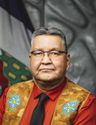
Thank you, Mr. Speaker. Mr. Speaker, the 19th Assembly, when I was elected I brought forward my issues in regards to priorities for my riding.
And what I was told is that put it in the suitcase and try to throw it on the train. I came in through midterm by-election. But, Mr. Speaker, in the 20th Assembly, after we got sworn in I wrote a letter to the Premier on February 13, 2024, outlining the priorities for my riding. And two weeks later, I had received a reply back from the Premier saying that he's going to encourage the Minister to work with me to look at how we could work together on my priorities. And to this day, Mr. Speaker, no Minister has reached out to me to talk about the priorities for traditional use Nedhe-Wiilideh riding. And now we're going to our third year of our mandate. And it's really frustrating because when I look through the budget right now, there's really nothing there, again, for small communities. And I am really, really concerned about that.
But, Mr. Speaker, this is the finance Minister's seventh consecutive budget since she assumed her role at the start of this last Assembly. In this budget, like the rest of her budgets, I haven't seen any real investment in my riding or traditional use Nedhe-Wiilideh.
What I notice, however, is a lot of debt. This Minister has increased our borrowing limit several times. Our debt limit is now projected to reach $2.21 billion. Our budget has ballooned to $2.7 billion now. And what do we get for it? Nothing in my riding.
A lot of public servants, over 1,100 employees added, since her first budget. About a 25 percent increase. Those aren't all doctors and nurses and social workers and teachers. What we have instead are a lot more bureaucrats to ensure that we can make studies, write reports, and develop strategies and business plans. But there are still not enough people to teach our children or keep our health centres open. We debate this every day in this chamber during our legislative session. And yet, for someone who is essentially the Minister of everything, the Minister of Finance rarely addresses the challenges our community faces. Leaving it to her to challenge her colleagues while responsible for their own departments must work with what the Minister of Finance provides. We know we're in a housing crisis.
We know our healthcare services are struggling. With Jordan principal's funding cuts, it's clear education will struggle to provide culturally programs to meet the needs of Indigenous students. And yet, we can't even come together to secure a small amount of funding for offices like Dene Nation to coordinate a community housing proposal to Build Canada Homes.
Since I was elected to the 19th Assembly, I've been keeping detailed lists of my community needs. I compile these lists with community leaders, stakeholders, my constituency, and send them to the Minister every year, only to have them denied. Then, here at budget time, I stand and go through that list, voicing my disappointment while the Minister and her colleagues sit across the chambers busy typing away on their laptops.
This has been a very effective way for me to speak to my constituents by pointing to the practical changes this Assembly can make in the communities I represent. But since that approach hasn't really worked when I speak to this government today, I would like to take a different track. This time, I want to take a step back and make a point in terms of bigger picture and hope that this time my point is carried through in this chamber a little further.
A long time ago, it was this government belief that they should invest in small communities that were struggling to help get people on their feet and their local economies moving, especially during tough times. Well, this isn't that kind of budget. Because my communities are getting nothing, and these hard times aren't due to some uncontrollable economic cycles.
Our communities have been on constant decline because of this government's long-standing inaction. More recently, governments have focused on cutting debts and creating an attractive environment for businesses. This isn't that type of budget either.
We're still waiting for modern regulations. Our debt keeps growing, and the government is still under our treaty. Sorry, our territory is our largest employer.
While other jurisdictions cut royalty rates to foster development, we scare businesses away and end up collecting a grand total of nothing in royalties. So what is this government doing?
It's sinking small communities while giving privileged classes in Yellowknife the biggest slice of shrinking pie. The city isn't an island. My people will keep coming here for services their own communities are losing. The tax base this government relies on will disappear because my people can't get jobs.
Health and social services will keep paying more to treat sicker people, and I fear that all public safety tools we are reaching for will be undermined by growing are not physically sustainable. By the territory this budget is building and the previous budget the finance Minister has tabled, it isn't sustainable either. Not physically sustainable, not economically sustainable, not socially sustainable. It is not sustainable to ignore our rights. It's not sustainable to keep our families in overcrowded homes. It's not sustainable to let our graduation rates drop off a cliff. And it's not sustainable to let our mines close. Taking impact benefit agreements funds with them, with new economic development on the horizon -- with no new economic development on the horizon. They aren't someone else's problem.
The Government of the Northwest Territories may not be a party to the treaties, but they are still having the duty to uphold them. The federal government didn't transfer administration of these services to this government so they could turn around and ask Ottawa to pay for everything.
Back in the day there were some pretty heated debates over establishing a public government for the Northwest Territories, but if anything is harming that idea today is budgets like this. Budgets that march our territory back under the mercy of the federal government.
When our communities aren't self-sufficient, our territory isn't self-sufficient, and it is not our communities who plan to sit around cap in hand waiting for handouts. They're ready for development. Their skills, they're ready for meaningful employment.
They want to own their own homes. It's this government that denies them that opportunity to succeed and then tell them to go to Ottawa for services it is supposed to provide and rights it's supposed to uphold.
So, Mr. Speaker, there is no plan in this budget.
There's no vision. There's no jobs, no education, no improvements to health care, no Indigenous-led housing. This government takes care of itself, consults itself, accommodates itself.
Plain and simple, my communities don't consent to this poor leadership. They want to make their own decisions. They want to create their own destiny. This is what the treaty promises.
I was elected to represent my constituents. I took an oath to uphold our treaties, and I will do so for as long as I have the privilege to sit in this chamber, and that means voting tonight on another bad budget from the Minister. So, Mr. Speaker, I will not be supporting this budget today. Thank you.