Thank you, Mr. Dent. The honourable Premier, Mr. Kakfwi.
Debates of June 7th, 2001
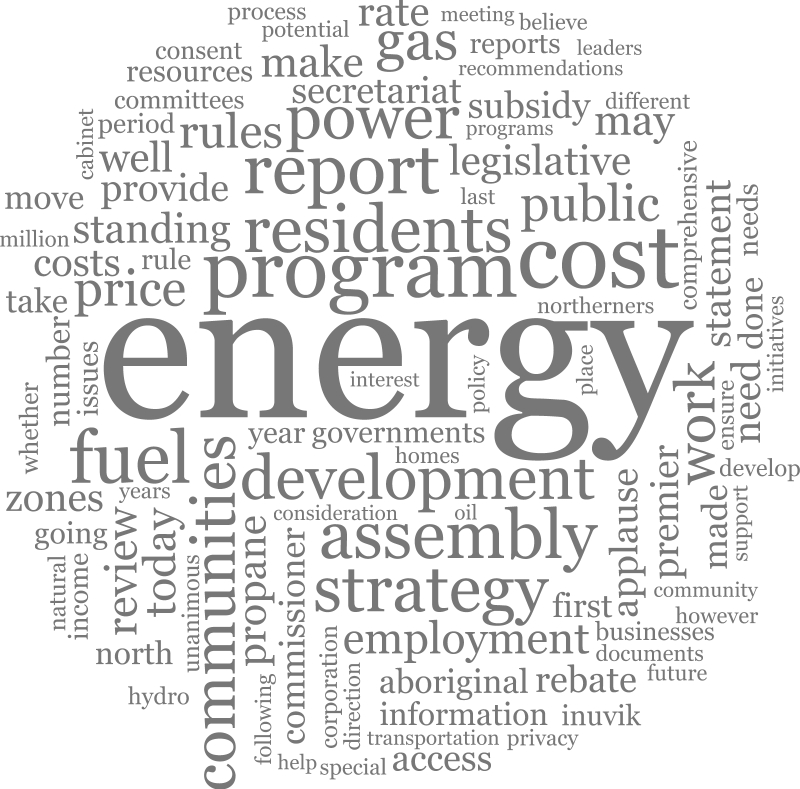
This is page numbers 63 - 89 of the Hansard for the 14th Assembly, 4th Session. The original version can be accessed on the Legislative Assembly's website or by contacting the Legislative Assembly Library. The word of the day was energy.
Topics
Supplementary To Question 32-14(4): Comprehensive Energy Strategy
Question 32-14(4): Comprehensive Energy Strategy
Item 6: Oral Questions
Page 82
Further Return To Question 32-14(4): Comprehensive Energy Strategy
Question 32-14(4): Comprehensive Energy Strategy
Item 6: Oral Questions
Page 82

Stephen Kakfwi Sahtu
Thank you, Mr. Speaker. What I could commit to providing to Members is a fairly good assessment of how much work would be required to engage in a multi-party process, much the same way we did with the Protected Areas Strategy. Using that, how long it would take to develop a draft energy policy. If we can get the secretariat staffed and operational by the end of July, then it may take anywhere from two to four months to get that initial assessment.
So probably if there is a session in the fall. If not, then I would look for providing some report to the Members in writing or reported through the Standing Committee on Accountability and Oversight of what work we have done to date and what we hope to do in the fall. That is the commitment that I can make. Thank you.
Further Return To Question 32-14(4): Comprehensive Energy Strategy
Question 32-14(4): Comprehensive Energy Strategy
Item 6: Oral Questions
Page 82

The Speaker Tony Whitford
Thank you, Mr. Kakfwi. Final supplementary, Mr. Dent. Thank you. The time for question period has ended.
Item 7, written questions. Item 8, returns to written questions. Item 9, replies to the opening address, Item 10, petitions. Item 11, reports of standing and special committees. The Chair recognizes the honourable Member for Yellowknife South, Mr. Bell.
Committee Report 3-14(4): First Report Of The Standing Committee On Rules And Procedures
Item 11: Reports Of Standing And Special Committees
Page 82

Brendan Bell Yellowknife South
Thank you, Mr. Speaker.
On May 11, 2000 the Speaker of the Legislative Assembly referred, by letter, a number of issues to the Standing Committee on Rules and Procedures for consideration. These issues had been brought to the Speaker's attention by Members of the Legislative Assembly.
Specifically, these issues were:
- The perceived need for a mechanism allowing for committees to make statements in the House related to the business of the committee;
- Members' access to confidential internal documents of standing committees of previous Legislative Assemblies;
- The possibility of imposing time limits on Members' questions and Ministers' answers during oral question period in the House; and
- The question of why it must be for an hour's duration when unanimous consent is granted to return to, or extend question period.
In addition to these items, the committee received a referral from the Speaker on October 13, 2000 to consider a process for the Legislative Assembly's consideration of a number of statutory reports that are tabled regularly in the Assembly. This item is designated as "item 5".
This report will address the committee's consideration of each item in turn and conclude with recommendations where appropriate.
Item 1: Committee Statements
Item 11: Reports Of Standing And Special Committees
Page 82
Brendan Bell Yellowknife South
This issue remains under consideration by the committee at this time.
Item 2: Access To Previous Committee Documents
Item 11: Reports Of Standing And Special Committees
Page 82
Brendan Bell Yellowknife South
The committee directed its staff to prepare a brief discussion paper outlining the issues respecting Members' access to the confidential records of committees of previous Assemblies. An examination of legislative authorities and the practices in other jurisdictions was included.
This issue was deferred at the Rules Committee meeting of November 1, 2000 and considered at the committee's meeting of March 1, 2001.
The committee documents referred to do not include committee reports, transcripts of public proceedings, or any other material published under the authority of a standing or special committee of the Legislative Assembly. Access to these materials is not restricted as they form the public record.
In its deliberations, the Rules Committee examined firstly the Rules of the Legislative Assembly, specifically Rule 95(1) which states:
"All documents which come into the possession of a committee or which come into existence in the course of the conduct of committee business belong to that committee before it reports to the Assembly and belong to the Assembly after the committee reports to the Assembly, subject to any direction of the Speaker acting on an order of the Assembly."
Rule 95(2) qualifies the first part of the rule as follows:
"Notwithstanding Rule 95(1), where a committee does not report to the Assembly before dissolution of the Legislature, all committee documents belong to the Assembly upon its dissolution subject to:
(a) any direction of the committee as to their disposal;
(b) any direction by order of the Assembly as to their disposal; or
(c) in the absence of any other direction, the direction of the Speaker.
In the instance which precipitated a Member's raising the question of access to committee documents, the Speaker's direction was sought in the absence of clear direction -- in essence, Rule 95(2)(c) was applied.
However, there are a number of considerations and questions that the committee addressed to clarify the right of access to confidential committee documents from previous Assemblies. In assessing the issues, a number of long-standing parliamentary authorities are consulted.
The application of Rule 95 suggests that all unpublished committee documents from a previous Assembly are the property of the current Assembly. What is not clear however, is what that means for current individual Members or committees. Does this mean that all current Members, including Ministers, have the right of access to all confidential documents from a committee of a former legislature? Should this access be restricted to Members of the respective committees?
It had been suggested that committee work and issues do not end with the dissolution of an Assembly and that there needs to be some continuity in committee information available to the same committee of the next Assembly.
With respect to committee documents, such as in-camera transcripts, or other material which has not been published or reported, Beauchesne's 6th edition offers the following:
c. 851 "When a committee chooses to meet incamera, all matters are confidential. Any departure from strict confidentiality should be by explicit committee decision, which should deal with what matters should be published, in which form and by whom. Committees should make clear decisions about the circulation of draft reports, the disposition of evidence and the publication of their minutes."
In support of this position, yet taking it a step farther, Marleau and Montpetit, on pages 850 and 865 of their House of Commons Procedure and Practice, make the case for clear committee decisions about the destruction of records, suggesting that what is not destroyed will be available to all Members and will form part of the permanent record of the committee, available to the public after a specified period.
"While no public record is produced of what is said during incamera proceedings, committees often find it useful to have a transcript produced for the private consultation of the members and staff of the committee. In addition to deciding whether or not to keep a transcript of an incamera meeting, the committee must also decide how such transcripts will be disposed of at the end of the session (i.e., whether they will be made part of the committee's permanent record for historical purposes, or destroyed)."
"Where concerns about confidentiality exist, a committee may agree to have documents tabled at an in-camera meeting. Transcripts of in-camera meetings and other confidential documents of committees are to be classed as secret records by the National Archives for a period of 30 years from the end of the session in which they were created. The documents remain available to Members of the House during that time."
In consideration of these factors, the Rules Committee concluded that both the Rules of the Legislative Assembly and the parliamentary authorities indicate that in the absence of any committee direction, or House direction after the committee has reported or been dissolved, respecting the disposition of committee records, that they would be made available to all Members upon request. This would include current committees and Members of the Executive Council as no distinction is made in any reference.
It has not been common practice in this jurisdiction for committees to make explicit decisions about the disposition of committee documents in accordance with the rules and conventions. It may be advisable that more attention be paid by standing and special committees of the Legislature to the disposition of documents, particularly confidential materials of a sensitive nature.
Recommendation 1
Item 11: Reports Of Standing And Special Committees
Page 82
Brendan Bell Yellowknife South
The Standing Committee on Rules and Procedures recommends:
That standing and special committees of the Legislative Assembly pay particularly close attention to Rule 95(2) at the time of their reporting to the House on any issue, or prior to the dissolution of the Assembly in which they were constituted.
Item 3: Time Limits On Questions And Answers
Item 11: Reports Of Standing And Special Committees
Page 82
Brendan Bell Yellowknife South
This issue dealt with the possibility of establishing time limits on Members' questions and Ministers' answers during oral questions in an effort to maximize the benefits of an hour-long question period. The committee considered this issue at its meeting of June 6, 2000.
In addressing this issue the committee decided that the implications and complications of timekeeping each question and response would be counterproductive and that requests for unanimous consent to conclude both questions and answers would likely proliferate the Chamber, not to mention take up a considerable amount of time.
It was decided that the present rules and guidelines governing oral questions and question period would suffice, particularly if they are stringently enforced by the Speaker. A letter to this effect was sent to the Speaker by the chair on June 19, 2000, requesting stringent application of the rules and guidelines for oral questions on behalf of all Members.
Item 4: Returning To, Or Extending Oral Question Period
Item 11: Reports Of Standing And Special Committees
Page 82
Brendan Bell Yellowknife South
The committee considered this issue at its meetings of June 6 and November 1, 2000. Specifically, the issue deals with the question raised by a Member as to whether it is possible to "extend" or "return" to oral question period after being granted unanimous consent for a specified time period less than one hour.
In its consideration of this matter, the Rules Committee noted that Rule 38(5) of the Rules of the Legislative Assembly prescribes oral question period to be one hour. However, as in all jurisdictions, any rule may be waived with the unanimous consent of the Members in attendance. Therefore it has become an accepted practice to seek unanimous consent to either "extend" question period before it ends or "return" to question period if it has concluded. In most instances, unanimous consent is sought in the interest of allowing the completion of a Member's, or some Members', lines of questioning. In rare instances it may be related to a matter of some import or urgency, where it may not be in the public interest to wait another day to ask certain questions.
However, upon being granted unanimous consent, the question period clock is reset in both cases for one hour, in accordance with Rule 38(5).
With regard to the possibility of returning to, or extending question period for a shorter duration, the committee agreed that a time limit or a condition cannot be placed on a request for unanimous consent. Setting aside or waiving a rule by the unanimous consent of Members must be unconditional. The rule or procedure is either set aside or "waived", or it is not. There can exist no middle ground, or "qualified waiving" of a rule.
It is therefore the position of the Standing Committee on Rules and Procedures that no change to this provision be contemplated, and that current rules and procedures in this regard continue.
Item 5: Referral Of Statutory Reports
Item 11: Reports Of Standing And Special Committees
Page 82
Brendan Bell Yellowknife South
On October 13, 2000 the Speaker, by letter, charged the Standing Committee on Rules and Procedures with the task of reviewing the process for the Legislative Assembly's consideration of certain statutory reports. The Speaker, in his letter, pointed out that:
"There are a large number of reports tabled in the Legislative Assembly, some of which are required to be tabled by legislation. There are a number of these reports that require no review by the Assembly or a committee, but there are those which have to be reviewed and actioned."
The issue to be addressed by the committee was to recommend a mechanism that would serve to automatically refer specific statutory reports to the appropriate standing committee for review after they have been tabled. Such a mechanism would then preclude the House from having to pass a motion of referral to a standing committee each time a specific report was tabled.
In addition, the timely public review of the Report of the Auditor General on Other Matters arising from their examination of the government's public accounts had been hindered because the report could not be tabled as the House was not sitting at the time. In this particular case, a mechanism was required to allow for the Report of the Auditor General and the government's public accounts to be transmitted to the Standing Committee on Accountability and Oversight for public review prior to tabling in the Assembly.
In initiating its consideration of these issues the committee first identified the following reports as those that required review on an annual basis and should be referred automatically:
- • Annual Report of the Official Languages Commissioner;
- • Annual Report of the Conflict of Interest Commissioner;
- • Annual Report of the Information and Privacy Commissioner; and
- • The Report of the Chief Electoral Officer.
All other reports, annual or otherwise, currently fall under the broad mandates of the current standing committees in accordance with the rules, which state that the committees may "review departmental performance, including that of boards and agencies."
On the matter of statutory reports, the committee agreed that the annual reports of the Languages Commissioner, the Conflict of Interest Commissioner, and the Information and Privacy Commissioner should be referred automatically to the Standing Committee on Accountability and Oversight and that an amendment to the Rules of the Legislative Assembly be proposed to implement this decision.
The committee also agreed that the appropriate committee to be charged with the review of Reports of the Chief Electoral Officer is the Standing Committee on Rules and Procedures, and that a further amendment to the rules be proposed to implement this decision.
On the matter of Auditor General's Report and the GNWT Public Accounts, the Rules Committee agreed to propose an amendment to the rules to allow the Speaker and the Minister of Finance to transmit the Auditor General's Report and the GNWT Public Accounts respectively, to the Standing Committee on Accountability and Oversight when the Legislature is not in session. This will allow for public review prior to tabling in the House.
Recommendation 2
Item 11: Reports Of Standing And Special Committees
June 6th, 2001
Page 82
Brendan Bell Yellowknife South
Therefore, the Standing Committee on Rules and Procedures recommends:
That the Rules of the Legislative Assembly be amended to specify that, when the Assembly is not in session, the Speaker and the Minister of Finance may provide the Auditor General's Report and the Public Accounts to the Standing Committee on Accountability and Oversight for public review in advance of tabling in the House;
And further, that the rules be amended to specify that the Standing Committee on Accountability and Oversight shall review the annual and other reports of the Commissioner of Official Languages, the Conflict of Interest Commissioner, and the Information and Privacy Commissioner;
And furthermore, that the rules be amended to specify that the Standing Committee on Rules and Procedures shall review the reports of the Chief Electoral Officer on the conduct of elections, plebiscites, or votes conducted in the Northwest Territories in accordance with statute.
Committee Update
The Standing Committee on Rules and Procedures is currently seeking input by way of written submissions on the Report of the Chief Electoral Officer on the Conduct of the 1999 General Election. Copies of the report can be obtained from the Legislative Library or on the Elections NWT website at www.electionsnwt.com.
The standing committee will conduct a public meeting with the Chief Electoral Officer on Tuesday, October 9, 2001 to review the report and any written submissions or comments we receive from northern residents. The committee will then report its findings and recommendations to the House during the fall sitting.
Mr. Speaker, that concludes the report of the Standing Committee on Rules and Procedures.
I MOVE, seconded by the honourable Member for Thebacha, that Committee Report 3-14(4) be received by the Assembly and adopted. Thank you, Mr. Speaker.
Recommendation 2
Item 11: Reports Of Standing And Special Committees
Page 85
The Speaker Tony Whitford
Thank you, Mr. Bell. There is a motion on the floor. The motion is in order. To the motion. Question has been called. All those in favour? Thank you. All those opposed? The motion is carried. Committee Report 3-14(4) is received and adopted. Item 11, reports of standing and special committees. Item 12, reports of committees on the review of bills. Item 13, tabling of documents. The honourable Member for Yellowknife South, Mr. Bell.
Tabled Document 9-14(4): May 10, 2001 Deh Cho Drum Newspaper Article Entitled "mlas Told Power Belongs In Regions"
Item 13: Tabling Of Documents
Page 85
Brendan Bell Yellowknife South
Thank you, Mr. Speaker. I would like to table an article published in the Deh Cho Drum on Thursday, May 10, 2001, in relation to highway tolls. I should indicate that the highlighting is mine. I have highlighted a quote of Mr. Handley's saying, "the net should be no increase for average citizens in the North." Thank you.
Tabled Document 9-14(4): May 10, 2001 Deh Cho Drum Newspaper Article Entitled "mlas Told Power Belongs In Regions"
Item 13: Tabling Of Documents
Page 85
The Speaker Tony Whitford
Thank you, Mr. Bell. Item 13, tabling of documents. Item 14, notices of motion. The honourable Member for Thebacha, Mr. Miltenberger.
Motion 1-14(4): Appointment Of Sole Adjudicators
Item 14: Notices Of Motion
Page 85

Michael Miltenberger Thebacha
Thank you, Mr. Speaker. I give notice that on Monday, June 11, 2001, I will move the following motion.
Now therefore I move, seconded by the honourable Member for Weledeh, that in accordance with section 103 of the Legislative Assembly and Executive Council Act, the Legislative Assembly approves the following for appointment as Sole Adjudicators:
- • Claude Bisson -- Jurisconsult of the National Assembly, Quebec
- • Robert C. Clark -- Ethics Commissioner, Alberta
- • Hon. Gregory Evans, Q.C. -- Integrity Commissioner, Ontario
- • Gerald L. Gerrand, Q.C. -- Conflict of Interest Commissioner, Saskatchewan
- • Wayne Green -- Commissioner of Members' Interests, Newfoundland and Labrador
- • Hon. Ted Hughes -- Commissioner of Conflict of Interest, Yukon
- • Hon. H.A.D. Oliver, Q.C. -- Commissioner of Conflict of Interest, British Columbia
- • Hon. Robert Stanbury, Q.C. -- Conflict of Interest Commissioner, Nunavut
Thank you, Mr. Speaker.
Motion 1-14(4): Appointment Of Sole Adjudicators
Item 14: Notices Of Motion
Page 85
The Speaker Tony Whitford
Thank you, Mr. Miltenberger. Item 14, notices of motion. The honourable Member for Hay River North, Mr. Delorey.
Motion 2-14(4): Affordable Access To Energy
Item 14: Notices Of Motion
Page 85
Paul Delorey Hay River North
Thank you, Mr. Speaker. Mr. Speaker, I give notice that on Monday, June 11, 2001, I will move the following motion:
Now therefore I move, seconded by the honourable Member for Deh Cho, that the Premier and Cabinet bring forward a comprehensive energy assistance program that will serve to offset the high cost of energy to all northern residents regardless of income.
And further, that the benefits from this program be received by Northerners by October 31, 2001.
And furthermore, that the Premier and Cabinet bring forward a comprehensive energy strategy for the Northwest Territories that includes the development of alternative energy initiatives such as residual heat recovery programs, and encourages and promotes energy conservation.
And furthermore, that the energy strategy include a stabilization fund to benefit northern residents and businesses.
At the appropriate time, I will seek unanimous consent to deal with this motion today, Mr. Speaker.
Motion 2-14(4): Affordable Access To Energy
Item 14: Notices Of Motion
Page 86
The Speaker Tony Whitford
Thank you, Mr. Delorey. Item 14, notices of motion. The honourable Member for Yellowknife South, Mr. Bell.
Motion 3-14(4): Amendments To The Rules Of The Legislative Assembly To Facilitate Referral Of Statutory Reports
Item 14: Notices Of Motion
Page 86
Brendan Bell Yellowknife South
Thank you, Mr. Speaker. Mr. Speaker, I give notice that on Monday, June 11th, 2001, I will move the following motion.
Now therefore I move, seconded by the honourable Member for Weledeh, that Rule 85(2)d of the Rules of the Legislative Assembly be amended by adding after "Auditor General";
(i) in the event that the Assembly is not in Session, the Speaker may provide the Auditor General's Report and the Minister of Finance may provide the Public Accounts to the committee for review, which may include public hearings, in advance of tabling.
And further, that new Rule 85(2)(f) be added as follows:
85(2)(f) Review, as necessary or appropriate, the annual and other Reports of Statutory Officers of the Legislative Assembly, including the Commissioner of Official Languages, Conflict of Interest Commissioner and the Information and Privacy Commissioner;
And furthermore, that Rule 85(2)(f) be renumbered as 85(2)(g) and Rule 85(2)(g) be renumbered as 85(2)(h);
And furthermore, that Rule 85(4) be rescinded and the following be adopted:
85(4)The Standing Committee on Rules and Procedures shall:
(a) Review the reports of the Chief Electoral Officer on the conduct of elections, plebiscites or votes conducted in the Northwest Territories in accordance with statute; and
(b) Inquire into such matters as may be referred to it by the Legislative Assembly, the Speaker or the Board of Management.
Thank you, Mr. Speaker.
Motion 3-14(4): Amendments To The Rules Of The Legislative Assembly To Facilitate Referral Of Statutory Reports
Item 14: Notices Of Motion
Page 86
The Speaker Tony Whitford
Thank you, Mr. Bell. Item 14, notices of motion. Item 15, notices of motion for first reading of bills. Item 16, motions. The Chair recognizes the honourable Member for Hay River North, Mr. Delorey.
Motion 3-14(4): Amendments To The Rules Of The Legislative Assembly To Facilitate Referral Of Statutory Reports
Item 14: Notices Of Motion
Page 86
Paul Delorey Hay River North
Thank you, Mr. Speaker. Mr. Speaker, I seek unanimous consent to deal with the motion I gave notice of earlier today.
Motion 3-14(4): Amendments To The Rules Of The Legislative Assembly To Facilitate Referral Of Statutory Reports
Item 14: Notices Of Motion
Page 86
The Speaker Tony Whitford
Thank you. The honourable Member is seeking unanimous consent to deal with his motion. Are there any nays?
Motion 3-14(4): Amendments To The Rules Of The Legislative Assembly To Facilitate Referral Of Statutory Reports
Item 14: Notices Of Motion
Page 86
An Hon. Member
Nay.
Motion 3-14(4): Amendments To The Rules Of The Legislative Assembly To Facilitate Referral Of Statutory Reports
Item 14: Notices Of Motion
Page 86
The Speaker Tony Whitford
There has been a nay. You do not have unanimous consent. Item 16, motions. Item 17, first reading of bills. Item 18, second reading of bills. Item 19, consideration in committee of the whole of bills and other matters. The Chair recognizes the honourable Member for Weledeh, Mr. Handley.
Motion 3-14(4): Amendments To The Rules Of The Legislative Assembly To Facilitate Referral Of Statutory Reports
Item 14: Notices Of Motion
Page 86