Thank you, Mr. Antoine. Item 3, Members' statements. The honourable Member for Great Slave, Mr. Braden.
Debates of June 7th, 2001
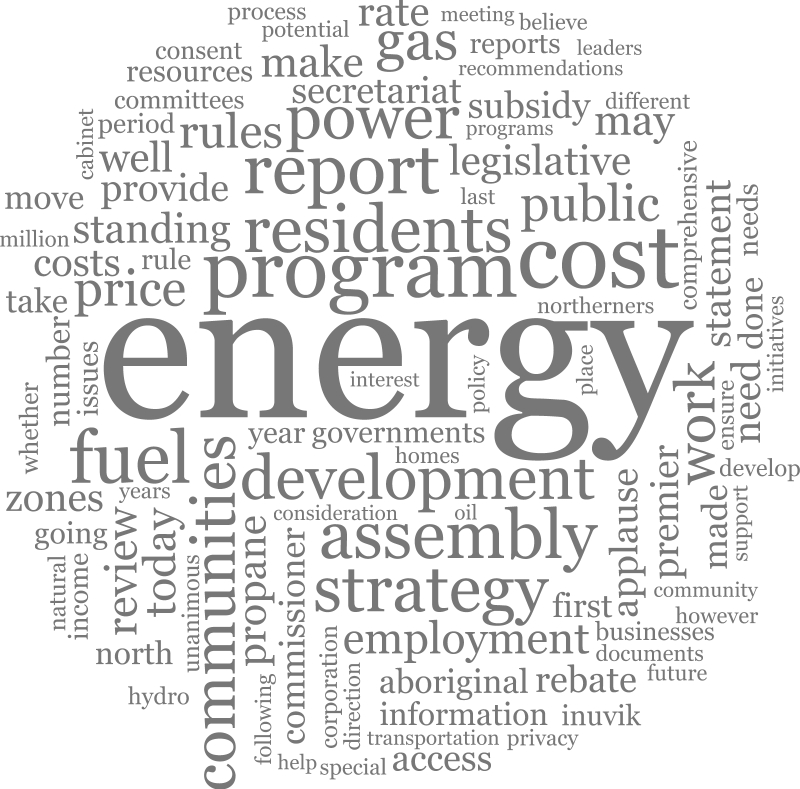
This is page numbers 63 - 89 of the Hansard for the 14th Assembly, 4th Session. The original version can be accessed on the Legislative Assembly's website or by contacting the Legislative Assembly Library. The word of the day was energy.
Topics
Minister's Statement 11-14(4): Second Intergovernmental Forum
Item 2: Ministers' Statements
Page 66
Energy Subsidy Programs
Item 3: Members' Statements
Page 66

Bill Braden Great Slave
Thank you, Mr. Speaker. On the heels of Mr. Handley's message today and the Premier's a couple days ago, as well as a number of other messages, we are very much an energized Assembly these days, and that is indeed the topic of my statement.
On Tuesday, Mr. Speaker, the Premier's Sessional Statement acknowledged that while the increased demand for energy in North America has resulted in increased employment here in the Northwest Territories, it has also resulted in increased energy costs here at home. Mr. Speaker, this is the crux of my problem.
How do we balance the rewards we stand to gain in jobs and wealth against the cost of energy to the average northern consumer? Mr. Speaker, the 1998 household survey showed that the average Yellowknife household paid $3,000 to meet their utility costs. The average Canadian household only paid $1,521 to meet their energy needs. All of the jobs in the world, Mr. Speaker, will not help if the cost of energy is so prohibitive that Northerners cannot afford to keep their homes, businesses and vehicles running comfortably with reliable, affordable fuel and electricity.
The Premier also outlined his plan to form the Energy Secretariat to develop and present an energy strategy to Cabinet within one year. This is a positive step. I have been advocating a coordinated approach to how energy is developed and managed in the Northwest Territories since I was elected in 1999.
The Premier also stated "Energy development must result in clean, affordable and accessible energy to our residents, our people." The key word here, Mr. Speaker, is affordability. I would certainly expect that the Northwest Territories energy strategy would also look at the issue of long-term stability in the supply and cost of energy to Northerners. It is our gas, our oil and our hydroelectricity.
Mr. Speaker, we have a major responsibility to manage this energy with a "Northerners first" strategic direction. I will be following up on this with the Premier during question period. Thank you, Mr. Speaker.
-- Applause
Energy Subsidy Programs
Item 3: Members' Statements
Page 67
The Speaker Tony Whitford
Thank you, Mr. Braden. Item 3, Members' statements. The honourable Member for Tu Nedhe, Mr. Nitah.
Relief From Rising Energy Costs
Item 3: Members' Statements
June 6th, 2001
Page 67
Steven Nitah Tu Nedhe
Thank you, Mr. Speaker. Mr. Speaker, the wallets of all the Northwest Territories residents have been hit hard by the rising cost of energy. Over the past year, we have watched as the cost of heating fuel for our homes goes up over 30 percent. The price of gasoline for our vehicles, snowmobiles and boats has skyrocketed as well. The cost for transporting food, clothing and other items into our communities has increased. The cost of a family to travel by airplane, or by other means of transportation from our communities, has become unaffordable.
Mr. Speaker, these high costs of living do not discriminate. It is affecting all residents of the Northwest Territories equally. It is time for something to be done to get relief to the citizens of the Northwest Territories, Mr. Speaker. Presently, the GNWT has a hodgepodge of subsidy programs in place to give some relief to Northerners. However, given the drastic increase in costs of energy over the past year, the subsidy programs have not kept pace with the soaring energy costs.
The low-income people have been hit the hardest. Rising costs have driven more and more families into poverty. Mr. Speaker, the government needs to take immediate action and develop a comprehensive energy program to supply relief to our residents. This program should not focus on just heating fuel. It should address the high cost of transportation of goods and tackle the costs for a family to travel to and from communities. Mr. Speaker, the program should deal with the cost of gasoline.
Mr. Speaker, I am convinced that this program should be a rebate program, a rebate that is given directly to the consumer. The money should go into the pockets of all of our residents. If the program is set up in such a way that the rebate or subsidy is given to a supplier, I am not so confident that benefits will flow down to the consumer. The money would just remain in the pockets of the supplier. Further, we should have a program where there is no clawback.
Mr. Speaker, I seek unanimous consent to conclude my statement.
Relief From Rising Energy Costs
Item 3: Members' Statements
Page 67
The Speaker Tony Whitford
Thank you, Mr. Nitah. The honourable Member is seeking unanimous consent to conclude his statement. Are there any nays? There are no nays. The Member should just wait until the time has expired. Mr. Nitah.
Relief From Rising Energy Costs
Item 3: Members' Statements
Page 67
Steven Nitah Tu Nedhe
Mahsi, Mr. Speaker. Mr. Speaker, there should be a second part to the energy program that assists residents in reducing their energy consumption. Many low-income earners live in housing that is not energy-efficient. Being low-income earners, they do not have the disposable money to make improvements to their homes to reduce energy costs. They do not have the money to buy energy-efficient appliances. They do not have the money to improve insulation to reduce heat loss. They do not have the money to change from one type of heat to another, should that type of heating be more cost-effective.
Mr. Speaker, we desperately need a program that assists our residents in reducing their energy consumption and costs.
In summary, Mr. Speaker, we need an energy assistance program that is twofold in nature. We need to give a rebate to the residents. A rebate will lessen the impacts of cost of energy in the Northwest Territories. We also need to assist residents in reducing their energy consumption. We need to do this soon, Mr. Speaker, our people are hurting. Mahsi cho.
-- Applause
Relief From Rising Energy Costs
Item 3: Members' Statements
Page 67
The Speaker Tony Whitford
Mahsi, Mr. Nitah. Item 3, Members' statements. The honourable Member for Thebacha, Mr. Miltenberger.
Key Components Of An Energy Strategy
Item 3: Members' Statements
Page 67

Michael Miltenberger Thebacha
Thank you, Mr. Speaker. I as well would like to speak on the issue of energy, specifically the energy strategy, a strategy whose time has come and is, in fact, overdue.
Mr. Speaker, I do not think the people of the Northwest Territories realize the hundreds of millions of dollars that are spent and put towards the provision of energy in all its forms. What we have developed is a fragmented service system, supply system of power, fuel, natural gas, wood, oil, electricity, all scattered all over under different legislation and different authorities.
Mr. Speaker, it is time to bring the whole issue of energy under one strategy and to look at the very many component parts of what we need for an effective energy strategy.
Mr. Speaker, we have to address issues like import replacement, as we are burdened almost daily with price increases on imported, expensive carbon-based fuels. We have to look at all energy sources, hydro, fuel, solar, wind, hydrogen and any other viable alternative source. We have to look at our supply and distribution systems and programs that we have and how we are going to make them more efficient and effective and link them.
We have to come up with a way to stabilize prices for energy so that our constituents are not burdened and beggared by the sheer cost of this particular form of energy.
We have to look at the regulations and the regulatory regime. We have hydro rate zones. We have fuel price regimes. We have to look at coordinating those and integrating those in an effective, careful way to provide the necessary checks and balances.
We have to address issues of the environment, the Kyoto Accord, greenhouse gas emissions. We cannot forget that very critical factor as we seek to preserve that very important part of northern heritage.
Mr. Speaker, I would hope that this panel and secretariat the Premier is setting up will have and be led by those with northern expertise, of which there are some in the North that I am aware of. There has to be a commitment to consultation, Mr. Speaker, so that people can have an idea of what we are buying into. The plan has to be comprehensive and long-term enough so that it will take us into the 21st century in a careful, measured way to bring together all these very many threads of what is necessary for an effective energy strategy. Thank you, Mr. Speaker.
-- Applause
Key Components Of An Energy Strategy
Item 3: Members' Statements
Page 68
The Speaker Tony Whitford
Thank you, Mr. Miltenberger. Item 3, Members' statements. The honourable Member for North Slave, Mr. Lafferty.
Energy Issues In Small Communities
Item 3: Members' Statements
Page 68
Leon Lafferty North Slave
Thank you, Mr. Speaker. Mr. Speaker, I have heard the Premier speak of the development of an energy strategy and the formation of an Energy Secretariat.
Whenever I hear the word strategy, or hear about new branches of the bureaucracy, I have to wonder whether there will be any benefit to the people that I represent in the North Slave.
The people in the communities try and do their part to save energy. They would like to be able to use the power of the sun and the wind to dry their clothes. Unfortunately, Mr. Speaker, this simple action is often contaminated by the diesel fumes and exhaust from generators located in the centre of most communities.
As well as tainting clothes, I have no doubt that these diesel fumes and exhaust also affect the health of elders and youth. We also watch new mines open, and there is little doubt that we need economic activity. However, as we open our Territory to development, I think we can do things to ensure that we do not add to the greenhouse gases already being produced by our dependence on fossil fuels.
Greenhouse gases lead to climate change; climate change affects all areas of life and could mean that the caribou may change their migration patterns. It is a vicious cycle, Mr. Speaker, one that can have serious implications on the lives of the people I represent.
Any energy strategy developed by the government must take into account the needs of people who do not live on the highway system who do not have access to clean, cheap hydro power and who depend on the land to sustain them.
All of the government studies I have seen so far have excluded my region. The studies are short-sighted and they do not show departments working together. Cabinet votes as a block. They should work as a block to establish infrastructure and develop long-range plans to meet the needs of all residents equally and fairly. Thank you, Mr. Speaker.
-- Applause
Energy Issues In Small Communities
Item 3: Members' Statements
Page 68
The Speaker Tony Whitford
Thank you, Mr. Lafferty. Item 3, Members' statements. The honourable Member for Deh Cho, Mr. McLeod.
Seniors' Fuel Subsidy Program
Item 3: Members' Statements
Page 68

Michael McLeod Deh Cho
Thank you, Mr. Speaker. Mr. Speaker, in keeping with today's theme of energy costs to Northerners, I would like to address the needs of our elders. The Minister of Education, Culture and Employment, in response to my colleague for Great Slave, indicated he hoped to be making a statement on changes to the Income Support Program.
I hope, Mr. Speaker, that the Minister will be addressing a seniors' fuel subsidy as part of the changes to the Income Support Program.
Seniors' Fuel Subsidy Program
Item 3: Members' Statements
Page 68
Some Hon. Members
Hear, hear.
Seniors' Fuel Subsidy Program
Item 3: Members' Statements
Page 68
Michael McLeod Deh Cho
We are all aware that the vast majority of our seniors live on a fixed income. Some are lucky and have indexed pensions from working for the government. Others do not. Whatever the seniors' situation, I can tell you, Mr. Speaker, that their purchasing power has not kept pace with their cost. My problem with the way the seniors' fuel subsidy works is its eligibility requirements. To be eligible, you must have an income of a set amount. For the communities I represent, the figure is set at $31,000 per household per year. If you make more than that, you do not qualify for the fuel subsidy.
The seniors' fuel subsidy is a great program, but the requirements have not been adjusted lately and consequently, have not kept pace with inflation. Mr. Speaker, this means that there are senior households grossing $31,000 in income that are facing crippling price increases in the cost of energy. The cost of heating fuel has increased by over 50 percent. The cost of electricity will be going up in the near future.
I challenge the Minister to explain how a man and wife can maintain a house, meet the rising costs of energy and put food on the table on a pre-tax income of $31,000. I suggest, Mr. Speaker, that for a couple, a figure of $50,000 in pre-tax income would be more appropriate as a minimum access threshold to the fuel subsidy.
It is time, Mr. Speaker, to evaluate the seniors' fuel subsidy to make sure it is meeting the needs of our elders to make sure that there are no seniors who are being forced into poverty because of decreases in their purchasing power. I will be following up on the Minister on this important matter during question period. Thank you, Mr. Speaker.
-- Applause
Seniors' Fuel Subsidy Program
Item 3: Members' Statements
Page 69
The Speaker Tony Whitford
Thank you, Mr. McLeod. Item 3, Members' statements. The honourable Member for Yellowknife South, Mr. Bell.
Impacts Of Rising Fuel Costs
Item 3: Members' Statements
Page 69

Brendan Bell Yellowknife South
Thank you, Mr. Speaker. The rising cost of energy is having an adverse impact on the people of the Northwest Territories. Stats Canada produces information on the cost of living in the publication, The Consumer Price Index. According to this, the cost of heating fuel went from 32 and a half cents per litre in March, 1999, to 52.3 cents per litre in March, 2001, in Yellowknife. Mr. Speaker, this is an increase of 19.8 cents per litre, or 61 percent over two years.
Over that same period, the cost of gasoline went from 69.9 cents to 87.5 cents, an increase of 17.6 cents per litre, or 25 percent.
Mr. Speaker, there have also been drastic increases in the price of propane. In January 2000, the plant price for propane in Edmonton was $130.98 per cubic metre. In January of this year, the price had increased over two-and-a-half times.
While increases in the price of fuel have had an affect on our southern neighbours, the impact is even greater in the Northwest Territories. We have longer winters, less daylight and require our staples to be transported greater distances, Mr. Speaker.
The cost to run our vehicles has increased and has become a burden for some families. As well, the cost of air travel has become out of reach for an increasing number of our citizens. Compounding these costs will be the cost to travel on NWT highways coming from the user toll on commercial trucking proposed by the Minister of Finance.
Mr. Speaker, the fuel rebate this spring was a good start, but it disqualified too many people. The Minister thinks that the price of oil is on its way down, and as he said yesterday "It is predicted to go down even lower", so he is not looking at a rebate at this time.
However, I wish he would have told the Power Corporation this, Mr. Speaker. They have submitted a general rate application asking to raise the cost of power to our homes by $20 to $25 a household on average, due in large part to the cost of fuel going forward. Other experts are also predicting higher fuel prices.
Mr. Speaker, it is time to start talking about another fuel rebate, but this time, let us do it right. Base it on usage. Do not discriminate on income. Find some relief for small business. Mr. Speaker, let us start discussions about another fuel rebate. Thank you.
-- Applause
Impacts Of Rising Fuel Costs
Item 3: Members' Statements
Page 69
The Speaker Tony Whitford
Thank you, Mr. Bell. Item 3, Members' statements. The honourable Member for Hay River North, Mr. Delorey.
Hay River Propane Costs
Item 3: Members' Statements
Page 69
Paul Delorey Hay River North
Thank you, Mr. Speaker. The rising price of propane is severely impacting my constituents and my community of Hay River. Many businesses and residents in Hay River converted to propane several years ago, at a time when the price of propane was advantageous. At the time, propane was not only abundant, reliable and cleaner than other fossil fuels, but it was also affordable.
Mr. Speaker, using Edmonton as a benchmark, the plant price for propane per cubic metre was $130 in January 2000. This January, however, that same cubic metre of propane was $346, an increase of 266 percent over one year. The price of propane is continuing to increase.
This price spike is accompanied by similar increases in other forms of fuel. It now costs more to drive our vehicles, heat our homes or businesses, ship our goods and deliver services.
This government has introduced subsidies for diesel fuel, for power and other fossil fuels, but not all rebate subsidies or other forms of relief have been adopted or considered for small businesses or residential users that rely on propane. The high cost of propane has a significant adverse impact on businesses and residents in my constituency in Hay River and in the North.
Mr. Speaker, it could be said that Hay River has a great advantage over other communities in the North when it comes to propane due to the fact that most of the town is connected by means of an underground piping system. I agree. We look forward to the day when we can access natural gas in our area. The conversion would be quite easy. This may help down the road in the future, Mr. Speaker, but at present, there is no indication that is about to take place in the near future.
Mr. Speaker, at the appropriate time today, I will ask the Minister responsible regarding subsidies for propane users in the Northwest Territories. Thank you, Mr. Speaker.
-- Applause
Hay River Propane Costs
Item 3: Members' Statements
Page 69
The Speaker Tony Whitford
Thank you, Mr. Delorey. Item 3, Members' statements. The honourable Member for Inuvik Boot Lake, Mr. Roland.
High Cost Of Living In Small And Remote Communities
Item 3: Members' Statements
Page 69

Floyd Roland Inuvik Boot Lake
Thank you, Mr. Speaker. Living in small and remote communities within the Northwest Territories is a unique experience. It is becoming even more of a unique experience as we watch the cost of living rise, far outstripping increases in income. Over the last two years, there has been a drastic increase in the cost of fuels used to heat our homes, run our vehicles and supply electricity.
We have heard from my colleague for Yellowknife South that through the Consumer Price Index, he has learned that the cost of heating fuel in Yellowknife increased by 61 percent over two years. Gasoline increased by 25 percent and propane increased by over two and a half times.
Whatever the effects of rising costs of energy are in the large centres, Mr. Speaker, the effects on remote and smaller communities are even more adverse.
The NWT Bureau of Statistics uses the term 'living cost differential' to give an idea of the cost of living in northern communities as compared to the city of Edmonton. Mr. Speaker, the city of Edmonton is given the base number of 100. For 1997, the living cost differential for Inuvik was 155 to 160. This can be simplified to indicate that what costs $100 in Edmonton costs $155 to $160 in Inuvik. An example, auto fuel price in Inuvik is $1.04 per litre, and that was just before travelling down here to Yellowknife, Mr. Speaker, when I had the opportunity of filling up my vehicle.
Further, the more remote the community is, the greater the cost of living is. For example, the living cost differential for Colville Lake was $210, Holman was $175 and Paulatuk and Sachs Harbour both came in at $180. The highest cost of living differentials in the Fort Smith region were Lutselk'e and Rae Lakes at $150. Looking at larger centres, we find Yellowknife was $120, Hay River was $125, and Fort Smith $130.
Mr. Speaker, the general trend is that the smaller and more remote communities, the higher the cost of living. What further compounds the situation is that using... Mr. Speaker, I seek unanimous consent to conclude my statement.
High Cost Of Living In Small And Remote Communities
Item 3: Members' Statements
Page 70
The Speaker Tony Whitford
The honourable Member is seeking unanimous consent to conclude his statement. Are there any nays? There are no nays, Mr. Roland, you may conclude your statement.
High Cost Of Living In Small And Remote Communities
Item 3: Members' Statements
Page 70
Floyd Roland Inuvik Boot Lake
What further compounds the situation is that using information collected by the NWT for 1997, we find that the average income for the smaller isolated communities overall is lower than the average income in the larger centres. When we look at this in relation to the increase in fuel costs, the people in remote communities like Inuvik and smaller communities are going to be hit harder. It will cost more to heat our homes, drive our vehicles and obtain goods and services, and all this with less income to cover these higher costs.
Mr. Speaker, this disparity must be addressed when we deal with subsidies and rebates. I will pursue this later in question period. Thank you.
-- Applause
High Cost Of Living In Small And Remote Communities
Item 3: Members' Statements
Page 70
The Speaker Tony Whitford
Thank you, Mr. Roland. Item 3, Members' statements. The honourable Member for Frame Lake, Mr. Dent.
Realizing Benefits From Energy Resource Development
Item 3: Members' Statements
Page 70

Charles Dent Frame Lake
Thank you, Mr. Speaker. Presently, there is great excitement in the Northwest Territories. We have tremendous potential for new revenue to be generated from the development and transport of northern hydroelectricity and oil and gas to southern markets. We see a future where we move from being dependent upon funding from the Government of Canada to independence and a future where Northerners control our lands and resources.
Mr. Speaker, Minister Handley spoke eloquently earlier today about the potential economic benefits and the number of jobs on the horizon in the Northwest Territories. Mr. Speaker, hand in hand with independence goes responsibility -- a responsibility to ensure that the people of the Northwest Territories benefit from the development of our resources.
Today we are focusing on energy and continuing along this line, it is only reasonable that the people of the Northwest Territories benefit directly from the development of our energy reserves. People of the North should pay lower rates for energy resources that are produced in the North.
Mr. Speaker, the Government of the Northwest Territories will never be able to control the North American price for heating oil, gasoline, electricity, oil or natural gas. However, Mr. Speaker, we can use the development of our resources to make the lives of northern people better. Through an energy strategy, we can ensure that the development of our energy resources will result in a reduced price for these commodities for our people.
Further, Mr. Speaker, most good things come to an end. This is also applicable to non-renewable resources. There will be a time when our oil and gas supplies will run out, and our energy strategy must also plan for this eventuality.
We must also be careful that as we help to keep prices low for essential energy, we are not encouraging the overuse of our resources. There needs to be a balanced approach that recognizes how important it is to our northern environment that we look for alternative forms of energy for our residents. I was pleased to hear Minister Handley talk about this in his statement earlier today.
Throughout the North, elders are raising alarm over the visible signs of global warming and the affect that greenhouse gases are having on the Northwest Territories. Yet even though Minister Handley spoke of the need to protect the environment today, we have done little as a government to encourage reduced production of greenhouse gases. We do not have an energy strategy yet that sets out this as the direction in which we want to head.
Mr. Speaker, we need an energy strategy that will allow our residents to benefit from the reduced costs of energy that originates in the North, whether it be directly through rebate or through a rate stabilization fund.
Mr. Speaker, I seek unanimous consent to conclude my statement.
Realizing Benefits From Energy Resource Development
Item 3: Members' Statements
Page 70
The Speaker Tony Whitford
Thank you. The honourable Member is seeking unanimous consent to conclude his statement. Are there any nays? There are no nays, Mr. Dent, you may conclude.