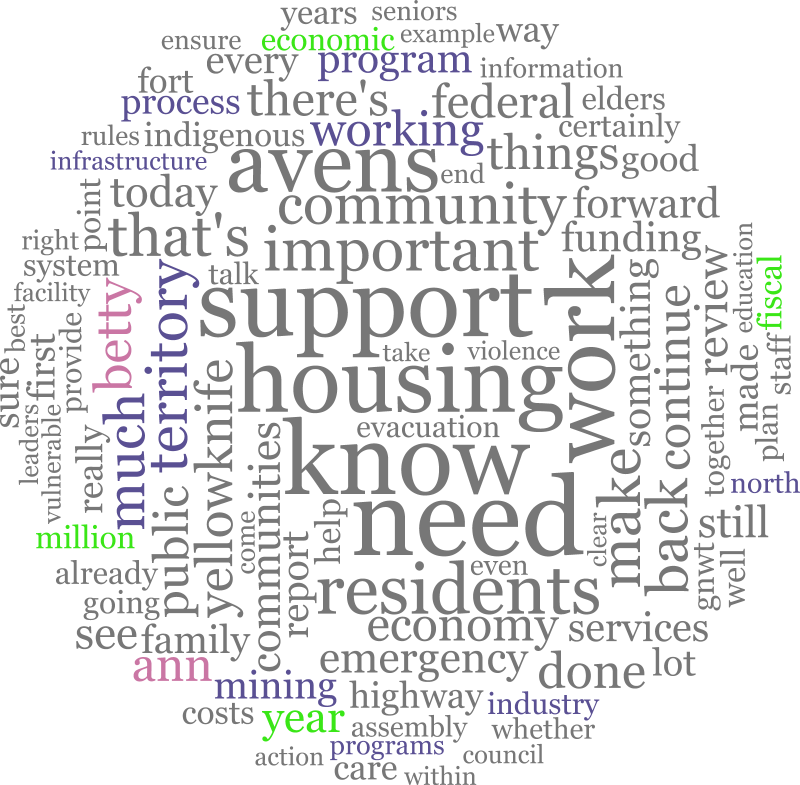
This is page numbers of the Hansard for the 20th Assembly, 1st Session. The original version can be accessed on the Legislative Assembly's website or by contacting the Legislative Assembly Library. The word of the day was need.

Topics

Member's Statement 717-20(1): Negotiation of Akaitcho Final Agreement
Members' Statements

Richard Edjericon

Richard Edjericon Tu Nedhe-Wiilideh

Mr. Speaker, in the face of global uncertainty, the federal government has embraced a one-Canada approach, encouraging provinces and territories to work together in the national interest to build a stronger and more resilient economy where security is built on cooperation and shared prosperity. Canada is a country of many distinct and diverse nations where cooperation is key to success, and the same is true about our own territory. For us to be at our best, we must first ensure that we are united and working together; however, I fear our efforts to build the unity we need for our territory to grow and prosper remains overshadowed by the lack of resolution on the Akaitcho land claim and self-government agreement. The absence of this final agreement is not only denying my constituents the recognition and rights they deserve but also holding back the economic progress of our entire territory. Without this agreement, we face uncertainty around land access, long-term development, and investment. And let me be clear, it is not the Akaitcho or their leaders standing in the way of prosperity. They have been at the negotiating table for years, working to find a fair and just realization of our treaty. What my people feel in holding this process back is the lack of urgency and vision from the government to finalize this crucial process.

As this crucial moment for our territory's economic future, our government must recognize that long-term sustainability of economic growth can only be built on the foundation of reconciliation and respect for my communities. That foundation starts with finalizing the agreement. My constituents have waited for 125 years. They shouldn't have to wait for another 100 years. I have questions for the Premier on this issue at the appropriate time. Thank you, Mr. Speaker.

Member's Statement 717-20(1): Negotiation of Akaitcho Final Agreement
Members' Statements

The Speaker

The Speaker Shane Thompson

Thank you, Member from Tu Nedhe-Wiilideh. Members' statements. Member from Frame Lake.

Member's Statement 718-20(1): Yellowknife Encampment
Members' Statements

October 17th, 2025

Julian Morse

Julian Morse Frame Lake

Thank you, Mr. Speaker. Mr. Speaker, this spring, an encampment was established in Yellowknife's downtown which caused a significant amount of public concern. It was quickly apparent we were right back where we left off last fall, and the situation was just as untenable this time. However, this year, something changed.

Peter Adourian, a lawyer representing residents of the encampment, approached the GNWT to see if they could work together to identify a better solution. This quickly resulted in an orderly dismantling of the encampment and moving it to a mutually agreed-upon location which was much better suited to the residents of the encampment and the community.

It was an incredibly effective approach, and I think it provides an important lesson for government in how we approach solutions to homelessness. This summer, I took the opportunity to meet with some of the residents of the encampment. Interestingly, the young men I spoke with were previously housed but faced eviction for various reasons. When asked why they chose to camp instead of accessing shelters, they noted that the shelters don't feel like a safe place to be. They're sleeping on mats in a large room or a hallway. They don't have somewhere to keep their things. It's just not a solution that works for them.

In putting myself in their shoes, Mr. Speaker, I can't blame them. I wouldn't feel comfortable sleeping in a shelter. Would you want to sleep on one of those floors? Would you want your children to? Shelters are an important short-term solution, but they are not housing and they are not a viable alternative to encampments.

Something else stood out to me when visiting this encampment. Rather than coming to anyone for government handouts, these folks took the situation into their own hands. It was clear that it was important to them to have agency over their housing. While the encampment itself may not be an end goal, the residents of the encampment are demonstrating exactly the kind of independence we work so hard to foster in people, and I believe this represents a huge opportunity. We clearly need a solution for people who are unhousable within the current spectrum of solutions offered. I would suggest that the best people to talk to about what that can look like would be the people in the encampments themselves. They are already standing up a solution, and they're currently doing it at a significantly lower cost than those run by government. We need to harness their energy and help them solve this problem for themselves. I am not suggesting this would be an easy solution or that it comes without risk but I do believe, Mr. Speaker, that it is the best way forward. Thank you.

Member's Statement 718-20(1): Yellowknife Encampment
Members' Statements

The Speaker

The Speaker Shane Thompson

Thank you, Member from Frame Lake. Members' statements. Member from Yellowknife Centre.

Member's Statement 719-20(1): Support for Northwest Territories Economy
Members' Statements

Robert Hawkins

Robert Hawkins Yellowknife Centre

Thank you, Mr. Speaker. Mr. Speaker, I'm going to join my colleagues on this mini-theme day regarding the economy. But first I'm going to set the table.

Mr. Speaker, some of us, Mr. Testart and I in particular, have asked the government to prorogue. And the reason we do proroguing is to reset the government's refocus and align its mandates. Mr. Speaker, it's true the economy is listed as one of the four mandate pillars, but it doesn't feel like that. Mr. Speaker, the opportunity being missed here is, frankly, that the federal government has changed, maybe our focus has changed, or maybe our focus should align with those who have the bags of money that we continually count on, because government building more government is not a true economy, Mr. Speaker.

So what is the economy right now? Well, if you speak to the folks on the street, there's nothing but fear. That's the economy. It's the economy of concern and worry about where we're going in the future. It's not a day that goes by I don't hear someone talk about how they're afraid that there's no mine on the future. Now, the government will say well, we're investing in training. By the time next year rolls around, potentially the risk of those thousand jobs moving out of the Northwest Territories, it'll be too late to train anyone. And by the time NICO, Pine Point, Prairie Creek, or Nechalacho comes online, five, ten years from now, all of those workers are long gone, Mr. Speaker. Mr. Speaker, there will be no one to train, to retool.

You know, we've bought into the mantra and we chanted you will never get another diamond, that's true. But we have ways we can fix that, Mr. Speaker. The mining industry has come forward and said yes, we want an independent mining committee to look at the decline. We could bring back people like Bob McLeod, fantastic people who are in business, like Daryl Bealieau and others in the industry who can talk about what would change the narrative.

Mr. Speaker, I'm prepared to eat my hat today in the sense of I often thought Bob McLeod was off the page. What's happening? He's turning into the Metis Churchill. Goodness sakes. Ten years ago, he said this was important, and some of us gave him a hard time but it's turning out he was true. He turned the page way ahead of us, Mr. Speaker. So when he called for a red alert on the economy, Mr. Speaker, he must have felt something or knew something we didn't know. So I join my colleague, Mr. Testart, in saying I agree the red alert matters because we need to be asking ourselves the serious, serious question: Where is the tax credit for mining? We need to immediately modernize our ten-year system for mineral staking, settle land claims, and approve many other things that we can do. We should get our blue chip committee telling us how do we turn the page and get our economy back rolling forward. Thank you, Mr. Speaker.

Member's Statement 719-20(1): Support for Northwest Territories Economy
Members' Statements

The Speaker

The Speaker Shane Thompson

Thank you, Member from Yellowknife Centre. Members' statements.

Member's Statement 720-20(1): Celebration of Life of Betty Ann Villenueve
Members' Statements

Shane Thompson

Shane Thompson Nahendeh

Colleagues, Betty Ann was born on February 2nd, 1968, the daughter of Jo and Alice Villenueve, in Fort Simpson. She was a sister to four siblings and mother to Skyler, Steven and Cheyenne. Betty Ann spent her life in Fort Simpson, close to her family and those she grew up with.

When she was young, she was known to be close with her father Jo and a bit of a daddy's girl. Often, Jo was the only one who could get Betty Ann to do anything, and it was through him that Betty Ann learned to love dancing, as they would often be dancing and jigging together. Sometimes her brother Jo would join them. It's well known in Fort Simpson that Jo is one of the best jiggers in town, so it is not surprising that they share the love of jigging.

From a young age, Betty Ann and her brother Jo were always close. They were there for each other and, as children, would go on little adventures along the airstrip on rafts. Once they played hooky from school to try hunting with Jo's bow and arrow, sometimes the cousins and other kids in town would join them. The airstrip was a popular place to play. Two of the sisters remembered picking flowers that grew like a jungle for Betty Ann. They would pick so many flowers and bring them back to Alice. In a day they would bring her several batches of them, so she would have to get rid of some to make room for more.

Betty Ann was also known for her caring and was often the nurse when people would get hurt. When her niece was badly burned, Betty Ann jumped to help. She helped take control of the situation, went to the hospital, took down all the information that was needed to care for her niece, and then helped her for care. She jumped in to help when her sister couldn't handle seeing her daughter in pain and needed someone. Betty Ann was there, and that was common with her and her other nieces and nephews. She always had a soft spot for them and cared for them and helped her and the family when it was needed.

As Betty Ann finished school, she spent time in various positions in the community, from the Sub Arctic, the Northern Gas Bar, firefighter's training, and many other odd jobs she would pick up. One of her positions was at the Nahanni Inn where she met Wayne. Together they had children and continued to live in Fort Simpson.

The kids remember Betty Ann as being loving, caring, and an attentive mother who would always make sure the kids ate first and made the best soup. Betty Ann was known to make holidays special with her love for decorating which is evident to the community, as many would drive by her yard and see decorations with Christmas lights or Halloween decorations. During the holidays, her children would say that she would be Martha Stewart up the house as she went all out for the holidays to make it look like Hallmark holidays.

Betty Ann really had a big heart for her family and her children and animals, her extended family and her friends. This was her to a T.

Being respectful of the time, I have attached other stories from family and friends, which I will like them to be deemed as read.

The family would like to talk everybody for their prayers and support during this difficult time. She will be sadly missed, especially by her partner Robin.

When the kids were still young, Betty Ann and Wayne decided to get married. They kept it very small and didn't tell many. The kids were surprised to learn the wedding would be happening in the living room the next day, they quickly cleaned the House for the wedding, just to have it destroyed by rice that was thrown in celebration. It was a very small and intimate wedding, which seemed to be just how Betty Ann wanted it. About her, her partner, and her children.

With Cheyenne being the youngest, Betty Ann would often tell the brothers, Skyler and Steven, to watch out for her. One summer they were playing in their yard, and Cheyenne kept running towards the long grass, Steven was getting more and more upset because he was supposed to make sure Cheyenne was all good. The boys would get in trouble if anything happened to her, and he was afraid he would lose her in the grass. Betty Ann came up with a solution, to get shoestrings and tie them together and then tie Cheyenne to Steven so they couldn't separate and Cheyenne could not run off. It ended up being a tug of war between Cheyenne and Steven as she still tried to run into the grass. While Betty Ann probably laughed, she also ensured Cheyene's safety, and likely put Steven at a little more at ease knowing his sister wouldn't get lost. Something a caring and inventive mother would think of. Making things work with what she had.

During Christmas and Halloween, she was good at directing the kids, as she would often get everything out and then tell the kids exactly where to hang the decorations. Her love for decorating and making holidays special, shows how much she cared about others and wanted to make things extra special for all those around her.

As life moved on for Betty Ann and the kids got older, Betty Ann remarried to Michael. It was another very intimate wedding that many in the family did not know about. But that was Betty Ann, no one could tell her what to do when she was younger, except her dad Jo, and she often continued to do the things she wanted as she got older.

Michael and she were a duo that often drove to Wrigley or Yellowknife to see his family. Michael shared his love for Dene culture and the Drum with Betty Ann. They would often be at drum dances, with Michael teaching younger people in the family and community to drum. Betty Ann learned and practiced a lot of culture with Michael.

Arlie Brown shared memories of her sassy and caring personality. When she first moved to Fort Simpson, she met Betty Ann, amongst all the other staff at Nahanni Inn. She had a hard time remembering all the names of everyone and as she was having lunch, and Betty Ann was working, Arlie accidentally called her, "Betty Sue". She immediately said sorry, but the damage was done, and Betty Ann went into the kitchen and didn't say a word to her. A couple of days later, she said good morning to Betty Ann, but she just flicked her hair and walked away. She didn't give up and kept saying good morning every day. Betty Ann eventually came around and one day came with a gift for her and apologized for being so rude. From then on, they were good friends, talking practically every day on the phone. Betty Ann also had a sassy side to her, but ultimately was a caring and forgiving person.

Betty Ann had a close network of cousins. Often when she would see them, she greeted them with a "hey Cuz!" And a housing. She was typically a warm presence with a big smile, and treated her cousin's children as her own, as she doted on them. Her and Michael would gift small drums to the younger boys, and she taught others how to play bingo. She and Cathy played bingo with Amaria for her first time, even before she knew what big numbers like 45 were. Betty Ann would help her and tell her it's a 4 and a 5. Then Nateyaa fondly remembers a time she gave him a huge bag of change in an enormous zip log baggie. I'm sure a lot of Canadian was bought with that.

Some of her cousins share these words:

"Betty Ann was not only our cousin, but she was always there for us with open arms and a loving smile in times of need. It was a connection of the heart we all shared throughout the years of experiences with laughter, tears, and mutual understanding. She had an extraordinary capacity for empathy; she could sense something was wrong and would ask, "what's wrong'. She would provide comfort, strength, laughs and a jolly smile in times of need. Our conversations with her, whether serious or silly, always left you feeling uplifted and understood. She had a gift for listening without judgment. She had a special bond with each family member and had nicknames for many. She will be deeply missed and will have a special place in our hearts."

Betty Ann's love of dancing, from her childhood, carried on in her life. As her kids would often stop at her House to see her with the satellite music station on the tv, playing blasting music, as she danced away while cleaning.

I ask that we remember her the way she would have wanted us to. Dancing away with her loved ones, smiling and laughing.

Members' statements. Member from Deh Cho.
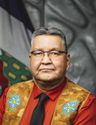
Member's Statement 721-20(1): Eulogy for Samuel Gargan
Members' Statements

Sheryl Yakeleya

Sheryl Yakeleya Deh Cho

Thank you, Mr. Speaker. Today I want to honour the life and legacy of Samuel Gargan, a respected Dene leader, a dedicated public servant, and a proud Northerner whose contributions have left an enduring mark in the Northwest Territories.

Born in 1948 at Redknife River, Sam's life was deeply rooted in the land and the people of the North. His journey was one of service, guided by a profound respect for tradition, community, and the natural world.

Prior to his election in 1983, Mr. Gargan worked as a counsellor with Higher North, was a classroom assistant at Elizabeth Ward School in Fort Providence and was a director with the Dene Nation. He was a member of the Fort Providence Hamlet and Band Council and sat as National Aboriginal Health Board with the Assembly of First Nations. For 16 years, he represented the people of the Deh Cho as the MLA in this Legislative Assembly with integrity, compassion, and unwavering commitment.

In 1995, he was elected Speaker of the House, a role he embraced with humility and a deep sense of responsibility. In his first speech as Speaker, Sam reminded us that tradition is more than ceremony. It is a foundation of values. He pledged to uphold both the cultural and procedural traditions of the Assembly, ensuring that every voice was heard and respected. He believed that leadership was not just about personal gain but about service and that every decision made in the House should serve as an example to our people.

Sam's leadership extended far beyond the walls of this legislature. Sam served as the mayor of Fort Providence in early 2001 but stepped down from that position in June of 2001 after being elected as Chief of the Deh Gah Got'ie First Nations, also located in Fort Providence.

In 2009, Sam was chosen as grand chief of the Deh Cho First Nations. He was a passionate advocate for the protection of our communities, our water, our animals, and our land.

At the elders' Parliament in 2014, he posed a question that continues to resonate today. Who is going to protect the people? Who is going to protect the animals, the water, and the land? This was not just a rhetorical question; it was a call to action, a reflection of the values he lived by every day.

Sam was also a devoted husband and father. He often spoke of the love and support he received from his wife Alphonsine and their children. He credited them as a source of his strength throughout his public life, and their presence was a constant reminder of the importance of family and community.

Those who knew Sam remember a man who led with wisdom, humility, and a quiet strength. He was a bridge between generations, a guardian of traditions, and a tireless advocate for the North. His legacy lives on in the communities he served, in the values he championed, and in the example he set for future leaders. Though he is no longer with us, Sam's spirit remains on the land he loved, in the people he served, and in the traditions he upheld. Mahsi cho, Sam. Thank you for everything. Your legacy lives on. Mahsi, Mr. Speaker.

Member's Statement 721-20(1): Eulogy for Samuel Gargan
Members' Statements

The Speaker

The Speaker Shane Thompson

Our condolences and prayers go out to the family during this difficult time.

Members' statements. Returns to oral questions. Recognition of visitors in the gallery. Member from Yellowknife Centre.

Recognition Of Visitors In The Gallery

Robert Hawkins

Robert Hawkins Yellowknife Centre

Thank you, Mr. Speaker. Mr. Speaker, I'll start off by saying, first I'll acknowledge a former colleague and friend -- not former friend, but former colleague of the Legislative Assembly. Punctuation matters as they say.

So, Mr. Speaker, let me start again, just to make sure we're clear. Former colleague of this House and a friend, I'll say, who used to be the Member for Range Lake, as you've already acknowledged, Mr. Daryl Dolynny. He's also been an entrepreneur in the city, but he's currently the CEO and president of Avens. I appreciate him being here today. By his side, he also has some folks. He has board member Taig Connell, Ron Allen, and I believe from my notes here that were just sent to me, I believe we might have Steven Nicholas up there, Sara Fullerton and Carol Norwegian and Jessica Ewing and Dina van delft. Without the benefit of my spectacles, I'll assume they're all sitting there at this very moment and along with our millions of subscribers, mostly from Avens. Thank you.

Recognition Of Visitors In The Gallery

The Speaker

The Speaker Shane Thompson

Thank you, Member from Yellowknife Centre. Recognition of visitors in the gallery. Member from Tu Nedhe-Wiilideh.

Recognition Of Visitors In The Gallery

Richard Edjericon

Richard Edjericon Tu Nedhe-Wiilideh

Thank you, Mr. Speaker. I too want to recognize the former MLA Daryl Dolynny and also his colleagues and the board members and also everybody in the gallery here today, I just want to say mahsi for being here.

Recognition Of Visitors In The Gallery

The Speaker

The Speaker Shane Thompson

Thank you, Member from Tu Nedhe-Wiilideh. Recognition of visitors in the gallery. Member from Range Lake.

Recognition Of Visitors In The Gallery

Kieron Testart

Kieron Testart Range Lake

Thank you, Mr. Speaker. I too want to recognize the former Member for Range Lake, Daryl Dolynny. He's a good friend and is a tireless advocate for seniors in our community. I also want to recognize his team and the Avens board who have come here to join us today. Thank you very much for being here.

Recognition Of Visitors In The Gallery

The Speaker

The Speaker Shane Thompson

Thank you, Member from Range Lake. Recognition of visitors in the gallery.

If we missed anyone in the gallery here today, welcome to your chambers. I hope you are enjoying the proceedings. It is always nice to see people in the gallery, and I appreciate the fact that you allow us the privilege of representing the people of the Northwest Territories for the four years.

Recognition of visitors in the gallery. Acknowledgements. Oral questions. Member from Range Lake.

Question 777-20(1): Status of Mineral Resources Act Regulations
Oral Questions

Kieron Testart

Kieron Testart Range Lake

Thank you, Mr. Speaker. Earlier today we called for a -- some of us called for a red alert into mining because the situation is dire. We have aging legacy mines that are closing, no new mines on the horizon. Can the Minister of Industry, Tourism and Investment speak to why the MRA was passed at the end of the 18th Assembly. It's been ten years before it's come into force, and we do not see a clear path forward. Can the Minister speak to the status of the Mineral Resources Act regulations? Thank you.

Question 777-20(1): Status of Mineral Resources Act Regulations
Oral Questions

The Speaker

The Speaker Shane Thompson

Thank you, Member from Range Lake. Minister of ITI.

Question 777-20(1): Status of Mineral Resources Act Regulations
Oral Questions

Caitlin Cleveland

Caitlin Cleveland Kam Lake

Thank you very much, Mr. Speaker. Mr. Speaker, I appreciate the Member bringing up the Mineral Resources Act regulations in the House today. The technical working group has been working hard in unison and collaboratively with Indigenous governments, and that is the most important part of this work, is that it's done collaboratively, and I'm happy to say that the policy intentions document is going out for engagement this fall. Thank you.

Question 777-20(1): Status of Mineral Resources Act Regulations
Oral Questions

Kieron Testart

Kieron Testart Range Lake

Thank you, Mr. Speaker. Policy intentions are great, but they don't result in new regulations or a Mining Act that's in force. So when will the -- let's just focus on the outdated 19th century tenure system. When will the tenure system be modernized, computerized, and online map staking available to bring the Northwest Territories in to 2025 like other jurisdictions that are doing far better than we are? Thank you, Mr. Speaker.

Question 777-20(1): Status of Mineral Resources Act Regulations
Oral Questions

Caitlin Cleveland

Caitlin Cleveland Kam Lake

Thank you, Mr. Speaker. Mr. Speaker, the policy intentions document is a very important part because it's really important to give people, residents, the opportunity to feed into the process before the regulations are fully drafted and really baked in. And that was something that was requested by multiple residents and concerns that were brought forward that residents have the opportunity to feed into this process.

So in response to the Member's questions, so the draft regulations will be ready for section 35 consultation in winter of 2027. So once we get the feedback from the policy intentions document, that work will be taken by Department of Justice, and that drafting will be taking place, public posting in spring of 2027, and then it will go through step G of the intergovernmental gouncil secretariat process in summer of 2027, and then from there, it'll be public posting of the draft regulations once that process is done. Thank you.

Question 777-20(1): Status of Mineral Resources Act Regulations
Oral Questions

The Speaker

The Speaker Shane Thompson

Thank you, Minister of ITI. Final supplementary. Member from Range Lake.

Question 777-20(1): Status of Mineral Resources Act Regulations
Oral Questions

Kieron Testart

Kieron Testart Range Lake

Thank you, Mr. Speaker. So 2027 is the plan. Is the Minister able to work with partners because it's very important that we do; it's part of the devolution agreement; it's part of our co-management system. But is the Minister able to work with partners to expedite this process to indicate the dire state of our exploration? Exploration's dropped by 50 percent since 2018. That's a huge decline. Can the Minister bring those concerns to that table and expedite this process? Because we desperately need reform now. We don't say red alert idly. Will the Minister act and expedite this process so we can have this modernized system in place right away? Thank you.

Question 777-20(1): Status of Mineral Resources Act Regulations
Oral Questions

Caitlin Cleveland

Caitlin Cleveland Kam Lake

Thank you, Mr. Speaker. Mr. Speaker, short answer, yes. Absolutely, this is a key focus of mine, it's a key focus of my colleagues, is making sure that we can get this piece of legislation done. I can also say that through Council of Leaders and the working groups that we are -- or sorry, the time that we spend with Indigenous leadership in this territory. The economy is incredibly important to everyone that is at the table, and we're hearing that from Indigenous governments as well. We're not travelling alone as Cabinet in these conversations. We're travelling alongside Indigenous leadership, and we're travelling as a team. And I think that's really critically important. So the short answer is yes, it's very important to me that this work gets done and gets done as quickly as possible. Thank you.

Question 777-20(1): Status of Mineral Resources Act Regulations
Oral Questions

The Speaker

The Speaker Shane Thompson

Thank you, Minister of ITI. Oral questions. Member from Yellowknife Centre.

Question 778-20(1): Mining and Economic Opportunities
Oral Questions

Robert Hawkins

Robert Hawkins Yellowknife Centre

Thank you, Mr. Speaker. Again, joining the semi-mini theme day, Mr. Speaker, I want to talk about the economy and more particular, I want to speak about the mining issue.

Mr. Speaker, my Member's statement I pointed out that the benefit of an independent sort of mining committee to review, we could convene a three-person or four-person blue chip panel and bring back Bob, you know, our guy who knows his stuff, who called the red alert, Mr. Speaker. Would the Minister be willing to do that, create a panel of people who have specialized expertise, could say what are the issues they foresee in our economy that's slowing mining down, because we all know it is truly the foundation of our economic future. Thank you, Mr. Speaker.