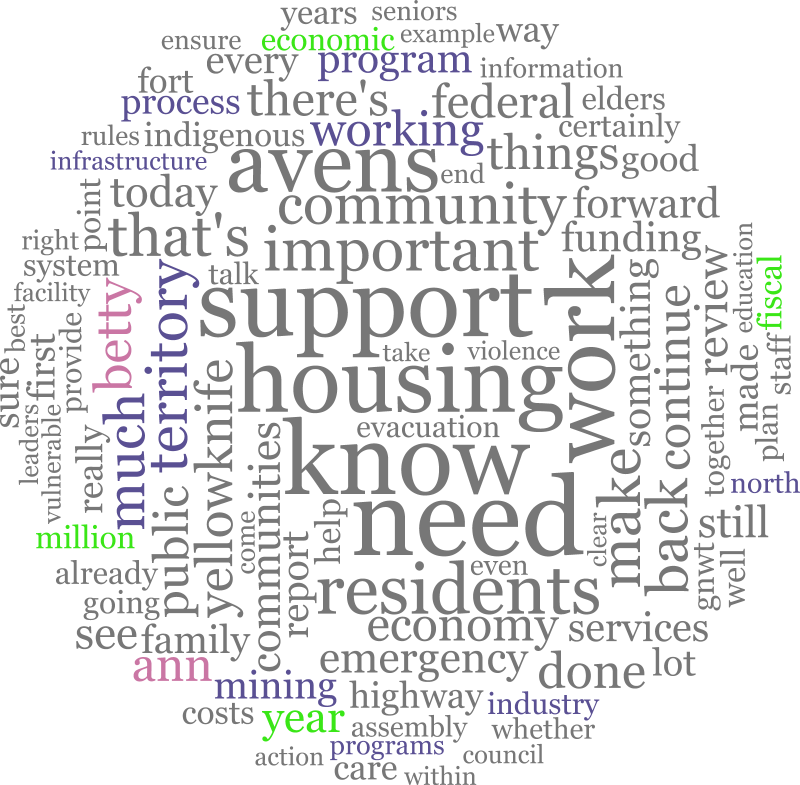
This is page numbers of the Hansard for the 20th Assembly, 1st Session. The original version can be accessed on the Legislative Assembly's website or by contacting the Legislative Assembly Library. The word of the day was need.

Topics

Members Present

Hon. Caitlin Cleveland, Mr. Edjericon, Mr. Hawkins, Hon. Lucy Kuptana, Hon. Vince McKay, Mr. McNeely, Ms. Morgan, Mr. Morse, Mr, Nerysoo, Ms. Reid, Mr. Rodgers, Hon. R.J. Simpson, Mr. Testart, Hon. Shane Thompson, Hon. Caroline Wawzonek, Mrs. Weyallon Armstrong, Mrs. Yakeleya

The House met at 1:30 p.m.

---Prayer or reflection

Prayer Or Reflection

The Speaker

The Speaker Shane Thompson

I'd like to thank Suzie Napayok for the opening, guiding words. Colleagues, I'd like to draw our attention to the presence of Daryl Dolynny in the gallery, a Member of the 17th Legislative Assembly. Welcome back to our Assembly.

Member from Range Lake -- or Yellowknife Centre, sorry.

Point Of Order
Point Of Order

October 17th, 2025

Robert Hawkins

Robert Hawkins Yellowknife Centre

That's okay, sometimes you can't tell us apart, Mr. Speaker. We do it to ourselves.

Mr. Speaker, I rise on a point of order regarding Bill 26 which received second reading in the House on May 29th, 2025, and was referred to the Standing Committee on Government Operations on that date.

Mr. Speaker, our rules lay out the procedures for the committee to review bills in chapter 8.3, and I do not believe they have been followed in this case. Rule 8.3(1) specifies that, quote, bills referred to a standing committee, special committee, shall not be proceeded until the Assembly receives the report of the committee or 120 calendar days past from the day the bill was given second reading, end quote.

The clear expectation is that committee will report on the review of a bill within 120 days or at the earliest opportunity subsequent to the passage of the 120 days.

Mr. Speaker, further, Rule 8.3(4) states that, and I quote, a standing or special committee shall conduct its clause-by-clause review of a public -- sorry, of a bill in public, end quote.

Mr. Speaker, yesterday was the earliest opportunity subsequent to the passage of 120 days from the date of the referral to standing committee, and the bill was not reported back to the House.

Further, the committee has not conducted a public clause-by-clause review as required by rules.

Mr. Speaker, that's my point of order, and if you do allow debate, I will have some comments. Thank you.

Point Of Order
Point Of Order

The Speaker

The Speaker Shane Thompson

Thank you, Member from Yellowknife Centre. I am going to call on the chair from Frame Lake to respond. Do you need time to respond? Are you prepared to do it now, or would you like to respond later on? Member from Frame Lake.

Point Of Order
Point Of Order

Julian Morse

Julian Morse Frame Lake

Thank you, Mr. Speaker. Mr. Speaker, I think I would need a little bit of time just to speak with committee staff and make sure that my response is in order with everything required of me as a chair.

Point Of Order
Point Of Order

The Speaker

The Speaker Shane Thompson

Thank you, Mr. Chair. So my ruling is we will bring this back before Committee of the Whole. Thank you.

Ministers' statements. Minister of Finance.

Minister's Statement 146-20(1): 2025-2026 Fall Economic and Fiscal Update
Ministers' Statements

Caroline Wawzonek

Caroline Wawzonek Yellowknife South

Thank you, Mr. Speaker, for this opportunity to provide the Legislative Assembly with the fall economic and fiscal update. This statement will describe the changes that have happened since Budget 2025 was released, review the supplementary appropriations to date for 2025-2026, and outline how we are revising our fiscal strategy goals to better match the uncertain economic times that we find ourselves in.

2025 has, again, been marked by notable natural disasters which were a major focus for many residents and workers over the past few months. The year is not over and still there are active wildfires across the territory. More specifically, residents in Fort Providence and Whati had to evacuate in late August and the Tthets'éhk'édélı̨ First Nation was under evacuation alert for a short period.

The wider Canadian economy, alongside much of the world's geopolitical situation, are facing times of notable uncertainty. The United States is the largest economy in the world and remains under a state of rolling tariff changes that reverberate through the world. For the territory, the private sector remains highly dependent on a single resource commodity, which makes us particularly vulnerable to international markets and consumer demand swings.

In response to the level of ongoing uncertainty, we are modifying our fiscal strategy. The previous fiscal strategy aspired to increase operating budgets through a combination of new revenue generation and expenditure management to decrease short-term debt and increase fiscal capacity so that the GNWT could continue to respond to expenditure shocks. Unfortunately, significant economic disruptions are upon us even sooner than anticipated.

We will be responsive by investing in the stability and resilience of the territory. While these goals will increase debt, we are careful to ensure that our debt remains affordable and that investments provide long-term economic benefits.

The federal government granted us a borrowing limit increase in March 2025 and with this higher borrowing limit, we gained $1.3 billion in flexibility to respond to new challenges and continue investments in public infrastructure. To be clear, increased borrowing does not mean increased revenue. To make an analogy, our credit card limit has increased but our income has not. We remain committed to stay within the guardrails of the fiscal responsibility policy to restrain the rate of debt accumulation. Even with a shifting of our formal fiscal strategy, fiscal responsibility and sustainability remain key pillars for the GNWT.

We will continue to expect good value in all programs and services, keep a close eye on public sector growth, and seek innovative paths forward to find efficiencies.

The dominance of the diamond mining industry over the past few decades makes the territorial economy especially sensitive to the shifting tides of global markets. In recent months, new hurdles have emerged. American import tariffs have added uncertainty for markets, particularly in mining and other resource and trade dependent industries.

Earlier this year, the Government of the Northwest Territories provided targeted support measures to the diamond mines, including temporary tax relief and operational assistance. This support does not change the reality that the planned closure dates of the mines are already upon us. The recent tariffs and market demand volatility reminds us of the vulnerability of our economy and the dependence for contracts many businesses associated to the mines rely on. We must continue to reduce barriers to speed up new investments and encourage a more diversified private sector.

Declining diamond production, slow to no growth in private investment, and housing shortages continue to weigh on the economic outlook. Public and private sector employment have remained relatively steady. Wages have grown in mining and public administration but are flat in other key sectors. Inflation has eased, offering relief to households, and total active businesses has recovered to pre-pandemic averages.

The economy does not stand still. It will continually evolve in response to changing human and social dynamics that surround us. I have long said that I remain optimistic for the Northwest Territories' potential future and that remains true, now in particular, with changes coming on the national landscape.

The federal government is looking North and seems to be sincerely hearing the calls from leaders across the Territories to deal with the lack of connections in and between 40 percent of Canada's landmass. This is a challenge to our sovereignty that all of Canada should be aware of but investing in true nation building by looking towards the Arctic can build Canada into the northern Arctic leader that many Canadians see ourselves as.

The Arctic Economic and Security Corridor is already on the list of nation-building projects, and there is continued interest in the Mackenzie Valley Highway as the department of defense has invested significant resources to upgrade the Inuvik airport as a future forward operating location. In addition, energy connections broadly remain a strategic focus, including projects like Taltson, as does the critical minerals sector where the Northwest Territories has several advanced opportunities.

Mr. Speaker, we started this fiscal year with a projected operating surplus of $170 million. Consistent with the previous fiscal strategy, this represented enough of a cash surplus to fully pay for the 2025-2026 capital budget without additional borrowing. We are now projecting an operating surplus of $16 million. This $154-million decline in our operating balance takes into account the two supplementary appropriations prepared and year-end expenditure projections.

Approved supplementary spending to date this year is $47 million that comes with $38 million in federal support, for a net total of $9 million of new spending compared to Budget 2025. Among the new spending, higher salaries for educators required $2 million under the school funding framework. Transitional housing and shelter services, harbour restoration in Hay River, and contributions to physical activity, sport and recreation were each approved for $1.8 million in supplementary support. Aurora College was approved for $528,000 for the practical nurse training program. The Yellowknife courthouse will receive $246,000 for approved security improvements, including a new sheriff position and other upgrades.

The second supplementary funding process totals $87 million with $15 million of offsetting support. This is proposed new spending and it is primarily focused on three measures: Additional wildfire suppression costs, funding to education bodies to assist with the loss of Jordan's Principle funding, and further subsidies that are proposed to shield ratepayers from electricity price spikes that stem from low water. It would also include funding for the disaster response and recovery and proposed funding to continue fish plant operations in Hay River.

Mr. Speaker, 2025-2026 infrastructure budgets are also seeing increases. So far this year, the Legislative Assembly has approved supplementary capital budgets of $179 million, which includes $113 million in offsetting revenue, either federal funding or carried over from the previous year, for a net increase to the capital budget of $65 million. Most of this increase was for the first year of a new three-year annual $42-million housing investment commitment made after Budget 2025. This investment reflects an emphasis on mandate priorities that include suitable, accessible, and affordable housing.

Taking all these factors into account, we are now expecting to close the fiscal year with $840 million in short-term borrowing. And that will bring our total debt to $1.862 billion, an increase of $90 million compared to the original Budget 2025 projection.

Keeping our own fiscal house in order, Mr. Speaker, remains essential, but our progress towards meeting the original fiscal goals has been hindered by rising expenditure pressures and significant economic and geopolitical uncertainty. Revising the fiscal strategy to enable strategic investments that foster opportunity and stability for Northerners is essential amid challenging times.

Revising the fiscal strategy is also allowing more time to complete the work we started to find the best fiscal foundation for a sustainable healthcare system. We are providing the time needed for the healthcare system sustainability unit and the Northwest Territories Health and Social Services Authority public administrator to complete their work, while not sacrificing patient care. We are looking forward to the outcome of this work being incorporated into the 2027-2028 business planning process.

Despite the revised fiscal direction, I am reaffirming the GNWT's commitment to the fiscal responsibility policy and the guidelines that keep debt affordable and within the borrowing limit. With that continued guidepost, we are maintaining a balance between fiscal flexibility but still mindful of the need for restraint in the face of slow revenue growth.

Mr. Speaker, the Government of the Northwest Territories sees the challenges we face as opportunities to support an economy in transition. We remain committed to long-term sustainability but our near-term focus must be on stability and resilience. And with continued federal partnership, a continued focus on efficiency, and a commitment to maximizing northern benefits, we are creating conditions for a stronger and more diversified economy. Thank you, Mr. Speaker.
Minister's Statement 146-20(1): 2025-2026 Fall Economic and Fiscal Update
Ministers' Statements

The Speaker

The Speaker Shane Thompson

Thank you, Minister of Finance. Ministers' statements. Minister responsible for Housing NWT.

Minister's Statement 147-20(1): Capital Delivery Status Update
Ministers' Statements

Lucy Kuptana

Lucy Kuptana Nunakput

Mr. Speaker, I am committed to building more homes for Northerners. We are turning this commitment into action through multi-year planning with funding from the Government of the Northwest Territories, the Canadian Mortgage and Housing Corporation, and Housing NWT.

Each year for the rest of this Legislative Assembly, Housing NWT will invest $50 million annually, including $41.6 million per year from the Government of the Northwest Territories, to build new homes and repair existing ones.

This is a result of strong collaboration among Members of this House and reflects a key strength of this government, which I am proud to be a part of. This collaboration and ongoing funding commitment continues to bring us towards improving the suitability, accessibility, and affordability of housing in the NWT.

Since the start of the 20th Legislative Assembly, Housing NWT has completed 81 new housing units, 67 homes are being built as we speak, and we plan to build 152 more over the next two years, reaching 300 newly constructed homes over the life of this government. These projects rely on strong partnerships with contractors, local housing organizations, and Indigenous governments to plan and build homes that meet the needs of communities. We are also supporting residents to gain skills and education in the trades, with the additional requirement for each new construction contract to include an apprenticeship work assignment.

Mr. Speaker, our strategy focuses on new construction, as well as major renovation projects to existing public housing units. This includes replacing older units and upgrading units to improve the condition and extend their lifespan. We are using data from the Territorial Housing Needs Assessment to adjust our housing portfolio and align planning decisions with the types of housing that Northerners need both now and in the future.

Housing NWT staff are continuously looking for ways to meet and collaborate with Indigenous governments to improve housing outcomes. To date, we have entered into formal agreements with four Indigenous governments, including the Tlicho government, the Sahtu Secretariat Incorporated, the Deline Got'ine government, and the Gwich'in Tribal Council. These agreements help us work together on sustainable shared housing goals.

Construction on the 50-unit mixed-use building in Yellowknife progressed very well this summer. So far, the foundation, the utility service tie-ins, and the municipal connections are complete. We are exploring innovative ways to continue construction through the winter season. Off-site manufacturing of the mass timber and building envelope will continue this winter in southern Canada. These pieces will be ready and delivered to the worksite in the spring. This future mixed-use building is located on 50th Street and will support vulnerable populations directly with access to safe and stable housing.

I would like to extend my sincere thanks to the city of Yellowknife for the land contribution, CMHC's Rapid Housing Initiative of $20.8 million in funding, and PCL Construction and Stantec as design-build partners in this project.

Mr. Speaker, I would also like to highlight the modernization of Aspen Apartments. This project demonstrates strategic initiative, an important step forward in improving public housing and reducing reliance on third party landlords. This upgrade will extend the building's service life by 25 years and add 36 newly owned units to Housing NWT's portfolio. This project is on track to be completed by mid-November. Once construction is complete, public housing tenants currently renting from third party landlords will move into the building. This will free up market rental units in Yellowknife, providing more homes for residents in need of market housing. We are switching from oil heat to a cleaner biomass system as part of our energy plan and, again, to strategically invest in our buildings and reduce costs in the long-term.

Work continues across the NWT, with the award of Housing NWT's most recent design-build contract to ARCAN Construction Ltd. who will work with METCAN Building Solutions, a northern Indigenous-owned NWT manufacturer of modular homes. The contract will deliver 84 units to eight communities in the form of duplexes and four-plexes, with construction beginning in spring 2026. Homes will be constructed in Hay River at METCAN Building Solutions' facility to ensure durability, efficiency, and suitability for northern conditions.

I am pleased to report that earlier this summer, Housing NWT entered into a negotiated contract with the Fort Smith Metis Council to deliver a public housing duplex. Other negotiations are underway with Indigenous governments for additional 14 units, and I look forward to providing more details as negotiations progress.

We are advancing our energy strategy by switching to biomass and electric heating where possible, including Housing NWT's first ever electric boiler in Fort Smith. Other exciting energy initiatives include testing cold climate heat pump technology in partnership with the Arctic Energy Alliance and designing all new buildings to be at least 20 percent more energy efficient than the 2015 model National Energy Code. At the end of the month, a biomass heating system will be online in Fort Providence for the Seniors Multiplex.

Mr. Speaker, I look forward to sharing more updates as we continue to make progress and deliver more homes for Northerners. Quyananni, Mr. Speaker.

Minister's Statement 147-20(1): Capital Delivery Status Update
Ministers' Statements

The Speaker

The Speaker Shane Thompson

Thank you, Minister responsible for Housing NWT. Ministers' statements. Members' statements. Member from Great Slave.

Member's Statement 710-20(1): Northwest Territories Nominee Program
Members' Statements

Kate Reid

Kate Reid Great Slave

Thank you, Mr. Speaker. Mr. Speaker, today I want to continue to talk about the NWT nominee program. In September, the Minister announced that Immigration Refugees and Citizenship Canada has increased the Northwest Territories' 2025 allocation for our nominee program by 47 nominees which brings the total to 197. This does not restore the NWT allocations 2024 levels of 300 spots, but it's a step in the right direction.

I'm heartened to see that the Minister continues to advocate to her federal counterparts when she was in Ottawa with her Cabinet colleagues and Council of Leaders, and then this week in Toronto, she attended the forum of Ministers responsible for immigration meeting. I'm hopeful for some good news.

Limited spots means that there are knock-on effects for newcomers, many who are panicked and need support. Crucial support is not readily available in the NWT, including but not limited to immigration lawyers. This creates intense anxiety for people who think they are doing all the right things, following all the right paths, and are stymied by the whiplash of federal policy changes. Additionally, I hear from newcomers that they continue to be frustrated that those here the longest are not considered a priority, which means they need to apply to extend their work permits which puts them into perpetual limbo.

Mr. Speaker, I also wish to raise two important points:

1. We are not facing the same challenges south of 60 that have created this policy turnaround. Our newcomers are already here and established, building their lives and families and supporting our communities; and,

2. While the support of the business community here in Yellowknife and in our regional centres is greatly appreciated, I would also like to highlight that everyone in the NWT who is not Indigenous also has a newcomer story in their family. Being kind to those who want the same opportunity to be a good neighbour costs nothing and makes our communities stronger. I will have questions for the Minister of ECE. Thank you.

Member's Statement 710-20(1): Northwest Territories Nominee Program
Members' Statements

The Speaker

The Speaker Shane Thompson

Thank you, Member for Great Slave. Members' statements. Member from Range Lake.

Member's Statement 711-20(1): Government Support for Mining Industry
Members' Statements

Kieron Testart

Kieron Testart Range Lake

Mr. Speaker, in 2017, Premier Bob McLeod raised a red alert over oil and gas development in the Beaufort Sea after Prime Minister -- then Prime Minister Trudeau declared a moratorium without consulting the Northwest Territories. At the time, I was fairly critical of that. I was focused on other aspects of the economy, particularly mining, but now I owe him an apology because I see the real value of that red alert in sending a clear signal across the country and the world that the NWT was open for business and fighting to preserve the opportunity to develop its own resources.

Mr. Speaker, today we need a new red alert, a red alert over our mining industry. Northerners were sent -- or the North's economy was sent into shock waves when the Ekati mine stopped open pit mining earlier this summer. Hundreds of jobs were lost. The economy is at risk of losing its most significant private sector contributors through Ekati and all the mine's employment, training, infrastructure investment, face an uncertain future after years of relying on this industry to support our economy, and Indigenous nations who co-manage our regulatory system are soon to lose financial and economic benefits from their agreement with these companies.

Mr. Speaker, mining contributes 24 percent of the NWT's GDP, and if you add in the spinoffs to the larger economy it exceeds 40 percent. This should not be a surprise that the mines were eventually going to close. All mines do. But we stand completely, seemingly, unprepared for this eventuality. No new projects have been meaningfully advanced and are on the horizon to replace the mining decline. The three things that have led to this are declining exploration, outdated systems of mineral tenure, and ineffective policy that have stalled out our mining sector. And despite the urging of industry experts to correct this for more than a decade to both the federal and territorial governments, we only have further inaction and hesitation to show for it. We must act now at the midpoint of this Assembly before it is too late to reverse this decline. And if we don't, it will continue to send a chilling message that the NWT is not open for business contrary to the messaging of the government. It's time for a red alert for mining, it is time for an independent review of mining decline, it is time to expand the mineral incentive program and a North of 60 tax credit, and it is time to modernize the tenure system after ten years of languishing in regulatory process. Thank you.

Member's Statement 711-20(1): Government Support for Mining Industry
Members' Statements

The Speaker

The Speaker Shane Thompson

Thank you, Member from Range Lake. Members' statements. Member from the Sahtu.

Member's Statement 712-20(1): Small Business Week
Members' Statements

Daniel McNeely

Daniel McNeely Sahtu

Thank you, Mr. Speaker. Economy related, Mr. Speaker. The potential of the Mackenzie Valley Highway presents boundless business opportunities for small businesses in the Northwest Territories, recognizing that Small Business Week starts this coming Sunday, October the 19th to October the 25th. I'd like to take this opportunity to encourage all entrepreneurs and small business owners across the Northwest Territories to participate in this important celebration for entrepreneurialship. Small Business Week is Canada's entrepreneurial celebration, and it offers valuable opportunities for the business owners to learn, connect, interact, and celebrate with experts and other entrepreneurs from across our great nation.

Mr. Speaker, as we look forward to the economic opportunities that infrastructure projects like the Mackenzie Valley Highway will bring to our territory, it's more important than ever that our small businesses are prepared and equipped to seize these opportunities. I encourage all NWT entrepreneurs to take advantage of the resources and events scheduled, available during the Small Business Week to strengthen our businesses and position themselves for future successes.

Small businesses are the backbone of our northern economy, and supporting their growth, stability, and development is essential to bringing a prosperous future and building a prosperous future of the residents of the Northwest Territories and thus attracting certainty on future investment. Mahsi.

Member's Statement 712-20(1): Small Business Week
Members' Statements

The Speaker

The Speaker Shane Thompson

Thank you, Member from the Sahtu. Members' statements. Member from Inuvik Boot Lake.

Member's Statement 713-20(1): Mackenzie Valley Highway
Members' Statements

Denny Rodgers

Denny Rodgers Inuvik Boot Lake

Thank you, Mr. Speaker. Mr. Speaker, last week, I had the privilege to attend the Council of Leaders. I was invited as chair of the accountability and oversight committee as an observer. I'd like to thank the Council of Leaders, the Indigenous leaders, our Premier and Cabinet for that invitation.

Mr. Speaker, I would say there's some kudos to be sent out. I think that certainly our Premier and his Cabinet did a great job in presenting to the federal Ministers. The Indigenous leaders likewise. It was very much a we are speaking with one voice, and I thought that was a great approach. And certainly some of the things they discussed down there, Mr. Speaker, housing, the ongoing criminal activity, health concerns and, of course, the major infrastructure projects.

While I was there, Mr. Speaker, there was also a presentation done by the Sahtu Secretariat Incorporated as well as in collaboration with GNWT on the proposed Mackenzie Valley Highway. And, again, what I thought was a good presentation. There was some -- certainly some representation there from the federal government as well. And, Mr. Speaker, it's an exciting project. And I know, and I've heard the Minister speak about it today, that the Slave Geological Highway has kind of gotten a little more of a boost, I guess, from the federal government than the Mackenzie Valley Highway, but I think, Mr. Speaker, as a group, I think we need to make sure we continue to push and to ensure that the Mackenzie Valley Highway remains our number one priority. I think it's our road, it's good for everyone, it's good for the entire territory. Not only for the -- you know, for the defence and for sovereignty and the things that are important to our nation, and certainly important to us, but I would argue as an energy corridor as well, Mr. Speaker. We talk about we have mining -- the mines that are now closing down. We know, and I've said it many times, you know, we're sitting on 19 trillion cubic feet of natural gas in the Beaufort Delta. We've seen the Indigenous government in that region, the Inuvialuit, starting their own development in that process. So imagine, Mr. Speaker, not only would that provide an energy source, energy security within our own territory for us, Mr. Speaker, but also the revenue and the royalties that come with that to make us more of a have-territory and we're not sad here during budgets, Mr. Speaker, and fighting over the small amount of revenue that we do have. So, again, Mr. Speaker, I think the Mackenzie Valley Highway, we -- you know, we have an office set up in Ottawa. I had an opportunity to speak with our envoy down there. I had some very positive conversations. We need to continue that push. I think we need to continue to make sure that the Mackenzie Valley Highway is the number one project, Mr. Speaker. The Slave Geological, yes, it's important, but it's ten years out likely. We have permits in place, we are ready to put shovels in the ground in the Mackenzie Valley Highway. We need to keep that plan. Thank you, Mr. Speaker.

Member's Statement 713-20(1): Mackenzie Valley Highway
Members' Statements

The Speaker

The Speaker Shane Thompson

Thank you, Member from Inuvik Boot Lake. Members' statements. Member from Monfwi.

Member's Statement 714-20(1): Support for Transitional Students
Members' Statements

Jane Weyallon Armstrong

Jane Weyallon Armstrong Monfwi

Thank you. Thank you, Mr. Speaker. Mr. Speaker, with the closure of the Aurora College 19 community learning centres, students who live outside of Yellowknife, Fort Smith, and Inuvik, face even greater challenges in accessing programs or transitional -- or transitioning successfully into university level studies. These students are left with few options to upgrade their skills or complete prerequisite courses and, as a result, face barriers to obtaining funding under the student financial assistance program.

Take, for example, a 19-year-old Tlicho citizen from Behchoko who was denied financial support from student financial assistance for enrolment in an emergency medical responder program at NAIT. This program is a critical first step towards becoming a paramedic, yet it is not recognized as post-secondary program under current funding policies. This student is passionate about serving her community, and yet she is being told her education does not qualify.

Mr. Speaker, living in small communities with poor education outcome, many of our youth rely on this kind of program to move forward. If we fail to support our youth in obtaining positive education outcomes now, we are setting them up for failure in a future where they will most certainly end up relying on income support. In a territory where we urgently need Indigenous healthcare workers, we must do better. We must ensure our funding systems reflect the realities of modern training pathways and support those who choose to serve.

Mr. Speaker, the SFA framework as it currently exists does not support university bridging programs, which are essentials for students who do not meet direct requirements for university. These programs offer academic upgrading, skill development, and transitioning support that can make the difference between access and exclusion. Now is the time to look at amending the Student Finance Assistance Act and regulation to explicitly include university bridging programming as eligible for financial support. Mr. Speaker, can I have unanimous consent to conclude my statement.

---Unanimous consent granted

Mr. Speaker, doing so would align with the Act's intent and ensure that students are not penalized for systemic gaps in educational access. Education is a right, not a privilege, which we have said quite a few times. We need to ensure that every student in the Northwest Territories has a fair chance to succeed regardless of where they live or the path they must take to realize their dreams. Masi.

Member's Statement 714-20(1): Support for Transitional Students
Members' Statements

The Speaker

The Speaker Shane Thompson

Thank you, Member from Monfwi. Members' statements. Member from the Mackenzie Delta.

Member's Statement 715-20(1): Condition of Dempster Highway
Members' Statements

George Nerysoo

George Nerysoo Mackenzie Delta

Thank you, Mr. Speaker. Mr. Speaker, today I would like to follow up on my colleague's Member's statement from Boot Lake on the condition of the Dempster Highway. As my colleague stated, I too have been receiving daily texts about the highway conditions in terms of safety.

Mr. Speaker, I personally drive this highway on occasion, and I know what the residents of the Beaufort Delta are referring to and have them express their concerns about the horrible conditions of the highway at this time of the year. Just to put into context, when I went to Inuvik with the cab, the cab driver was driving 35 kilometers in the section in question. A two-hour drive turned into a three-and-a-half-hour drive.

Mr. Speaker, residents of the Beaufort Delta often ask me what are you doing about the conditions of the Dempster Highway, and I wish I could do something. All I can do is bring this to the attention of the Minister and his department and hope that something will be done for the safety of all users of the Dempster Highway.

Mr. Speaker, communication between all levels of this department is important to relay message on to everyone concerned. Mr. Speaker, in closing, I know the department has a website to update the users of the Dempster Highway. Communication between the Ministers and the regional departments must be maintained so the Minister's kept up to date on the condition on the highway systems throughout the NWT. Thank you, Mr. Speaker. I will have questions for the Minister of Infrastructure at the appropriate time.

Member's Statement 715-20(1): Condition of Dempster Highway
Members' Statements

The Speaker

The Speaker Shane Thompson

Thank you, Member from Mackenzie Delta. Members' statements. Member from Yellowknife North.

Member's Statement 716-20(1): Family Violence
Members' Statements

Shauna Morgan

Shauna Morgan Yellowknife North

Mr. Speaker, today I'm speaking about a difficult thing, and I urge listeners to take care of yourselves and seek support when you need it.

Family violence is one of those things that we seldom talk about inside or outside of this building, yet it is so pervasive that it affects every aspect of northern life, people's health, their ability to work, our economy, the ability of communities to function. It impacts people of every culture, Indigenous and non-Indigenous, of every education level and every income bracket.

The rates of intimate partner violence in the NWT are astronomical - 12 times the national average. One of this Assembly's priorities is to prevent, interrupt, and address the effects of trauma, but every day in our communities the cycle of trauma and violence is repeating itself.

It would be so much easier if it was just a matter of law and order, just punishing the bad guys, keeping them away forever from the helpless victims. But our family and community webs are too interconnected to separate the good guys and the bad guys like that. And survivors are not helpless. We may get frustrated when they go back, sometimes again and again, to abusive situations, but people's choices are complicated and the only way out is for survivors to be able to take their power back, to gain more realistic options and to make their own choices.

Over the past 25 years, the NWT has had family violence action plans, research studies, calls to action, and in 2023 a new strategic framework was published, yet this government continues to miss opportunities to make fundamental changes.

I say no more strategies, reports, hand-wringing, until we've taken action on the main recommendations that keep being raised over and over. Survivors need safe housing options. We don't yet have safe homes even in every region, and the ones that exist, for example the safe homes run by the YWCA with partners in Fort Simpson and Fort Good Hope, are constantly in danger of losing funding and shutting down. We need more transitional housing options because people cannot stay in a shelter long term. We need better ways of enforcing emergency protection orders and ways to make EPOs more responsive to changing needs. We need a justice system that is accessible, that doesn't re-traumatize people, and that has options for reconciliation and healing. Survivors need better access to legal aid. Abusers need supportive housing too and opportunities to heal and unlearn violent behaviours. These are big, expensive changes, Mr. Speaker, but the cost of the status quo is much, much more. Thank you.

Member's Statement 716-20(1): Family Violence
Members' Statements

The Speaker

The Speaker Shane Thompson

Thank you, Member from Yellowknife North. Colleagues, family violence is a challenging topic, and if anybody's listening needs support or assistance, please contact the RCMP, health centres, or visit the government website to find resources available to you.

Members' statements. Member from Tu Nedhe-Wiilideh.