All those opposed, please stand. All those abstaining, please stand.
Debates of Oct. 17th, 2025
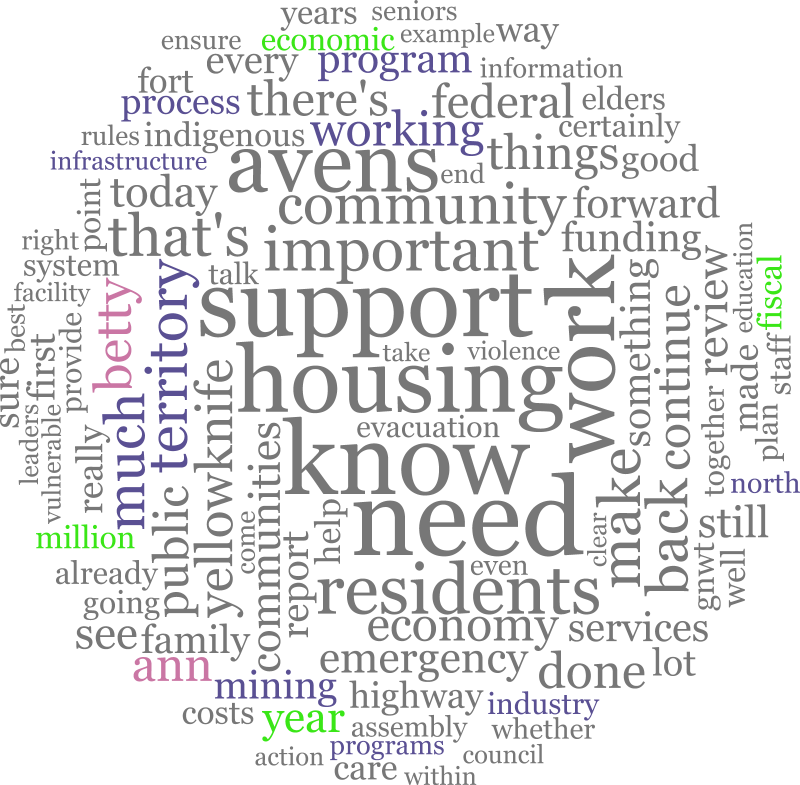
This is page numbers of the Hansard for the 20th Assembly, 1st Session. The original version can be accessed on the Legislative Assembly's website or by contacting the Legislative Assembly Library. The word of the day was need.
Topics
Recorded Vote
Motions
Clerk Of The House Mr. Glen Rutland
The Member for Yellowknife South. The Member for Kam Lake. The Member for Hay River North. The Member for Hay River South. The Member for Nunakput.
Recorded Vote
Motions

The Speaker Shane Thompson
All those in favour, 10. Opposed, 0. Abstention, 5. The motion has carried.
---Carried
Motions. Notices of motion for the first reading of bills. First reading of bills. Second reading of bills.
Point Of Order
Point Of Order
October 17th, 2025
The Speaker Shane Thompson
Colleagues, I will now return to the point of order raised by the Member of Yellowknife Centre in relation to whether it was a breach of the rules for committee not to report on its review of Bill 26 yesterday.
I will call upon the Member for Frame Lake, the chair of the Standing Committee on Government Operations, to respond. Member from Frame Lake.
Point Of Order
Point Of Order

Julian Morse Frame Lake
Thank you, Mr. Speaker. Thank you for granting me a bit of time to prepare a response, Mr. Speaker. I would like to inform you and the House that the committee is ready to present a report as early as next week summarizing its review of Bill 26 to date and explaining the reasons the bill has not been reported back as of yet.
Mr. Speaker, the committee is scheduled to meet on Monday, October 20th.
Mr. Speaker, Rule 8.3(2) states that a committee may request an extension of its review, not that it must. The rules do not state that a committee must report a bill back as ready or not or seek an extension.
Mr. Speaker, Rule 8.3(3) covers what happens when a committee doesn't report a bill back and does provide recourse to the bill's sponsor to remedy the situation. The sponsor has the option to give notice of intent to proceed with a bill not reported moving into COW for consideration by the Assembly. Sorry, by COW, I mean Committee of the Whole, Mr. Speaker.
I have spoken with a Member for Yellowknife North, and she is aware that this option is available to her.
Mr. Speaker, there is precedent to refer to here. Committees do not always report back on bills. This has happened before in the 20th Assembly with Bill 3. Mr. Speaker, in the 19th Assembly, Bill 91, a Private Member's bill regarding the annual reporting on the carbon tax was not reported back by Standing Committee on Government Operations. Instead, most of its provisions were added to Bill 92, which was a separate government bill concerning the carbon tax.
Mr. Speaker, I'll quote from SCOGO's report on Bill 92. Given the Minister's concurrence with Motion No. 4, committee decided to not proceed with Bill 91. The government's legislation now includes detailed annual reporting requirements that committee supported. Committee is satisfied with this outcome. And committee left it at that. Mr. Speaker, those are all the points I have on the point of order itself. As noted, committee is continuing its work on the bill, is prepared to report back as early as next week. So thank you for consideration of these points, Mr. Speaker.
Point Of Order
Point Of Order
The Speaker Shane Thompson
Thank you, Member from are Frame Lake. To the point of order. Member from Yellowknife Centre.
Point Of Order
Point Of Order

Robert Hawkins Yellowknife Centre
Thank you, Mr. Speaker. Mr. Speaker, I'll begin with saying that I hear the Member or, in this case, the chair of the committee. The problem with using the Bill 3 example is it was done in error, and it -- but more importantly is even the extended examples as you provided which I can see it as a real example, but the problem is in both cases, they were treated with unanimity, so everyone was in agreement, and sometimes that's the best way to look at something. But there wasn't unanimity in this particular case.
Mr. Speaker, the other thing is is that whether reciting one example or two examples, the fact is we have hundreds and hundreds of examples where the practices and procedures have been codified, if not galvanized into our system. We're allowed to break to some extent -- I want to use a little liberty when I describe this this -- all our rules based on unanimous consent. And now, that's not meant to be the assumption of every situation, but I'm just saying that when we agree with unanimous consent, we can sidestep and there are particular examples theoretically --
Point Of Order
Point Of Order
The Speaker Shane Thompson
-- Member from Frame Lake. Yes, Frame Lake, called a point of order. Member from Frame Lake.
Point Of Order
Point Of Order
Julian Morse Frame Lake
Thank you, Mr. Speaker. Mr. Speaker, this is a bit of a difficult one. I understand that the Member's speaking to his point of order; however, in accordance with Rule 3.2, paragraph 3(o), the Member's alluding to matters discussed during a confidential meeting of a committee. And so this puts us in a bit of a difficult situation where we're raising a point of order and speaking to the reasons for that point of order on things that are discussed during committee. Committee hasn't reported back on the bill yet. Thank you.
Point Of Order
Point Of Order
The Speaker Shane Thompson
Thank you. Thank God it's Friday.
So, Member from Yellowknife Centre, do you wish to debate or withdraw your comments regarding to the point of order brought forth by Frame Lake? Do you want to debate -- (audio).
Point Of Order
Point Of Order
Robert Hawkins Yellowknife Centre
I wouldn't mind debating for a second if it's possible, Mr. Speaker. I'm trying to figure out exactly what I revealed in the context of responding to the Member who just spoke. So in other words, I felt I was responding to his saying internal committee report was coming. That's only an internal process. He had just stated that on the record, and I was, hence, responding. So I can withdraw the points just to move on, but I was responding to him. Thank you.
Point Of Order
Point Of Order
Robert Hawkins Yellowknife Centre
Yeah, no, no, I'll withdraw that last thing I insinuated. I'm not sure of the exact wording, but I think we all understand that I must have said something of some minor content, and I'm willing to -- I'm really just trying to say I don't know exactly the wording, but I do understand the intent the Member had raised and I respect that calling our -- and I'm not going to parry that with another point of order, just so we can move on. Thank you.
Point Of Order
Point Of Order
Robert Hawkins Yellowknife Centre
Original? Oh, yeah, yeah; it's getting confusing. Okay, now we're on the same page.
I think I'm within my realm that if we talked about the importance of unanimity on doing things collective, I will stay focused on Bill 3 and the previous examples. And I think that that's important foundation sometimes if you change things. But, again, what's critical, and absolutely codified, is our traditions and practices matter. And whether you provide one example, you know, we can't use the word precedent because it has to be a normal sense that it's structured around. I don't believe at any time that this is that case. An anomaly, yes, but not a precedent.
So, Mr. Speaker, the procedures, as I'm trying to outline here in our rules for committee review of a bill, strike an important balance between ensuring that our committees have adequate time to thoughtfully consider -- of consideration of legislation and ensuring that progress on legislation continues in a meaningful pace -- or at a meaningful pace, I should say. I believe that 120-day timeframe for reporting a bill is reasonable; and further, when necessary, our rules allow for committee to request an extension to continue their review beyond 120 days. When made, these requests are rarely denied by the House. If additional time is required to further consider legislation, the committee should be seeking an extension in accordance with our rules. If additional time is not required, the bill should be reported back to allow for timely consideration by this House in Committee of the Whole. If committee believes the bill should not proceed to review by the House, our Rules 8.3(9) allow for it to be reported as such. Further, this rule also permits the sponsor to move the motion in the House to have a bill proceed to Committee of the Whole.
I believe this process is both fair to the committee and the sponsor of the bill. The requirements of the public clause-by-clause review of a bill as outlined in Rules 8.3(4) are also very reasonable. I would go so far as to say it is necessary when enacting the legislation we consider as standing committee becomes the law that governs the people of the Northwest Territories. The public deserves the opportunity to be informed about the legislation before it is passed. Should the Speaker find that there is a point of order, I request that he directs the committee to complete their review in accordance to our rules, report back to the House within a reasonable timeframe. I also request that the Speaker considers asking our Standing Committee on Procedures and Privilege to review chapter 8.3 of our rules to determine if any changes are necessary to ensure that we continue to strike an appropriate balance between thorough consideration and legislation by our committees and timely passage of the same legislation.
And finally, Mr. Speaker, I'll say unnecessary delay, whether it's considered and in a manner of fullness of consent could hold a bill at hostage and at bay, and that's the last thing we want done, that a bill just disappears without public reporting, and, hence, I think our rules, practices, and procedures account for that by commanding a bill has time that it must be returned.
And my apologies, the last thing I need to point out is committee should be drawing their reviews of bills to a decision, not dispensing them with their studies of bill to avoid negative reporting or a division in the House. The business of the Assembly, especially decisions, must be public to ensure accountability and transparency. Regardless of the committee's intentions to report next week, it did not report within the obligations to our rule -- to or under our rules, and I urge you not to take predicted action as evidence that the committee discharge its responsibilities. Mr. Speaker, it should have reported back, and that's the bottom line. Thank you.
Point Of Order
Point Of Order
The Speaker Shane Thompson
Thank you, Member from Yellowknife Centre. To the point of order. Member from Inuvik Boot Lake.
Point Of Order
Point Of Order

Denny Rodgers Inuvik Boot Lake
Thank you, Mr. Speaker. Mr. Speaker, I'll be brief. Some of this has been outlined by the chair of the SCOGO committee. Rule 8.3(3) outlines a path for a bill if a committee chooses as a majority not to report it back. The bill is not deleted, it's not gone, and it does not mean that the committee has not done its work. The sponsor can still bring the bill into the --
Point Of Order
Point Of Order
The Speaker Shane Thompson
-- the camera process of reporting there. Oh, sorry, I apologize. No, go ahead. Finish.
Point Of Order
Point Of Order
Denny Rodgers Inuvik Boot Lake
So the bill is not deleted, it's not gone, and it does not mean the committee has not done its work. The sponsor can still bring the bill into Committee of the Whole, Mr. Speaker. We have seen this done in this Assembly. We've seen it done in previous Assemblies. Our rules do not state we must report a bill back. Therefore, Mr. Speaker, I do not think there's a point of order here. Thank you.
Point Of Order
Point Of Order
The Speaker Shane Thompson
Thank you, Member from Inuvik Boot Lake. To the point of order. Member from Frame Lake.
Point Of Order
Point Of Order
Julian Morse Frame Lake
Just very quickly, Mr. Speaker, the Member for Yellowknife Centre suggested that the committee can hold the bill hostage. I would just note that...
Point Of Order
Point Of Order
The Speaker Shane Thompson
Mr. Morse, you can continue because this is your opportunity to prevent -- his debate. He responded to the point of order. Now this is his sharing of -- Mr. Morse, or Frame Lake.
Point Of Order
Point Of Order
Julian Morse Frame Lake
Thank you, Mr. Speaker. Actually, Mr. Speaker, I made my point already, and it's on the record. I'll just leave it at that.