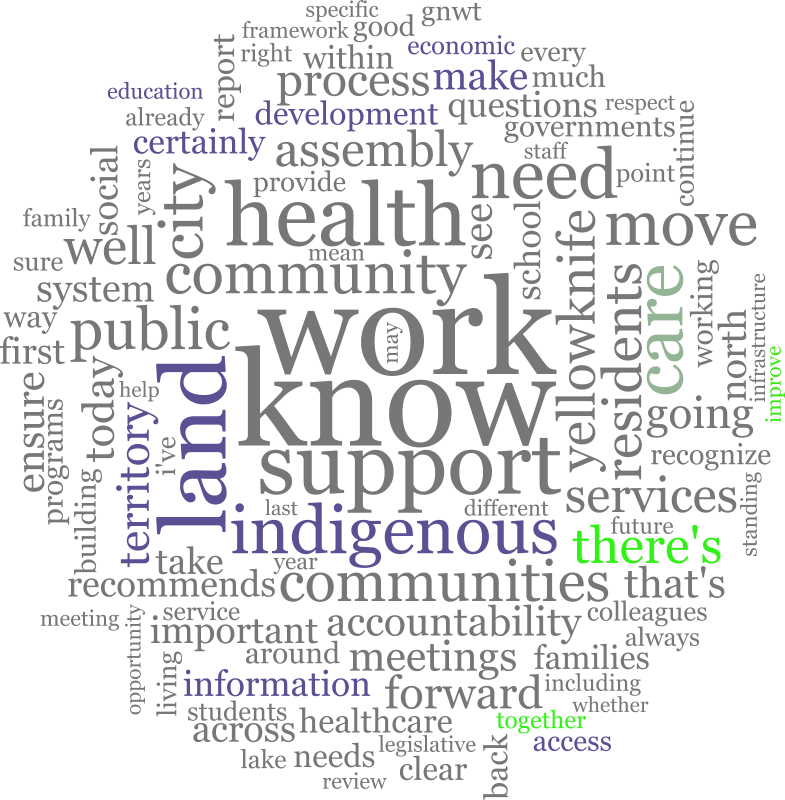
This is page numbers of the Hansard for the 20th Assembly, 1st Session. The original version can be accessed on the Legislative Assembly's website or by contacting the Legislative Assembly Library. The word of the day was work.

Topics

Members Present

Hon. Caitlin Cleveland, Mr. Edjericon, Mr. Hawkins, Hon. Lucy Kuptana, Hon. Vince McKay, Mr. McNeely, Ms. Morgan, Mr. Morse, Mr. Nerysoo, Ms. Reid, Mr. Rodgers, Hon. Lesa Semmler, Hon. R.J. Simpson, Mr. Testart, Hon. Shane Thompson, Hon. Caroline Wawzonek, Mrs. Weyallon Armstrong, Mrs. Yakeleya

The House met at 1:31 p.m.

---Prayer or reflection

Prayer Or Reflection

The Speaker

The Speaker Shane Thompson

Please be seated. I'd like to thank Karen Mitchell for the reflections today.

Mr. Clerk, can you please determine whether the Commissioner of the Northwest Territories, the Honourable Gerald Kisoun, is prepared to enter the chambers and assent to the bills.

Assent To Bills
Assent To Bills

The Commissioner Of The Northwest Territories Gerald W. Kisoun

[No translation available] Good afternoon, Mr. Speaker, Premier Simpson, Ministers, Members of the Legislative Assembly, staff, and visitors in the public gallery. I would like to extend my warm wishes to each of you for a safe, restful, enjoyable summer. This is a time to reconnect with loved ones, spend time on the land, and appreciate all that our communities have to offer. Please be seated.

Whether you are traveling by road, by water, or by air this summer, I encourage everyone to take care and make safety a top priority. Please continue to look out for one another and remind friends and family to be prepared and to respect the land. While I hope you all find time to rest and recharge, I know that the important work of serving our communities continues. Your dedication to improving the lives of Northerners does not go unnoticed and it remains vital throughout the summer months.

Now, as Commissioner of the Northwest Territories, I am pleased to assent to the following bills:

  • Bill 32, An Act to Amend the Public Service Act, No. 2;
  • Bill 41: An Act to Amend the Real Estate Agents Licensing Act;
  • Bill 48: An Act to Amend the Workers' Compensation Act, No. 2;
  • Bill 51: An Act to Amend the Local Authorities Elections Act;
  • Bill 52: Supplementary Appropriation Act (Infrastructure Expenditures), No. 1, 2026-2027;
  • Bill 53: Supplementary Appropriation Act (Operations Expenditures), No. 1, 2026-2027.

Quyananni. Hiya. Mahsi cho. Merci beaucoup. Thank you.

Assent To Bills
Assent To Bills

The Speaker

The Speaker Shane Thompson

Thank you Commissioner Gerry Kisoun for being here today to assent to our legislation. It is always an honour to have him join us in this chamber.

Thank you, Commissioner. Ministers' Statements. Mr. Premier.

Minister's Statement 217-20(1): Government Accountability
Ministers' Statements

R.J. Simpson

R.J. Simpson Hay River North

Mr. Speaker, I rise today to speak about the responsibility all of us carry as Members of this Legislative Assembly.

In our system of consensus government, every Member has an important role to play. Regular Members have a responsibility to scrutinize government decisions, hold Ministers accountable, propose alternatives, and speak on behalf of their constituents. Cabinet has a responsibility to listen, to respond, to be accountable for the decisions we make, and to do the work residents expect of us.

That is how consensus government is supposed to work. It is not about avoiding disagreement. It is about working through disagreement with respect, accountability, and a shared focus on the priorities Members set together.

It is not always easy. It is not always comfortable. There will be disagreement in this House, and there should be. The issues before us are serious, and Members are right to ask hard questions when residents are concerned about health care, social services, housing, public safety, affordability, infrastructure and the environment, economic development, and the delivery of government services and programs. But, Mr. Speaker, how we do this work matters.

Residents expect us to hold each other accountable. They also expect us to do that work with respect, humility, honesty, and a shared commitment to the public good.

I believe in consensus government. I believe it reflects something important about the North. We live in small communities. We know each other. We sit across kitchen tables, in community halls, and in the homes of elders and residents who expect us to listen carefully, speak honestly, and carry ourselves with respect. That same spirit should guide this House.

Mr. Speaker, the work before us has rarely been more important. Across Canada, people are paying closer attention to the North, to the people and the communities of the Northwest Territories, and to the role this territory can play in the future of the country. That attention brings opportunity but it also brings responsibility. We need to show, through our words and our actions, that we are ready to do this work together and in a good way.

Mr. Speaker, you have reminded us that all Members must focus on working together to advance shared priorities. You have also reminded us that debate must be respectful. Those reminders are important. They are not about limiting debate; they are about protecting the dignity of this House and the trust residents place in all of us.

The prayer that was historically used to open each sitting day reminded Members to honour the dignity and aspirations of those we serve. That is a powerful responsibility. It asks us to remember that this House does not belong to any one Member, any one group, or any one government. It belongs to the people of the Northwest Territories, and every one of us has a responsibility to honour the trust that they place in us.

Mr. Speaker, we are dealing with difficult issues. We are dealing with longstanding challenges in systems that affect people's lives in very real ways. These issues deserve strong scrutiny. They also deserve careful words, honest debate, good governance, and a focus on solutions.

As Premier, and on behalf of Cabinet, I want to reaffirm our commitment to being accountable to this House and to the people of the Northwest Territories. We will continue to answer questions, listen to concerns, accept criticism and scrutiny, and do the work required to advance the priorities of the 20th Legislative Assembly. I also want to reaffirm our commitment to the principles of consensus government, to the dignity of this House, and to working in a way that is serious, respectful, constructive, and focused on residents.

Mr. Speaker, none of us is perfect in this work. We will disagree. We will make mistakes. We will have hard days in this House. But we owe it to the people we serve to keep coming back to respect, humility and accountability, and the shared responsibility we all have to make life better for residents of the Northwest Territories. Thank you, Mr. Speaker.

Minister's Statement 217-20(1): Government Accountability
Ministers' Statements

The Speaker

The Speaker Shane Thompson

Thank you, Mr. Premier. Colleagues, before I go to the next Member, I would like to recognize Debbie DeLancey, former deputy minister of the Department of Municipal and Community Affairs and the Department of Health and Social Services but, more importantly, she used to be my former boss. Welcome to the Assembly.

Ministers' Statements. Minister of ITI.

Minister's Statement 218-20(1): Workforce Readiness
Ministers' Statements

Caitlin Cleveland

Caitlin Cleveland Kam Lake

Mr. Speaker, the Northwest Territories is at a pivotal moment. Significant investments are being made across our territory in critical minerals, infrastructure, and economic development and we stand to see immense benefits over the coming years. Meeting this moment is about workforce readiness, where each Northerner can participate fully in the economy, using skills, abilities, and resources to maximize what is possible. My focus for the remainder of this Legislative Assembly is clear: Ensuring northern businesses, residents, and communities fully benefit from emerging opportunities with the economic benefits of new investment staying in the Northwest Territories.

Mr. Speaker, to fully realize the potential before us we must ensure that the NWT workforce and business sector are ready.

For decades we have built a steady foundation through established programs and funding to support business, entrepreneurship, and labour market development, and we continue to build and improve on this foundation. Businesses that want to grow or pivot have access to advisors and funding for strategic investment, research and development, and financing options. People looking to entrepreneurship, who want to start something from scratch to meet the coming needs, have access to advisors to help guide them, as well as funding to help with start up costs or product development.

For residents who want to develop new skills, further their education, or train in a new career path, we continue to build on the success of the skills development program, schools north apprenticeship program, and student financial assistance.

Mr. Speaker, we are making progress to expand and build on these vital programs. We have increased pathways to trades education. There are more communities in the NWT with SNAP students than ever before, in fact we have more than doubled the number of SNAP across the NWT. A few months ago, we signed an agreement with the federal government giving us an additional $1.5 million for our labour market programs, supporting both employees and businesses. We are in the early discussions with Canada on increased funding and support for apprenticeships and trades as part of the recently announced Team Canada Strong $6 billion federal investment.

So, Mr. Speaker, we are not starting from zero. What comes next is how we collaborate and work together - the territorial government, Indigenous governments, employers, communities, and the education and training ecosystem - to improve pathways to employment and entrepreneurship.

Mr. Speaker, all Northerners have a role to play in ensuring we grab hold of this generational opportunity. Success is not guaranteed. It must be stressed that each and every one of us has to act now to be prepared to meet this moment. Businesses and residents must understand the key role they play in our ability to fully maximize every opportunity before us, but they cannot act if it is too difficult to access the supports they need.

We are working to streamline access to business programs and ensure they are strategically focused and easier to navigate. This includes advancing a more coordinated, single-window approach so residents and businesses can find the supports they need when they need them. This will especially help cumbersome application processes, not only for entrepreneurs and employers but also for trades students.

We will be improving access to programs through tools like the Business Benefits Finder, which will advance regional pilot projects that support innovation and economic preparedness. It also includes ensuring that our programs are fair, transparent, and coordinated across government, so residents and businesses experience a consistent and accessible support system.

Mr. Speaker, while increasing accessibility and awareness is vital to this work, I must also stress that we are not forgetting a critically important audience: Our youth. We cannot ensure workforce readiness without them because they are our future. We must ensure that young Northerners see a future for themselves in the Northwest Territories' economy. This includes showing what careers are possible and needed, while building on pathways to entrepreneurship including the access to the foundational skills, training, and experience they need to pursue these opportunities. The government is also working to simplify application processes for trades students to remove barriers to access the skills training that Northerners want and employers need.

Mr. Speaker, success in meeting the moment before us also requires strategic focus on the long-term gains. That is why the government created a new associate deputy minister, economic strategy and policy position: To provide dedicated leadership and coordination toward a more unified economic and investment strategy for the Northwest Territories.

Mr. Speaker, workforce readiness is about supporting the growth of strong, resilient Northerners. It builds strong, healthy communities across the Northwest Territories and ensures we have the people and capacity needed to be partners in projecting Arctic sovereignty. By working together across government and with our partners, we are positioning the Northwest Territories to make the most of this moment, building long-term prosperity for our residents.Thank you, Mr. Speaker.

Minister's Statement 218-20(1): Workforce Readiness
Ministers' Statements

The Speaker

The Speaker Shane Thompson

Thank you, Minister of ITI. Ministers' Statements. Minister of Health and Social Services.

Minister's Statement 219-20(1): Primary and Community Care Framework
Ministers' Statements

Lesa Semmler

Lesa Semmler Inuvik Twin Lakes

Mr. Speaker, access to primary and community health care matters to people across the Northwest Territories. It affects whether someone can get help when they need it, how supported they feel when managing ongoing health needs, and whether care reflects who they are, where they live, and what matters to them. Most importantly, it can support residents on their health and wellness journey. Residents have told us they want health care that is easier to access, more connected, and culturally safe. Later today, at the appropriate time, I will table the primary and community health care framework. This framework sets a long-term direction for how primary and community health care will evolve across the Northwest Territories in close collaboration with Indigenous governments, health providers, and residents. Mr. Speaker, primary care reform is not new. For many years healthcare providers have worked to improve access, strengthen continuity of care, and make services more culturally safe. What has often been missed is a shared direction that brings those efforts together. This framework provides that direction. It recognizes that communities across the Northwest Territories are diverse and that no single model of care will work everywhere. Instead, it establishes a common foundation to guide future planning and a co-design with Indigenous governments through existing partnership tables.

The framework is organized around three interconnected areas of focus.

First, Indigenous cultures are at the centre. This means creating a healthcare system where Indigenous knowledge, traditional healing, and cultures are weaved into the design and delivery. Indigenous self-determination also means supporting clients to make informed choices and focusing on prevention and community wellness.

Second are interconnected care models. This means strengthening team-based care, improving coordination between providers and the services they offer, and building a culturally safe and representative workforce.

The third, Mr. Speaker, focuses on a system that learns and is accountable. It emphasizes policies and decisions informed by the experiences of residents and communities while supporting intergenerational healing. It supports stronger accountability, Indigenous data sovereignty, and the use of evidence and Indigenous knowledge to improve quality and trust.

Mr. Speaker, the framework also identifies the conditions needed to support meaningful and lasting change. These include strong governance, a stable and supported workforce, sustainable funding approaches, and modern data and digital systems. This work has been shaped through collaboration with Indigenous communities, healthcare providers, clients, and the NWT Council of Leaders health and social services working group. It reflects lessons learned and innovation from communities across the Northwest Territories, evidence from leading practices across Canada, and the experience of those who deliver and receive care.

Mr. Speaker, success means stronger continuity of care and relationships with providers who know residents, their families, and their communities. It means care that is better connected and easier to navigate, including during referrals, transitions between providers, and medical travel. Most importantly, success means building a health system that people trust.

Transforming primary and community health care cannot be accomplished by this government alone. This framework establishes how the health system designs care with, for, and by Indigenous peoples, and promotes an organizational culture that continuously learns, adapts and improves based on the experiences of clients, communities, and frontline staff.

Mr. Speaker, the primary and community health care framework provides a North Star for that work ahead. It establishes a shared direction towards a more connected relationship-based and culturally safe system that reflects the strengths, cultures, and realities of the Northwest Territories.

I would like to thank the hundreds of staff, Indigenous leaders, healthcare providers, clients, and national partners whose expertise and commitment helped shape this work. Quyananni, Mr. Speaker.

Minister's Statement 219-20(1): Primary and Community Care Framework
Ministers' Statements

The Speaker

The Speaker Shane Thompson

Thank you, Minister of Health and Social Services. Ministers' Statements. Minister of Finance.

Minister's Statement 220-20(1): Federal-Provincial-Territorial Red Tape Reduction
Ministers' Statements

Caroline Wawzonek

Caroline Wawzonek Yellowknife South

Mr. Speaker, I recently represented the Northwest Territories in Toronto at the federal-provincial-territorial meeting of Ministers responsible for addressing red tape and improving government efficiencies. I highlighted the work we are doing in the Government of the Northwest Territories to improve services, modernize regulations, streamline permitting processes, and use digital technology to improve access and efficiency. I received a great deal of positive feedback on our efforts, and many of my colleagues are interested in learning more about our approaches. And while I take this interest as a positive sign, our focus remains forward-looking to continue identifying and addressing barriers that can delay projects, create challenges for businesses, and make more difficult access to services.

I want to take this opportunity to remind everyone of the centralized email address for residents, businesses, and public servants to raise red tape issues directly at [email protected]. I encourage all residents to continue bringing forward specific examples.

Work is also underway to address more complex barriers. For example, through our recent MOU commitments we are working with the federal government to improve how land, water, and mineral development are regulated to improve clarity and predictability and to better align environmental assessment and permitting processes to reduce timelines, duplication, and address uncertainty. We are also working collaboratively with land and water boards to ensure our major projects teams can deliver projects in a timely way while upholding our obligations for environmental stewardship. All of this work has a common goal of adding consistency, clarity, and avoiding unnecessary burden.

We plan to streamline permitting and improve service delivery across several areas. For example, we are developing regulation under the new Liquor Act that will reduce duplication and improve coordination with the fire marshal's office. We are expanding online services, such as motor vehicle transactions and licensing, to improve access and reduce processing times.

Mr. Speaker, since we introduced the GNWT guideline on the use of generative artificial intelligence, or AI, last year, we've been working to build awareness and skills to ensure public servants use AI responsibly and carefully. We have been exploring how we can use these tools to help with routine tasks so employees can focus on work that harnesses their individual knowledge and expertise. For example, AI tools are being tested to support notetaking in health care settings so less time is spent on paperwork and more time is spent with patients. In other areas such as cyber security, data analytics, and software development, AI is being tested to improve our efficiency. And as we move forward, these efforts are guided by a clear focus on responsible, careful, and ethical use to ensure accuracy, protect privacy, and maintain public trust.

Mr. Speaker, I want to thank all residents and business owners who take the time to help identify red tape and recognize the public servants who find ways to address it. The progress we are seeing reflects these coordinated efforts across departments. Through improving permitting systems, expanding digital services, strengthening regulatory design, or identifying practical efficiencies through fiscal sustainability work and frontline experience, this is a whole of government effort.

These efforts are making a meaningful difference, but we know the job is not finished. In October, I will be tabling a report on the government's red tape reduction efforts to demonstrate results, reinforce accountability, and set out the work we will continue to do for residents and businesses.

Mr. Speaker, reducing red tape requires ongoing attention and commitment to continuous improvement. It requires us to keep listening, learning, and adapting to what residents and businesses are experiencing so that we can reduce unnecessary barriers and improve access to all services. Thank you, Mr. Speaker.

Minister's Statement 220-20(1): Federal-Provincial-Territorial Red Tape Reduction
Ministers' Statements

The Speaker

The Speaker Shane Thompson

Thank you, Minister of Finance. Ministers' Statements. Members' statements. Member from Inuvik Boot Lake.

Member's Statement 1073-20(1): Standing Committee on Accountability and Oversight Response to the Child and Family Services Audit
Members' Statements

Denny Rodgers

Denny Rodgers Inuvik Boot Lake

Thank you, Mr. Speaker. Mr. Speaker, I rise today on behalf of the Standing Committee on Accountability and Oversight to speak to the recent findings of the auditor general on child and family services in the Northwest Territories by the auditor general.

Mr. Speaker, the report paints a deeply troubling picture. It identifies failures in responding to reports of maltreatment, gaps in monitoring and support for children and families, and serious staffing pressures. And these issues are not new, Mr. Speaker. This is not a single failure. It is a pattern, a pattern we have seen before, a pattern that remains unresolved.

Mr. Speaker, behind these findings are children and families who rely on this system. When the system does not work, the impacts are real and serious. We are emphasizing that this requires a clear and coordinated response. Members on all sides of this House have spoken to this issue at length, including during debate and the motion for a creation of a child and youth advocate. There is a shared understanding that gaps are significant and action is required.

Mr. Speaker, this is an issue that has already been debated in this House, and there is a clear expectation that it move forward. Committee is looking for a commitment to establish a child and youth advocate, and to do so with a defined and timely path. But, Mr. Speaker, that is only part of the solution. We also need to support the people delivering these services - social workers, frontline staff, those working in child and family services. They are doing difficult work under significant pressure. If we want better outcomes, we must give them the tools, the support, and the stability they need to succeed.

Mr. Speaker, we have heard from the Minister that further analysis is underway. But Members have been clear we are not starting from zero. We have audits. We have evidence. We have heard these concerns before. What is needed now, Mr. Speaker, is action. Analysis cannot become a substitute for action.

Mr. Speaker, this issue is bigger than one Member, one committee, or any one Minister. It speaks to the collective responsibility of this House. We are asking to work together. We are calling on the Premier and the Minister of Health and Social Services to work with Members to develop a coordinated response, one that strengthens accountability and supports the system and the people within it. The committee is ready to be part of that work, and we will continue to press to see it move forward. If work is already underway, we want to see it. We want to support it. We want to move it forward. Mr. Speaker, I seek unanimous consent to continue my statement.

---Unanimous consent granted

Thank you, colleagues. Thank you, Mr. Speaker. Mr. Speaker, the expectation is clear: This work must move with urgency. The Accountability and Oversight Committee does not accept further delays as an outcome of this work, and we are committed to being part of the solution. Mr. Speaker, this is an urgent government issue. It requires shoulder-to-shoulder response across all Members of this House. We have one goal: The betterment of the people we serve. AOC stands ready to work with the Premier, the Minister, and all the Members of this House to move this forward. Mr. Speaker, we are aware of the responsibilities of our Cabinet. We are aware of our own responsibilities. What we need now, Mr. Speaker, is this issue goes beyond that, Mr. Speaker. We need to act, and we need to act together. Thank you, Mr. Speaker.

Member's Statement 1073-20(1): Standing Committee on Accountability and Oversight Response to the Child and Family Services Audit
Members' Statements

The Speaker

The Speaker Shane Thompson

Thank you, Member from Inuvik Boot Lake. Members' statements. Member from Range Lake.

Member's Statement 1074-20(1): Health Information Act
Members' Statements

Kieron Testart

Kieron Testart Range Lake

Merci, Monsieur le President. [Translation] insert* [Translation Ends].

Mr. Speaker, earlier this year we learned that over 750 known health information breaches have been recorded in our territory over the past decade. That is a staggering figure for a population of our size. An average of 77 breaches a year in a territory of only 45,000 residents were roughly one breach for every 58 Northerners over that period.

While it is true that in this day and age there are only more and more seeking to exploit our personal data for whatever reason, including the companies that run our social media accounts, the scale of these breaches is neither normal nor inevitable. It reflects a systemic failure that too often exposes Northerners to privacy violations and unnecessary risk.

A recent CBC article dated March 18th highlights the real world impact of these statistics. It profiles a Range Lake constituent who feels he has lost confidence in health and social services after learning his personal health information had been accessed without authorization from someone within the department. He was not notified for well over a year after his information was accessed, and the letter he received was scant on details. He simply wants to know who was accessing his records, what was viewed, and why notification took so long and what consequences followed. Yet to date those questions remain unanswered. Even after reaching out to the department, his MLA, and the Minister, he was told the names of employees are not disclosed in breach notifications in order to protect the privacy of who committed the breach and comply with the principle that only minimum information be shared.

Mr. Speaker, our system of information protection should be supporting the victims of these breaches, not the people who are doing them. We need to put an end to snooping, and I will have questions for the Minister later today.

Member's Statement 1074-20(1): Health Information Act
Members' Statements

The Speaker

The Speaker Shane Thompson

Thank you, Member from Range Lake. Members' statements. Member from Frame Lake.

Member's Statement 1075-20(1): Disabilities Council Remarks on Barriers for Families with Disabilities
Members' Statements

Julian Morse

Julian Morse Frame Lake

Thank you, Mr. Speaker. In May, I attended an event where disabilities council CEO Denise McKee delivered remarks which I will highlight today in the House.

For a family living with disability, you learn early that there are moments in life when a family realizes that love alone is not enough to overcome the barriers placed in front of them. It can come when a parent spends months, sometimes years, fighting for therapies their child urgently needs while watching developmental opportunities slip away, or it comes when an adult living with a disability is told there is a waitlist for essential supports, accessible housing, transportation, mental health services, or respite care. It comes when families are already exhausted, isolated, and forced to become advocates, coordinators, therapists, and crisis managers all at once because the systems meant to support them are fragmented or unavailable.

The lack of service doesn't create inconvenience, it creates loss. It is the loss of independence for a person who could thrive with the right support. It is the loss of opportunity for a child who deserves every chance to learn, communicate, and belong. It is the loss of employment for parents who must leave careers behind to become full-time caregivers.

Too many people living with disabilities grow up hearing what they cannot do instead of being provided the supports to succeed. Too many families are left navigating systems that are complicated, underfunded, and difficult to access at the exact moment they are already overwhelmed. Each one of these unmet needs is not just a story but a human being. People living with disabilities are not asking for charity. Families are not asking for special treatment. They are asking for equity. They are asking for access. They are asking for systems that recognize their humanity and values their lives.

When appropriate supports are available, we see extraordinary things happen. Children communicate for the first time. Adults gain employment and independence. Families breathe again. Caregivers are able to rest. People become connected to their communities instead of excluded from them. Potential is no longer buried beneath barriers. Support services are not expenses to be minimized. They are investments in human dignity, inclusion, and stronger communities. So today I ask the Minister to help all of us. Please remember that accessibility is not only about ramps and policies. It is about whether people feel seen, whether families feel supported, whether a child is given the chance to thrive. I seek unanimous consent to conclude my statement, Mr. Speaker.

---Unanimous consent granted

Thank you, Mr. Speaker, and thank you, colleagues. Whether families feel supported, whether a child is given the chance to thrive, because disability can touch any family at any time, and when that moment comes every person deserves to know they will not have to face it alone. Thank you, Mr. Speaker.

Member's Statement 1075-20(1): Disabilities Council Remarks on Barriers for Families with Disabilities
Members' Statements

The Speaker

The Speaker Shane Thompson

Thank you, Member from Frame Lake. Members' statements. Member from Great Slave.

Member's Statement 1076-20(1): Gratitude
Members' Statements

Kate Reid

Kate Reid Great Slave

Mr. Speaker, I rise today to reflect on my gratitude for our time together and the summer ahead of us. I want to wish all my colleagues an early happy Indigenous Peoples Day. I hope that we can all celebrate that day with family, friends, and in community. I especially want to thank our interpreters for all their hard work and thank them as they support new colleagues in the interpreter career pathway program that is now underway. This program is very exciting to see and celebrate, and kudos to you and the Minister of ECE and your staff, Mr. Speaker.

I am thankful for the momentum that we have on the major projects front, Mr. Speaker. We have been given a couple of opportunities to meet with the MPO since the Prime Minister's announcement, and the excitement is palpable. Being mindful of parliamentary language, let's get the Cece Hodgson-McCauley Highway built, Mr. Speaker.

I am so grateful for and specifically want to thank my colleagues who are Indigenous women for their wisdom and support. Each of you has been unwavering in your strength and advocacy for your communities, nations, and territory. I am honoured to serve in this Assembly with you.

Today, the MLA for Monfwi had good words to share with us in committee about the Dene laws. These laws were never taught to me in school, I am afraid. That shows my age. And these days I am really happy to see them posted in classrooms and school boards that I visit as a Member: Share what you have. Help each other. Love each other as much as possible. Be respectful of elders and everything around you. Sleep at night and work in the day. Be polite and don't argue with anyone. Pass on the teachings. Be happy at all times.

Mr. Speaker, I have a long way to go on some of those laws. I strive to embody them as much as I can.

In closing, Mr. Speaker, I want to quote Behchoko Chief Bertha Rabesca Zoe, who recently said we all have a responsibility. Let us move forward with more compassion, more unity, and more accountability to one another. Let us speak life into our communities instead of negativity. Let us support each other through the difficult work ahead. Thank you, Mr. Speaker.

Member's Statement 1076-20(1): Gratitude
Members' Statements

The Speaker

The Speaker Shane Thompson

Thank you, Member from Great Slave. Members' statements. Member from Yellowknife North.

Member's Statement 1077-20(1): Northern Building Code
Members' Statements

Shauna Morgan

Shauna Morgan Yellowknife North

Thank you, Mr. Speaker. Mr. Speaker, yesterday I tabled reports produced by Taylor Architecture Group, which I am proud to say is a YK North business, which examined barriers and solutions towards establishing home building standards designed for the North. It's based on home visits with residents of Ulukhaktok, K'atlodeeche First Nation, and Somba K'e or Trout Lake.

Now, are NWT building standards just more restrictions and red tape?

Without any NWT standards, we either drive up the cost of building homes if you have to hire a professional engineer to design each home from scratch, which also delays the process, or else you buy homes off the shelf that meet southern standards and assumptions. Now, homes designed for the south usually don't include water and sewer tanks for truck services. They're likely to have high-tech digital controls for heating and ventilation for example, but what's the use of that if it suffers a blowout due to an unsteady local power grid and there's no one within a thousand kilometres who could fix it let alone parts available. Southern homes are not designed with appropriate insulation or ventilation to handle extreme cold, high winds, or blowing snow, so residents commonly seal windows and doors with plastic bags or blankets or use improvised fasteners to hold down roofing and siding. And of course there's all kinds of contraptions to stop pipes from freezing.

Now, one of the prototypes in the report is a home designed around a wood stove for those homeowners trying to save money on heating fuel. What often happens now, when a wood stove is just popped in as an afterthought, is that people shut off their high-tech heating and ventilation system, or HVAC, when they fire up their wood stove but this leads to poor air circulation, mould, and health problems.

Now, Mr. Speaker, the point is not to create a new one size fits all. The City of Yellowknife currently has its own set of building standards already, and what works in YK is different from what will work in Ulukhaktok. NWT building standards should be a suite of different pre-approved design options that a community or homeowner could choose from based on their particular environmental and economic conditions and constraints. Mr. Speaker, I ask for unanimous consent to conclude my statement.

---Unanimous consent granted

Thank you, Mr. Speaker. So those environmental and economic conditions and constraints could be, for example, whether wood is freely available for heating, whether the home is on permafrost, or what supply chains may be available for energy and construction materials. I believe we have the tools and the personnel in the North that we can move forward with northern homebuilding standards that work for us. Thank you, Mr. Speaker.

Member's Statement 1077-20(1): Northern Building Code
Members' Statements

The Speaker

The Speaker Shane Thompson

Thank you, Member from Yellowknife North. Members' statements. Member from the Sahtu.

Member's Statement 1078-20(1): Training and Education
Members' Statements

June 4th, 2026

Daniel McNeely

Daniel McNeely Sahtu

Thank you, Mr. Speaker. Mr. Speaker, the Northwest Territories stands at the threshold of an unprecedented opportunity. The Mackenzie Valley Highway is 70 percent of the right-of-way within the Sahtu region and major mineral projects from Fireweed, Snowline Gold, and Rio Tinto are moving forward representing hundreds of millions in investment and thousands of job opportunities. But are we ready?

We face a critical shortage of skilled, certified tradespeople across the Northwest Territories. This is recognized in the Sahtu also. Without immediate action, we risk and denying current and future next generational opportunities. Mr. Speaker, we have talented, experienced tradespeople in our communities, people with years of field hours who know the land and the work, but many lack formal Red Seal certification. We need to capture and credential this knowledge.

Mr. Speaker, we must start investing in education seriously. Succession planning and strategic planning are paramount to achieving a next generational workforce. Part of this successional planning is recognizing the trades and accumulated field hours by our employees and residents. This recognition must be activated and data collected for incoming major projects. We must create clear apprenticeship pathways and training programs. We need partnerships between government, Aurora College, schools, tech schools, and industry. We need designated trainers in all regions.

Mr. Speaker, I join my colleagues in previous statements on training and workforce development. The Northwest Territories will see an economic tsunami, a high creation of employment opportunities that represents forecasted positive results and will lower our dependency on social programs. We cannot emphasize enough the immediate need for training and investing in education. Mr. Speaker, I seek unanimous consent to conclude my statement. Mahsi.

---Unanimous consent granted

Thank you, colleagues. Thank you, Mr. Speaker. Mr. Speaker, this moment will not wait. Major projects like the Mackenzie Valley Highway timeline and schedules are set. If we are not ready with a trained, certified northern workforce, these opportunities will pass us by. Later, Mr. Speaker, I will have questions to the Minister of ITIT. Mahsi.

Member's Statement 1078-20(1): Training and Education
Members' Statements

The Speaker

The Speaker Shane Thompson

Thank you, Member from the Sahtu. Members' statements. Member from Mackenzie Delta.