
Thank you, Mr. Speaker. And thanks to the Minister for that clarification. What other improvements is ECE considering improving access to trades, especially to ensure workforce readiness in the time of the upcoming major projects, like the Mackenzie Valley Highway, Mr. Speaker?
Debates of June 4th, 2026
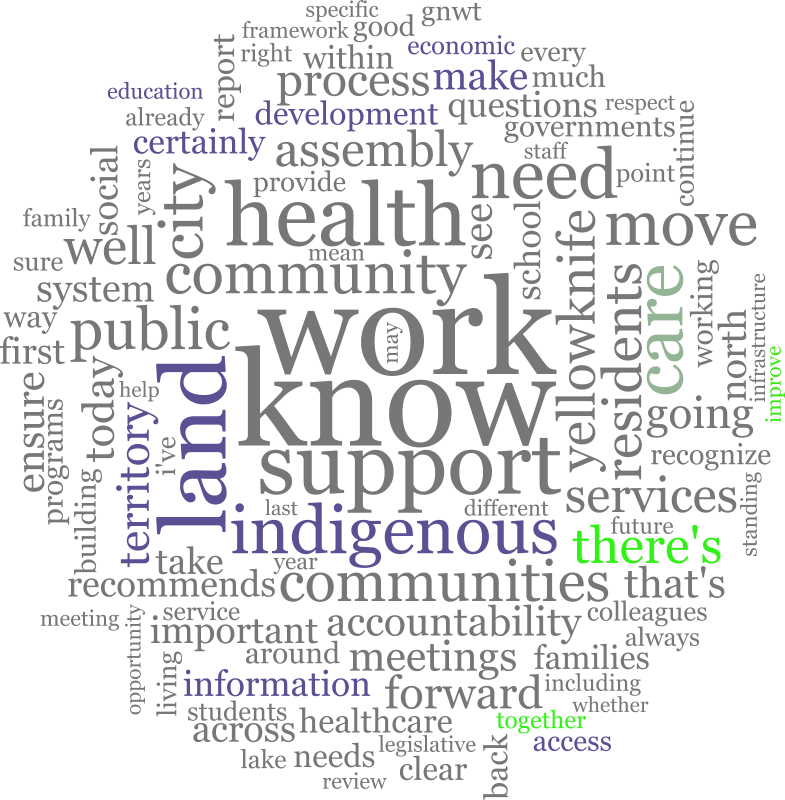
This is page numbers of the Hansard for the 20th Assembly, 1st Session. The original version can be accessed on the Legislative Assembly's website or by contacting the Legislative Assembly Library. The word of the day was work.
Topics
Question 1296-20(1): Solutions for Tradespeople Without Red Seal
Oral Questions

Caitlin Cleveland Kam Lake
Thank you, Mr. Speaker. Mr. Speaker, a very timely question, a very important question right now. Certainly, Mr. Speaker, last year there were additional entry pathways into the trades that were opened up by education, culture and employment. In addition, we continue to grow the SNAP program, or the Schools North Apprenticeship Program. We've more than doubled our SNAP students and tripled the communities that SNAP students are found in. In addition, Mr. Speaker, the department is currently reviewing the apprenticeship trades and occupational certification regulations. And in addition to that, Mr. Speaker, as you can imagine, there are multiple conversations happening in a very excited territory as projects of national significance are looking to be built in the territory. And so, Mr. Speaker, some of the other conversations that are happening are exploring communities to deliver trades essentials programming in the Northwest Territories, and in addition to that, exploring partnerships with education bodies, Aurora College, Indigenous governments who are looking to deliver trades fundamentals and trades opportunities in communities as well. Thank you.
Question 1296-20(1): Solutions for Tradespeople Without Red Seal
Oral Questions

The Speaker Shane Thompson
Thank you, education, culture and employment. Oral questions. Member from Mackenzie Delta.
Question 1297-20(1): Evidence on Land Claim Obligation Fulfilment
Oral Questions
June 4th, 2026

George Nerysoo Mackenzie Delta
Thank you, Mr. Speaker. My questions are going to be given to the Premier. You mentioned in one of your statements that you have a commitment and accountability and engagement to the House. Do you have a commitment to accountability and engagement to the residents of the Northwest Territories, the Indigenous governments, and especially to the -- what -- does the Premier believe that GNWT is currently meeting the obligations to work in partnership with Indigenous governments and land claim organizations? And if so, what evidence can he provide to demonstrate those obligations are being fulfilled to the land claim groups? Thank you, Mr. Speaker.
Question 1297-20(1): Evidence on Land Claim Obligation Fulfilment
Oral Questions

R.J. Simpson Hay River North
Thank you, Mr. Speaker. It's not a small question. A lot of the work that we do involves Indigenous governments. That's the reason work gets done. I can point to a number of areas where we've collaborated and improved relationships. I always start with the Council of Leaders, a place where all the different leaders in the territory, Cabinet, Indigenous leaders, can come together and actually discuss issues. And those discussions inform Cabinet decisions. They inform how I operate. And so right there, that level of communication doesn't exist anywhere else in Canada, in any other jurisdiction. There's no other Premier and Cabinet that sit down regularly with Indigenous leaders from across the territory and travel together to Ottawa and advocate together for shared priorities. There's examples with our major projects. Working with the Indigenous groups on the Mackenzie Valley Highway, Arctic Economic and Security Corridor, the Taltson Watershed. There's -- I mean, Mr. Speaker, it's kind of asking me what do we do as a government. Because that's what we do. Everything we do, we try to do in collaboration with Indigenous governments. We have housing MOUs with Indigenous governments. We work with the Inuvialuit on child and family services and taking over that authority. We're working with the Tlicho on drawing down authorities under their self-government. We're working with Deline on a number of different initiatives. I could go on and on, Mr. Speaker. This is what we do as a government. Thank you.
Question 1297-20(1): Evidence on Land Claim Obligation Fulfilment
Oral Questions
George Nerysoo Mackenzie Delta
Thank you, Mr. Speaker. What measures are in place to ensure that land claim organizations are meaningfully consulted and involved before the GNWT enters into contracts, projects, or initiatives that may affect settlement lands or treaty rights? Thank you, Mr. Speaker.
Question 1297-20(1): Evidence on Land Claim Obligation Fulfilment
Oral Questions
R.J. Simpson Hay River North
Thank you, Mr. Speaker. There are consultation guidelines, and we follow those. You know, there's some places across Canada, they might not think that those are very clear, those Section 35 consultation requirements. We understand those here in the Northwest Territories, and we consult whenever we are required to, and beyond that, when we're not required to because we want to be good partners. Thank you, Mr. Speaker.
Question 1297-20(1): Evidence on Land Claim Obligation Fulfilment
Oral Questions
The Speaker Shane Thompson
Thank you, Mr. Premier. Final supplementary. Member from Mackenzie Delta.
Question 1297-20(1): Evidence on Land Claim Obligation Fulfilment
Oral Questions
George Nerysoo Mackenzie Delta
Mr. Speaker, to that note, we -- I, myself, and a contractor and the GTC are trying to work collaboratively with the Cabinet to no avail. How does the Premier ensure that the commitments made through modern treaties, self-government agreements, and intergovernmental agreements are reflected in GNWT decision-making on contract negotiations? Thank you, Mr. Speaker.
Question 1297-20(1): Evidence on Land Claim Obligation Fulfilment
Oral Questions
R.J. Simpson Hay River North
Thank you, Mr. Speaker. You know, we have a negotiated contracts policy in the Northwest Territories. That is to support companies or Indigenous governments that are -- to help them gain capacity. Generally, for the first, you know, few times when there's not that capacity and they can't necessarily compete with other companies, there's an opportunity to enter into a negotiated contract and support them. There's -- it has been used differently across the territory, and there's some instances where a single company might get a negotiated contract for 5, 10, 15, 20 years in a row. And we can't always do those kind of things. Sometimes we need to ensure that there's opportunities for other companies. There's companies that do work. There's perhaps companies that want to do work but they can't get their foot in the door because contracts don't go out publicly; they just get negotiated. And so it's striking a balance to ensure we're keeping benefits in the territory, we're supporting northern businesses, and we're supporting entrepreneurs who want to get into business as well. Thank you, Mr. Speaker.
Question 1297-20(1): Evidence on Land Claim Obligation Fulfilment
Oral Questions
Question 1298-20(1): Government Response to Review of Residential Tenancies Act
Oral Questions

Kate Reid Great Slave
Thank you, Mr. Speaker. Mr. Speaker, the Government of the Northwest Territories recently released a what we heard report on the review of the Residential Tenancies Act, and at the end of this report, it states that they will -- or the Department of Justice will study the information gathered from the stakeholders that responded to their request for feedback as well as issues raised by the rental officer and consider how this feedback can contribute to improving and updating the Act. My question today is, does that mean, then, that the Residential Tenancies Act will be looked at to be opened and amended in the 21st Assembly? Thank you, Mr. Speaker.
Question 1298-20(1): Government Response to Review of Residential Tenancies Act
Oral Questions
Question 1298-20(1): Government Response to Review of Residential Tenancies Act
Oral Questions
R.J. Simpson Hay River North
Thank you, Mr. Speaker. I can't speak to what will happen in the 21st Assembly. I can speak to what will happen in the 20th Assembly, and I note that there was a review. I don't believe that it's on the legislative agenda at this point to be opened up, but we could be in a position at the end of this government where work has advanced to the point that the 21st Assembly is set up to open up that act and do work. Thank you, Mr. Speaker.
Question 1298-20(1): Government Response to Review of Residential Tenancies Act
Oral Questions
Kate Reid Great Slave
Thank you, Mr. Speaker. And so in this report, in the what we heard report, it talks about feedback from MLAs, and, of course, the feedback given by MLAs was from the 19th Assembly, Mr. Speaker, if you read it carefully. Will there be an opportunity for MLAs in this Assembly to provide feedback? Thank you, Mr. Speaker.
Question 1298-20(1): Government Response to Review of Residential Tenancies Act
Oral Questions
R.J. Simpson Hay River North
Thank you, Mr. Speaker. Absolutely, they get paid to do that. When we develop legislation, it's done with Members of this Assembly. As I've said before, when things are said in this House, when we get letters from committee, when Ministers are in front of committee, that's feedback. MLAs don't need a special designated time to provide feedback. They can always provide feedback. That is their role. Once we develop a legislative proposal, which is the first step in creating legislation after identifying a need, that legislative proposal is sent to the Standing Committee on Accountability and Oversight for feedback. Once a bill is drafted, there's a whole committee process where MLAs can have input and make amendments, propose amendments to bills. And then, of course, here in the House, there's opportunities to move motions as well. So yes, absolutely, Members will be intimately involved in that. Thank you.
Question 1298-20(1): Government Response to Review of Residential Tenancies Act
Oral Questions
Question 1298-20(1): Government Response to Review of Residential Tenancies Act
Oral Questions
Kate Reid Great Slave
Thank you, Mr. Speaker. I am glad the Premier can explain my job to me. But what I would like clarity around is, rather, if I have feedback and information and options that I think are fascinating and might not be chosen to be studied by committee, would the GNWT be interested in receiving those options? Thank you.
Question 1298-20(1): Government Response to Review of Residential Tenancies Act
Oral Questions
R.J. Simpson Hay River North
Thank you, Mr. Speaker. Yes. You know, I brought forward many pieces of legislation over the past six years, and I can tell you that it's very much informed by MLAs. If there's an MLA with a particular interest in a particular area, that is considered. When we're sitting around with our staff and Cabinet, we talk about that Member's concerns and what they want to see in legislation. So yes, absolutely, Mr. Speaker, I welcome that feedback. Thank you.
Question 1298-20(1): Government Response to Review of Residential Tenancies Act
Oral Questions
Question 1299-20(1): Supported Living Review Recommendations
Oral Questions

Julian Morse Frame Lake
Thank you, Mr. Speaker. Mr. Speaker, my questions are for the Minister of health, as I was speaking about disabilities earlier today. Mr. Speaker, as has been noted several times in this House, it's been three years since the supported living review was released. The last time I asked about it, the Minister noted that the health sustainability unit review is going to help integrate -- I am sorry, Mr. Speaker. The health sustainability unit is looking at that area. But, Mr. Speaker, how is the HSSU going to help identify a path by which the Supported Living Review recommendations will be actioned? Thank you.
Question 1299-20(1): Supported Living Review Recommendations
Oral Questions
The Speaker Shane Thompson
Thank you, Member from Frame Lake. Minister of Health and Social Services.
Question 1299-20(1): Supported Living Review Recommendations
Oral Questions

Lesa Semmler Inuvik Twin Lakes
Thank you, Mr. Speaker. Mr. Speaker, the Supported Living Review that was completed is -- the department continued to work on that over the last few years and implement and work on developing the supportive living standards, and most recently established the admissions committee. But within the partnership with health sustainability unit, some of that work has kind of paused while the analysis is going on, and they're analyzing the out of territory programs to determine, you know, the cost of it because it continues to increase year after year, and determine some options for in-territory service delivery. Thank you, Mr. Speaker.
Question 1299-20(1): Supported Living Review Recommendations
Oral Questions
Julian Morse Frame Lake
Thank you, Mr. Speaker. And certainly I am sure that disability advocates will be excited to hear that we are exploring service delivery in the territory, which is what people have been asking for, and so I am excited to see what the HSSU brings forward in potential savings that we can use to improve our programming. Mr. Speaker, I noted the standardized process for supported living admissions. I am wondering, is the department exploring other areas for service integration or improvement of service delivery for persons with disabilities and their families. Thank you.
Question 1299-20(1): Supported Living Review Recommendations
Oral Questions
Lesa Semmler Inuvik Twin Lakes
Thank you, Mr. Speaker. Mr. Speaker, what the supportive living review is doing is people who have needs beyond, you know, so that they need support. And I think there's different levels, and what that work that has been done is trying to identify, like, the different tiers. Like, in long-term care, we have different tiers of level of care, and so, like, anything under fours, they can remain at home and be supported. And that's how our home care program runs. And so with the supportive living, this is where we -- you know, we've had different organizations who have provided some services, NGOs, but we're trying to look at options right now. And I think that's the big piece, is that we know we have many residents who still live at home, families who just need support. We need people that are in the territory that can have independent supportive living, but then we have those higher levels that sometimes in the territory we can't support. So that's what -- a lot of the work that's going on. Thank you, Mr. Speaker.